Showing posts with label autumn. Show all posts

Tuesday, September 23, 2014

Got allergies? Don't blame the goldenrod!

It's mid-September and the goldenrod is now in full bloom -- right about the same time that the pollen count hits the roof.  Over and over, I hear people blaming their hay fever on goldenrod.   But they are wrong!  Read on...

A field of goldenrod on my land in Minnesota --
haven for many butterflies & other insects
 Everyone can see the bright yellow of a field of goldenrod plants in full bloom.  As they look at all those yellow flowers along the road, they visualize clouds of pollen choking the air.  Just the sight of it all is enough to make some people sneeze.

But the fact is, goldenrod pollen is not spread by the wind at all.  This is why weather reports that include a pollen count never even mention goldenrod as a source.

A Goldenrod flower
Don't believe me?  See for yourself: Touch a goldenrod flower and you will not have any pollen on your hands.  Shake one and you won't see any clouds of pollen hitting the air.  It just doesn't blow around.   It spreads by sticking to the bodies of insects.  Unless you are a bug with lots of tiny hairs on your body to pick up the pollen, it doesn't leave the plant very easily.  Ecologically speaking, Goldenrod is an important nectaring flower for wasps, bees, butterflies, and other beneficial insects.  So please -- don't yank it out!

Ragweed plant in full bloom
The real culprit is ragweed, a coarse weedy green plant that blends into the background in fields and woodland edges.  Unlike the showy flowers of goldenrod, the rather nondescript flower stalks of ragweed are just loaded with pollen, and it does indeed spread on the wind.

Ragweed is not particular about habitat, and will grow just about anywhere.  The plant in this photo grew next to my compost pile, so it got to be over 6 feet tall from all that rich chicken manure.  Along the road you might see flowering ragweed only about a foot high, eking out an existence in the hard-packed gravel on the shoulder.  But once you learn to recognize it, you'll see it growing just about everywhere.

(Well, maybe not in the high desert -- but it crops up in irrigated areas like Las Vegas.  In fact, according to The 30 Worst Cities for Ragweed, Las Vegas ranks #2.  The top city on the list is Phoenix, Arizona.)

The stuff is very easy to pull up, so if you learn to to recognize it before it pollens out, you can at least eliminate it from your garden.  But with all the acres and acres of wild areas where it can flourish, you will probably have to wait until frost kills the plants before your "hay fever" finally goes away for the season.  Just don't blame your misery on the innocent goldenrod!

Typical distribution of ragweed pollen in
the USA in September

Tuesday, November 19, 2013

Free the Thanksgivukkah turkeys!

"Thanksgivukkah" is the term coined for a very rare event happening on November 28, 2013:  This year, the first day of Hanukkah falls on the American holiday of Thanksgiving.  It won't happen again for another 70,000 years, so enjoy it now while you can!  (Plus the date also converges with a spectacular comet -- more on that below.)

"American Gothukkah" poster
designed by ModernTribe.com,
a take-off on a famous painting.
The Jewish community is certainly having a good time with it.   Search the Internet and you will find all kinds of Thanksgivukkah shirts, mugs, postcards, and other chochkes, as well as announcements of community celebrations.  (To see a gallery of shirt designs, click here.)  The Times of Israel has a nice roundup page of links, including songs and the story of a boy who designed a "menurkey" -- that's a Hanukkah menorah in the shape of a turkey.

One of my favorite images is this shirt by ModernTribe.com, featuring a Woodstock-inspired theme with "8 Days of Light, Liberty, Latkes."  Pretty clever!

Hanukkah really is about freedom, when the Jews rose up against the Greeks and re-dedicated the Jerusalem Temple to God.  Hanukkah may well be the first recorded war fought for religious freedom.  But this freedom theme also raises the issue of how "free" the Thanksgivukkah turkeys really are.  Can we eat turkey at a freedom fest when the birds themselves are not really free?

Unlike the colorful wild turkeys usually portrayed in Thanksgiving art, the turkeys you buy in the grocery store are factory-farmed white birds that have been bred to be so heavy they cannot even mate naturally, let alone fly up into trees or run through autumn fields like their wild ancestors.  Most of them probably never even see the outdoors at all, because they are raised in big, overcrowded barns.

As a vegetarian, I would urge you to consider not having a turkey for Thanksgivukkah.  In fact, it was at Thanksgiving time many years ago that my wife and I finally decided to go veg.  We had been eating very little meat anyway, and as the holiday rolled around, we asked ourselves:  Do we really want a turkey this year?  The answer was no, and has been no ever since.   The only turkey on our table will be this toy bird.

As for the holiday menu, there are plenty of delicious vegetarian foods you can serve -- and combining with Hanukkah this year makes for some creative recipes.  The Jewish Community Center of St. Paul, MN, sent out a recipe for squash latkes (instead of potatoes) along with their recent fundraiser.  I plan to try that one!

When you think about it, turkey was not the only traditional food that Native people brought to our tables.  Corn, squash, pumpkins, potatoes, tomatoes, beans, wild rice, maple sugar, cranberries, blueberries, and chili peppers are some of the foods that are native to North and South America.  So let's make this a real Festival of Freedom and let the turkeys live!

Now for the comet: November 28, 2013 is also the date that Comet Ison -- which could be the "Comet of the Century" -- will pass around the sun.  As of this writing, it is now visible to the naked eye in the dark sky, and is expected to grow brighter in the next few days.  In centuries past, such a convergence between two calendars and a comet would have been seen as an omen, for good or bad depending on the culture.  To me, it is just an interesting phenomenon.

There are 3 possibilities for what will happen to Ison in the next week or so:  1) it could burn up in the sun's corona and disappear; 2) it might break up into a bunch of glowing pieces; or 3) it may remain intact and come out from behind the sun glowing very brightly.  For more on Ison's perilous journey, visit this page on the NASA site.

Friday, August 30, 2013

Stirring up a hornet's nest -- literally!

Over the years, I have stirred up plenty of symbolic hornet's nests with my controversial stances on various issues -- but this time I did it for real.  OK, they were really Yellow Jackets, the smaller cousins of the Bald-faced Hornet -- but they get just as angry when you disturb their nests.

Yellow Jackets coming out of
an underground nest (Photo courtesy of
South Texas Nature Images on Flikr)
Of course I didn't do this on purpose -- nobody does that!  A couple days ago the wind took down a paper birch tree, and I needed some nice sticks for an upcoming Cub Scout craft project that my grandson's Pack is planning to do.  (Since I have a wood lot, it falls to me to provide a lot of the natural materials.)  I thought the white birch bark would look nice, so this morning I went out to cut off some of the branches -- and unwittingly stepped into the nest.

Yellow Jackets usually nest in the ground, often using an old rabbit hole or other tunnel, so they are very hard to see until it is too late  This one was covered by the crown of the fallen tree.   I was so intent on choosing and cutting my salvaged branches that I did not notice the wasps until a swarm was buzzing around me.

Luckily I was wearing heavy pants tucked into my boots, in preparation for tromping through underbrush in the ditch where the tree fell.  Good thing, because those little buggers grabbed onto the cloth of my pants and really hung on -- if I had been wearing shorts, I would have had stings all over my legs.  As it was, I only got 3 on my arms and one on my face as I high-tailed it out of there.  (This is why I'm always telling people NOT to wear shorts in the woods.   Sure it's hot wearing long pants -- but even worse getting scratched up or stung!)

While on the subject of Yellow Jackets, you may notice that there seem to be a lot more of them around your picnic table in the fall.  This is because during the summer they feed their young on insects, so they don't have much interest in your bottle of pop or your jelly roll.  But in the fall, after the new queens have flown and the colony starts to break up, the worker wasps switch to a sugary diet -- and start buzzing around your outdoor events.  Suddenly it seems as if the population has exploded overnight.  I myself have noticed a lot more of them around my hummingbird feeders lately -- and now I know where they are all coming from!  But really, they have been increasing steadily all summer, you just don't see many until fall.

Unlike honey bees, wasp and hornet colonies don't winter over.  The new queens fly and mate, then find a place to hibernate for the winter.  The rest of the wasps die off  with the cold weather.  So, after we get a few hard frosts, I'll be able to return to that tree and safely salvage some birch sticks.

Sunday, October 21, 2012

Why was this hornet's nest so close to the ground?

Now that the leaves are all down, you can sometimes spot interesting things that were hidden during the summer.  Like this Bald-Faced Hornet's nest that has its opening less than a foot above the ground, which is probably why I couldn't find it earlier in the summer.   I knew there were hornets around because I saw them, but I was looking UP into the treetops, where these nests usually are.  And here there was a nest less than 30 feet from my chicken coop and practically ON the ground -- not more than six feet from where I was harvesting wild plums!  I probably walked past that nest dozens of times and never even knew it was there.  I didn't bother them and they didn't bother me.

Bald-faced Hornet
This is the second time I've found a very low nest on my land -- the first was only about 3 feet off the ground, near another outbuilding.  There are plenty of trees around here to nest in, so I am wondering:  Do hornets often build so low, or do I have an unusual strain of these insects breeding here?  Hornets only use the nest for one season, after which they all die off except the new queens, who hibernate over the winter, producing new colonies in the spring.  So it is conceivable that some mutation is causing queens here to nest low.  I'll have to watch for more low nests next spring.

Before I go any further, I should mention that there is NO HONEY in a nest like this, in spite of what Hollywood might think.  In both cartoons and live action films (such as in Doctor Doolittle 2, where a bear climbs up to a nest for honey) hornet's nests are mistakenly confused with old-fashioned garden beehives.  Climb up to one of these nests and all you will get is a bunch of stings, because hornets don't make honey.  They are predators that feed their larvae on  insects.

Back of my coop -- the lighter areas
are where the hornets scraped off
wood fibers for their nest.
Where were the hornets getting their wood fibers to make this nest?  From the back of my chicken coop, where they scraped the bare weathered wood clean.  I've seen this behavior here before, both with hornets and wasps, but wasn't paying much attention this summer because of the heat wave.  It wasn't until I found the nest that I went to look at the coop.  You can very clearly see the lighter areas where they were working (click the pix to enlarge).

Interestingly, they seem to follow the vertical lines of the boards.  In cases where I have actually seen hornets doing this, they are always clinging vertically, never horizontally. Most likely, they are following the grain of the wood.  And if you listen very closely, you can actually hear them chewing.  In fact, the first time I observed this behavior many years ago, it was by first hearing a strange scraping sound, looking for the source, then seeing a hornet busily chewing along a dead goldenrod stalk.

In this closeup,  you can clearly see where they left off and the patina of the old wood (darker area on the left) still shows.  When you look at the nest itself, you also see variations in the color of the paper, with clear stripes from both the dark and light areas.  This suggests to me that each wasp goes back to the same part of the coop wall, gets a load of fibers, then returns to the same area on the nest.  But since I have not actually observed this, it is only guesswork.

All of this brings up the question of where wasps and hornets get their wood fibers in developed areas.  An old weather-worn shack like my chicken coop would never be tolerated in more upscale neighborhoods.  Ditto for dead trees and other suitable debris.  Maybe they use wooden fences?  I have seen photos of nests that are more reddish in color, as if made from redwood.

Hornets, along with their cousins, the paper wasps, are very good for the garden -- which is where the inhabitants of this nest were hunting all summer.  I watched them searching among the broccoli and cabbage leaves for those little green caterpillars.  When they find one, they sting it and carry it back to their nest.  Ditto for army worms and other pests, including flies, which can be found in abundance around the coop and manure pile. Plus, both hornets and wasps visit flowers to eat pollen and nectar, and seem to be moving into the niche that has been vacated by honey bees around here.  I only saw two honey bees all summer, but lots of wasps were on the flowers, and we got a good harvest.  So unless the nests are someplace dangerous to me or my animals, I leave these very beneficial insects alone.   Besides, they give me an excellent reason NOT to paint the chicken coop!

Closeup of the nest after I collected it, showing the
variations of colors of wood pulp used.

Tuesday, September 11, 2012

Harvesting Wild Plums (Prunus americana)

One good thing about the unusually warm spring we had this year: we got a great crop of wild plums.  This far north, the plum crop is rather iffy, because a late frost often kills the blossoms.  But not in 2012.  I just finished making jam, fruit leather, and wine from the fruit of our plum thicket.

Wild plums gathered on our land.
The window of opportunity for harvesting these delicious little plums is very narrow.  No sooner do they ripen, than the wind knocks them to the ground, where they are relished by various forms of wildlife.  In fact, it was my chickens who alerted me to the fact that the plums were ripe.  When the roosters find something especially good to eat, they call the hens with a very specific cackle and they all come running.  (This, by the way, is why the Talmud, Eruvin 100b, says we should learn "courtesy from the rooster" -- he lets his hens eat first.)   When I heard my chickens calling and scratching back there in the plum thicket, I knew something was up!  Chipmunks and wild birds were also enjoying the feast.

Wild plums don't keep very well, which is why you will never see them for sale in the store.  If you want to preserve them, you have to process them right away.  We usually make jam, and this year I decided to make fruit leather as well.  The normal way to extract the pulp and juice is to boil the plums and strain out the pits and skins, but this kills the seeds.  I wanted viable seeds to sell in my eBay store, The Happy Rooster, so I pitted them by hand.  A messy job! 

For fruit leather, I loaded the pitted plums, skins and all, into the food processor, set it on puree, then dried the resulting mess in my food dehydrator (which has special inserts for making leathers.  I suppose you could also do it on waxed paper in a low oven.  I'm told the Indians used to dry the pitted plums in the sun, and I've heard of people making solar food dryers.)  These plums are pretty tart, so we tried both a sweetened and non-sweetened version.  Both are delicious!

Getting a clear jelly from these plums is next to impossible, but they make a pretty good jam if you strain out the skins and most of the yellowish pulp.  I use a colander for this, since it is too thick to go through cheesecloth.  This leaves me with a pink slurry.  Following an old traditional recipe, I add one cup of sugar per cup of juice, then boil until it "seals the tines of a fork," or jells when you cool a spoonful.  (I suppose there is a proper temperature if you use a candy thermometer, but I've always done it seat-of-the-pants.)   I find there is enough pectin in the plums to jell on their own, but if you have some apple juice to add, it makes a nice combination.  If for some reason your jelly doesn't jell, you can still use it as a delicious syrup on pancakes or ice cream.

The last product I made is (or soon will be) a gallon of plum wine.  I started making my own wines when we moved to rural Minnesota, because the only kosher wine we could find here was Manischewitz grape, which is cheap and sweet for the local winos but not a vintage that I enjoy.  Over the years I've experimented with making all kinds of wines, some better than others.  Just be sure to use wine yeast, which you can order online, not baking yeast.  My last batch of plum wine was pretty good.  I'll let you know in a few months how this vintage turns out.  L'chaim!

(To add wild plums to your wildlife landscaping, either buy trees from garden catalogues or, if you have the patience to grow trees from seed, you can get seeds from my eBay store, The Happy Rooster  while supplies last.  This is a native species that grows in zones 3-7.)

Wild plum blossoms in spring.  In addition to fruit,
these trees form a thorny thicket that birds like to nest in


Thursday, July 26, 2012

Crickets chirping: That sweet, sad sound of summer's end

NOTE (added July 22, 2015):  My blog stats show that people keep getting here by searching for pages about crickets chirping in spring.  Crickets do not not chirp then, because they do not yet have their wings to make the sound.  So if you are hearing high-pitched chirpy sounds at night, it is most likely you are hearing Spring Peeper frogs or some similar species.  These make one of the first night sounds in early spring.  Read below about how and when crickets do chirp.

*  *  *

I heard my first cricket chirp of the season last night.  I love this sound, but I always feel a pang of sadness as well, because it signals the beginning of the end of summer.  Here in Minnesota, the chirping usually starts in mid-August, but is a bit early this year, perhaps because of the unusually warm weather.   Hearing crickets early does not necessarily signal an early winter, because warm weather can speed up the life cycle of these insects.

Adult male field cricket
(courtesy of OrganicGardeningInfo.com)
Of course, crickets don't really know in a conscious way that fall is coming.  The reason they don't chirp earlier is that they don't yet have the proper equipment to make the sound.   Crickets go through a life cycle called direct development:  egg, immature stage, adult.

When they hatch from their eggs in spring, the tiny hatchlings already look like crickets, but do not yet have their wings.  As they grow, they shed their skins several times until they get wings in the last, adult stage.

And it is the wings that the male cricket rubs together to make his chirps.  (Common folklore has him rubbing his legs together, but that is not correct.)  You can get an approximation of the temperature in Fahrenheit by counting the number of chirps in 15 seconds, then add 40. The reason this works is because crickets, being cold-blooded creatures, are more active on warm nights than chilly ones.

The adult female cricket also has wings, but they are smooth and do not have the ridges that the male rubs to make the chirp, so she does not sing.  This is one way you can tell an adult male from a female.  You can also tell a female by the long stiff ovipositor extending from the tip of her abdomen, which she uses to lay her eggs in the ground in late summer or fall.  The adult crickets die off with the coming of winter, and the eggs hatch in the spring to produce a new generation.

In China and other Asian countries, crickets are considered good luck, and are often kept for pets in specially-designed cages.   Some European traditions hold that a cricket chirping in the house is a sign of future prosperity.  (I sure wish this one were true!)  When I was a child, I kept crickets in a terrarium in my room and enjoyed hearing them sing at night.   They ate vegetable trimmings (especially cukes and tomatoes) and often lived through the winter (which would not happen in the wild here.  Crickets die with the frost and their offspring winter over as eggs.)  Some of the modern "bug cages" now available would probably work just as well.  Just be sure to take good care of your crickets, the same as you would with any other companion animal.

Sunday, October 16, 2011

Building my own Sukkah from stuff in the woods

Last week I spent three days building my sukkah, the little booth that Jews erect for the Festival Sukkot.   The sukkah has many meanings.  First of all, it reminds us of the days of wandering in the wilderness with Moses.  It also teaches us that this life is a journey through a world that is not permanent.  And it is a celebration of the harvest, the time when we have gathered in our crops and can enjoy the fruits of our labors.

White pine for shchach --
courtesy of road maintenance!
The basic requirements for building a sukkah are simple:  It must have 3 walls, and the shchach (roof covering) must be made of natural materials cut from the earth.  The sides can be made from anything handy, including the wall of an existing building if you build it against the house or other structure.  However, the location must be open to the sky, not under a tree or other obstruction.

Nowadays you can buy prefab sukkah kits made out of plywood or various other materials in a variety of designs.  However, these are rather pricey and way beyond our tight budget.  Besides, my wife and I are getting a bit old to be hauling heavy plywood panels in and out of the shed each year.  So, I called upon my old Boy Scout skills to lash together a framework of saplings that I cut from the woods on my own land. 

I use nylon twine instead of the old sisal kind, because, although it is harder to tie permanent knots with, it does not rot or stretch, although some kinds will degrade in a couple years from exposure to sunlight.  But for a sukkah it's fine.  Through trial and error, I found that tying it off with a square knot, followed by three overhand knots up tight against the first knot, pretty much keeps the ends from untying.

This creates a rather permanent frame that I leave up after the holiday, making repairs each year as needed.  However, last winter the snow was so unusually heavy, it collapsed the whole thing (read that story), so I had to start over from scratch.  But I can't really complain, because the old sukkah frame had lasted over 10 years.  Still, it is a lot of work to drag all those new poles in from the woods.  Not to mention finding appropriate trees in the first place.

Andy Cat, one of my "helpful"
construction workers who loves string!
Luckily, I had a bit of help from a road maintenance crew.  About two  weeks before I began my sukkah-building project, they came through and cut down a bunch of trees and brush along our road for fire control.  This gave me a set of nice straight maple poles -- all the verticals in the new sukkah frame are made from this free material.  I also got a good supply of white pine branches from trees they trimmed that were overhanging the road.  That, plus prunings from my own white pine that had bent down too low to mow under, gave me enough shchach to cover the sukkah.  Not only was this economical, it was also ecological, because I used materials that would otherwise have gone to waste.  Reduce, Reuse, Recycle!

Here is what the sukkah looked like after I got the basic framework up.  Four cinder blocks help to anchor it in place.   It still needs some more diagonal braces, which I installed after this picture was taken.  (I used a flash at early dawn,  to show up the frame better against the trees in the background.)


Covering the sukkah was a challenge this year, because most of the old sheets and bedspreads I used before were either torn or moldy.  My wife is very allergic to mold, so I had to throw most of it out and start over.   Because Rosh HaShanah had come back-to-back with the Sabbath, and Yom Kippur was on the Sabbath itself this year, I could not take advantage of all those Friday garage sales to find more used cloth.   Not to worry --  I did have a lot of feed sacks and some clear plastic on hand, so I used those instead.  To keep the wind from tearing these rather fragile materials off the frame, I put a strip of corrugated cardboard over the plastic where I was stapling to the wood.   That reinforced it very well.  The cardboard, of course, came from old boxes I got at the grocery.

Here is how the sukkah turned out.  The outside table has a bucket of water for the ritual handwashing, and there is room for more chairs around the card table if needed.  The side table is very handy for setting dishes aside.  Both of the low gray tables, by the way, are ones we already had for flea market sales,  A fourth wall could be added in front, perhaps by hanging a blanket, but that would have prevented me photographing the inside for this blog post.  Besides, we enjoy looking out at the scenery.


Definitely primitive, but functional.  And much closer to what Moses actually used.  He certainly didn't have any plywood on hand.  Then again, he didn't have any plastic, either.  (He probably used animal skins.)   But still, this sukkah did well to evoke the story of wandering in the wilderness.  Spiritually, what I got from this whole project is that we are to bloom where we are planted, and that God will provide for us, be we must also be creative in using what is available.  "Who is rich?  He who is satisfied with his portion!" (Talmud, Pirkei Avot.)  And by the way:  The whole thing only cost me about $15 out of pocket, for the nylon twine and some staples.  Thoreau would have been so proud!

(UPDATE 2012:  This year, the sukkah got an upgrade:  I was able to find enough old sheets at the thrift store to cover it with cloth instead of old feed sacks.  Since we took "salvage" quality rejects, we got enough for the whole sukkah for $5. The schach this year is tall grass and goldrenrod stalks.  My wife added the "woman's touch" with some fall-themed decorations.  It was also her idea to use the flowered sheet for the front -- making it nice and homey-looking.   And BTW, although the frame now leans a bit where it has settled in since last year, it is still good and sturdy, although I did add a few more diagonal braces.)
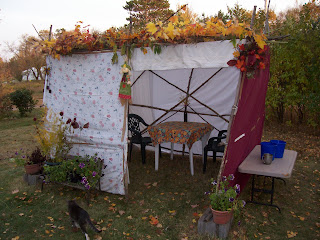
The sukkah upgraded in 2012
Here's a picture from 2019.  When we put in a ramp a couple years ago, we had to move the sukkah.  The only place near the house not shaded by a tree was farther away, so we set up a row of solar garden lights leading to it, and a solar spotlight inside. Also got a better folding table.

Revised version with solar lights


Tuesday, September 27, 2011

Autumn Leaves and Rosh Hashanah Thoughts

Tomorrow night begins Rosh Hashanah 5772,  the Jewish New Year.  As I wrote in a previous post, it comes in the fall in the Northern Hemisphere.  This year it is rather late, due to the cycles of the Hebrew Lunar Calendar.   Because there are no major Christian holidays at this time, many people have never heard of the Jewish High Holy Day cycle of Rosh Hashanah and Yom Kippur, followed by Sukkot, the Feast of Booths (or Tabernacles, as the KJV mistranslated.)  However, these holidays are much, much more important on our calendar that Hanukkah, which everyone has heard of because it comes near Christmas. 

Fall blackberry leaves
By Yonassan Gershom
Pine County, MN
 
In the natural world, the leaves are already turning fall colors here in Minnesota.  It might seem odd to begin a new year in the fall, when everything is going dormant.  Why not start in the spring, when new things are being born?  However, there is a spiritual reason for this.

The Jewish New Year, unlike the secular New Year, is not a time of parties and revelry.  It's a time of repentance and serious introspection, the Day of Judgement when God opens the Book of Life and looks at the karma of the world.  So it is appropriate that this holy day should come when the natural growth cycle is ending and old leaves are falling off, when we are looking over our past deeds, rather than focusing on the future.  This is a time to shed old behaviors, to bare our souls before God the way the trees are baring their branches.  A time to repent of our old mistakes and promise not to do them again.
Autumn Oak Leaves
By Yonassan Gershom
Pine County, MN

  Another symbolism connected with Rosh Hashanah is wearing white clothing, because of the verse, "Though your sins be scarlet, they shall be as white as snow." (Isaiah 1:18)  So once again, the brilliant red leaves falling off the trees are a reminder of the negative behaviors we seek to drop at this time of year.  They are beautiful for the moment, as temptations often seem to be, but they do not last very long.  At the same time, those falling leaves can, if composted properly, become fertilizer under the winter snow, for a better crop next year.  In the same way, understanding our past deeds becomes food for thought -- mental fertilizer if you will -- for improving our lives in the future.

Rosh Hashanah always comes at the dark of the moon, then the season moves toward greater light.  Much of Jewish symbolism focuses on moving from darkness into light.  Our days begin at sundown, based on the story of Creation in Genesis ("It was evening and it was morning...") where the very creation of the universe went from darkness to light.  So, as we move from Rosh Hashanah, the Judgement Day, toward Yom Kippur, the Day of Atonement, the moon is getting brighter and brighter, until on Sukkot, the Harvest Festival, it is full.  In  the same way, we go from the somewhat depressing prospect of examining our past sins, toward making amends during the Ten Days of Repentance, until we receive forgiveness on Yom Kippur.  After that, we move forward together, to celebrate in the sukkah during Sukkot, the Feast of Booths - which I shall tell you more aobut in a future post.

Meanwhile, wishing everyone Shanah Tovah -- may you have a blessed, prosperous, and peace-filled New Year!
 
Flaming Fall Oak
by Yonassan Gershom
Pine County, MN
 

Wednesday, September 14, 2011

Wild Turkeys -- hard freeze tonight -- picking green tomatoes

This has to be the most cruelty-free wild turkey feather ever -- it was dropped on our dirt road by a passing flock of turkeys about a week ago.   I frequently see turkeys around here, sometimes as many as 20 or more.   I wish I knew where they are roosting -- then I could find lots of feathers!

This morning our dogs were raising a ruckus from inside the house, and when I looked outside, there was a crow walking down the road.  I thought it was odd to see a crow taking a stroll there, but thought maybe he was looking for gravel or grains.  Then I saw the turkeys following behind.  At least, that's how it looked.  I grabbed my camera but of course, as soon as I went outside, the crow let out a warning call and the turkeys all ran into the bush.   I did get a good enough look to see that there were 5 adults and 2 older juveniles. 

Was the crow actually serving as a lookout for the turkeys?  It sure looked like it.  And he did fly off in the same direction that they went.

On another topic, we are due for a hard frost tonight -- going down to 26F, which is probably going to break some records around here. This is really early for a killing frost. Way too cold for tomatoes to survive, even if they are covered.  So I'm taking a break right now from picking and storing them all in the shed.   Some will ripen, and for the rest, I've got lots of recipes using green tomatoes -- fried, pickled, in sauces and relishes.   (BTW, naturally-ripening tomatoes do so from the inside out.  Any tomato showing some whitish or reddish on the skin is already ripening inside and will eventually turn red.) 

I've already pickled all my cukes, picked all my beans, onions, leeks and hot peppers, made sauerkraut and kimchi from the cabbages, jelly from the grapes.   All in all, it was a pretty good year for the garden.  Tonight we are making apple butter and applesauce, using fruit from our trees.  All of this certainly helps with the winter food budget.


Scarlet Sumac leaves against the sky
Pine County, Minnesota


Sunday, September 4, 2011

Birds flocking, crickets chirping -- Rosh Hashanah is coming soon!

 I woke up very early this morning and went outside for a dawn walk, to be met with the squawking of a huge flock of birds waking up in a distant tree. (Probably starlings, they were too far away to positively ID.)  I don't have a telephoto lens, just a digital point-and-shoot, but was able to snap this pic just as the flock took off with the sunrise.   Even though it's not the best photo I ever took, I'm pretty proud of it -- migrating birds have gathered in that same tree for years, and this is the first time I was able to capture them taking flight.


Flocks of chattering birds mean autumn is coming.  So does another sound:  the chirping of crickets.  I have always heard this as a sweet-sad sound: sweet, because I love the song of crickets, and sad, because it marks the beginning of the end of summer.  Crickets are around earlier, of course, but they do not get their song until they shed their skins for the final time and the males get wings with the "instrument" to make the sound.  It is the wings -- not the legs as is commonly thought -- that crickets rub together for this sound. 

A third sound that I associate with fall is not made by nature, although it does require a natural  object to produce it.  This is the sound of the shofar or ram's horn, that Jews blow on Rosh Hashanah, the Jewish New Year, as well as during the Hebrew month of Elul that preceeds the holy day.   The Jewish calendar is lunar, so the exact date of Rosh Hashanah varies form year to year, but it is usually in September.  (This year it is quite late, beginning after sundown on the 28th.)

Typical ram's horn Shofar
Some Christian Bibles mistakenly translate shofar as "trumpet" and refer to Rosh Hashanah as "the Feast of Trumpets."  The first time somebody asked me about the Feast of Trumpets, I had no idea what they were talking about, because no Jew would ever mistake a shofar for a trumpet.  Trumpets were also blown in the ancient Jerusalem Temple, but a shofar is definitely not a trumpet!  The shofar is an ancient, primitive horn that is literally made from an animal's  horn, usually from a male sheep but it can also be from a goat or gazelle.  (Never a cow, though, because of the sin of the Golden Calf.)   The shofar produces an archetypal, visceral sound that shakes the very soul and is meant to wake us up spiritually.  "Wake up, wake up!" the shofar says, "Return to the path of God, your Creator!"

I suppose that in the Southern Hemisphere, where it is now the beginning of spring, not fall, there are other nature sounds that Jews associate with Rosh Hashanah.  But for me, it is the sound of the crickets and the calls of migrating birds that remind me the High Holy Days are coming.