Showing posts with label photography. Show all posts

Friday, December 5, 2014

Orion launch: One small step toward Mars, one big nostalgic moment for me

This morning I woke up at 5:50 AM, just in time to tune in and watch the launch of the Orion spacecraft at 6:05 (Central time).  This was both a big moment for NASA and a nostagic one for me.  The newscaster said this was the farthest out in space that the USA had sent a spacecraft since the last Apollo mission in 1973.  The thing is, I'm old enough to remember those Apollo flights, as well as the earlier Mercury and Gemini programs.

I grew up in the space era.  The sound barrier was broken by Chuck Jaeger on October 17, 1947, just 13 days before I was born.  (That was also the year of the supposed alien landing at Roswell in July.  It has always been a family joke that I'm weird because I got zapped by an alien mind beam.  I was in my mother's womb in California at the time, so who knows?)

Ten years later, Sputnik orbited the earth.  I can still remember the day that my father showed me the story in the morning paper.  The same paper had times listed for when you could see the tiny satellite cross the sky.  That was a big deal back then, as we went into the backyard to look for that pinpoint of light.

Then the space race was on, and every kid I knew (and a lot of adults, too) were tuned in to the space program.  Like everyone else, I went through a phase of wanting to be an astronaut.  That never happened, but I still fulfill my love of outer space with Star Trek and movies like The Right Stuff and Apollo 13.  (I've lost track of how many times I've watched that movie, but I will say that Gene Kranz's line, "Failure is not an option!" has become a watchword around our house.  It's my favorite movie for how a group of people working together can achieve the seemingly impossible.)

"Earthrise" by Frank Borman
One of the interesting things about space flight back then was that the famous picture of Earth rising over the moon wasn't even on the original agenda.  Until the Apollo 8 astronauts actually saw that from the lunar orbit, nobody had thought to include it in the list of photographic goals because nobody could picture it.  But Frank Borman knew a good picture when he saw one, so he pointed the camera and clicked.  That photo -- as well as many others of the "blue marble" -- has become a universal symbol of the unity we might one day have on our planet.  It was no accident that the first Earth Day happened in April 1970, less than a year after the Apollo moon landing.

I was 22 and living in South Dakota when Neil Armstrong walked on the moon in 1969.  People today who claim the moon landing was faked don't know what they are talking about.  Sure, the pix are fuzzy, but that's because the cameras and transmissions back then weren't a good as today.  But for those of us glued to our TV sets during the live transmission, there was no doubt it was real.  Cynics ask who was taking the photos of that first step, but the answer is simple:  The Eagle lander took them, the same as there was a camera on board Orion that took pix of the earth receding as the craft rose into the sky, etc.  No, my conspiracy theory friends, the Apollo moon walk was very real.

Photo of Mars showing a thin atmosphere.
What else will we discover there?
Today's Orion mission was a test flight for new equipment -- including a heat shield and a re-design of the Mercury-type capsule -- that may eventually be used for a trip to Mars.  A lot of people will ask, why go there?  It's so expensive, what do we get from it?

True, it is expensive.  But the technological  advances we got from previous space missions have long since paid for themselves.  One example being those thin, light, but very warm materials we now use for so many things.  (I've got a pair of winter boot liners made of the same stuff as astronaut space suits.)  Learning to put satellites in orbit has given us GPS, cell phones, global communications.  Etc.  And the quest for lighter payloads has given us smaller and smaller electronics.

So who knows what we will learn from the Mars mission?  I say, let's go!

Tuesday, July 29, 2014

A beautiful pink and white spider!

"Even things you see as superfluous in this world -- like flies, fleas, and mosquitoes -- are part of the greater scheme of the creation of the world.  'And God saw all that God had created, and behold it was very good.'" (Midrash Exodus Rabbah 10:1)

For many people, including the words "beautiful" and "spider" together in the title of this blog post would be an oxymoron.  Spiders are often seen as ugly and even fearsome creatures.  But for those who can get beyond their arachnophobia, some spiders can indeed be attractive.  Consider this pretty spider I spotted on a milkweed plant in my garden. (Click photos to enlarge):

I had never seen a spider like this before, and was amazed at how the pink stripes on her (yes, it is a female) abdomen exactly match the color of the flowers.  I could not find this species in any of my nature books, so I googled "pink and white spider" and immediately found this page on a spider website that not only identified the species, it gave me a lot of other interesting info.  Turns out my pink and white spider is nothing rare.  The species is very widespread and often found on a variety of flowers. There were many, many more sites where people asked or wrote about this interesting spider.

The scientific name is Misumena vatia, and it a variety of crab spider, known as both a Milkweed Flower Crab Spider and a Yellow Goldenrod Crab Spider, among several other names.  This is one of the few North American spiders that can change its color to match its surroundings -- an arachnid chameleon!   After reading this, I remembered that I had seen similar spiders on goldenrod flowers, but they were yellow.  Now I know they are the same species.

This is a "wait and pounce" type of spider that does not spin a web.  Instead, it sits quietly on flowers, blending in and waiting for something to land.  When I checked back a few hours later, the spider was still there and feeding on a yellow jacket wasp that she had caught.

Which brings me to another nature observation.  This summer, I have not seen a single honeybee anywhere on my land.  Not one!  As you may already know, the honeybees are facing a serious health crisis and are dying out by the droves.  Years ago I used to stand under my apple trees when they were in bloom and hear a constant, busy humming as the bees did their work.  But no more.  This year, the fruit trees were silent. 


Hornet on milkweed
However, I am still getting pollenation on my flowers and vegetables.  The niche has been taken over by various other insects, including paper wasps, yellow jackets, hornets, flies,  moths, butterflies, and a variety of species of bumblebees.

This is why I do not remove wasp nests unless they are in a spot where they might be a problem for animals or humans -- such as right over a door way.  Otherwise, I leave them alone.  To those visitors who complain about wasps flying around, I reply that these are the insects responsible for pollenating the vegetables we harvest.  Plus they are insect predators, removing a lot of destructive caterpillars from the garden.  Really, the wasps and hornets are more beneficial that bothersome -- and if you don't bother them, they won't bother you.

Friday, January 24, 2014

Minnesota Zen: Melt Snow, Carry Water!


If you have been watching the weather on the news lately (and who hasn't?) you know that the upper Midwest has been going in and out of the arctic deep freeze for weeks.  Here in Minnesota we normally have cold winters, but even for us, it has been record-breaking.  Yesterday it was 20 below zero (F) at dawn, and it never got above zero all day.

The dogs went out, did their business, and came right back in within minutes, looking at me as if to say, "Do you really expect me to stay out in that?"  No, I don't.  All ten of our cats are in the house now, too, and showing no sign of wanting to go outside.  Who can blame them?  We are all beginning to feel that "snow" and "cold" really are four-letter words.

The chickens, geese and guineas are snug inside their coop, which I designed with a passive solar collector on the south side that helps keep their water liquid during the day.  Out of the wind with the sun shining in, the air inside is actually above freezing at noon.  Still, I have to go down there and empty all the waterers at sundown, or they will be frozen solid by morning.

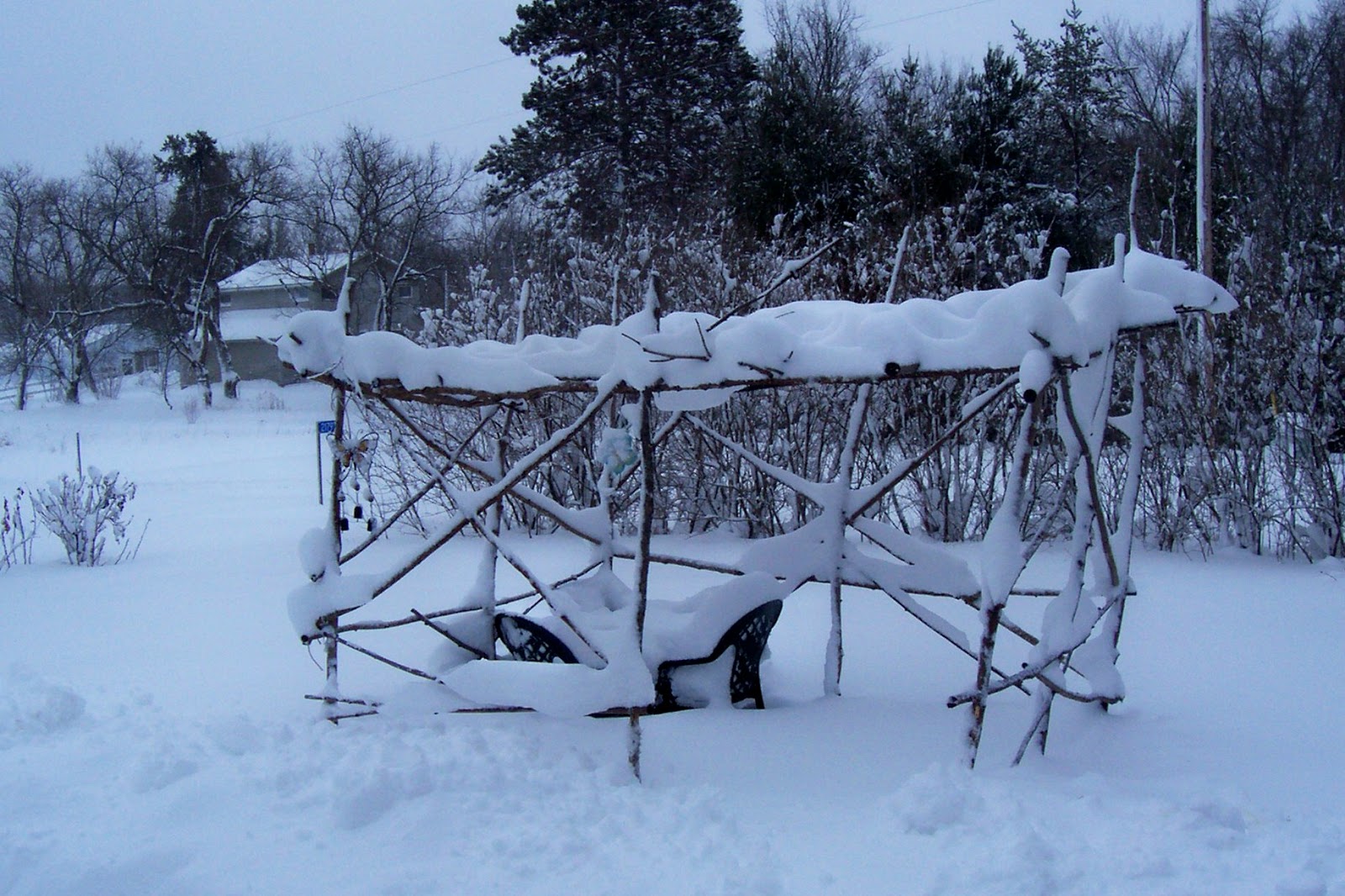
Snow on top of my sukkah frame --
I hope it doesn't collapse it  like
it did a few years ago.
Speaking of water, we have a shortage right now -- when it gets this cold, the plumbing freezes up.  Not enough to split the pipes, just enough to block water from getting from the well pump to the house upstairs.  It's an old house with an unheated basement and this is a recurring problem in the wintertime.

The pipes to the shower are in a outside wall, so we are just about guaranteed to have days with no water there -- meaning you try the faucets in the morning and take showers when the water flows.    This morning the shower was frozen but the sink was still running, so I washed up and did the dishes.  Three hours later, there was no water, period.  Hence the title of this post:  Melt Snow, Carry Water.

The bird feeders have been busy --
this downy Woodpecker
is a regular visitor.
The snow we have is light and fluffy, which makes it easy to shovel but a lot of work to melt down, because it has less water content.  Since we live out in the country away from traffic and pollution, the snow is also clean, if I get it off the beaten track.  (The trails I've cleared to and from the buildings are being used by cats, dogs, rabbits, squirrels and an occasional deer, all of whom leave their calling cards behind. So you don't want that "yellow snow" from on the trail!)

I am finding that it takes about 5 times the snow to make one unit of water.  Luckily I have a lot of big pots and kettles from canning and pickling, so I fill these with snow, then haul them in on a sled.  To save propane, I let the pots just sit at room temperature until I need some water.  The snow packs down as it melts,  making slush that I can put in a smaller pot to warm as needed.  It's a lot of work, but we are surviving.  Snow might shut down Washington D.C., but here in Minnesota we know how to deal with the white stuff.  As the saying goes, what doesn't kill you makes you stronger.

The arctic blast a couple weeks ago lasted over 60 hours below zero.  It was during that cold spell that the engine of my car died when I tried to start it at 30 below.  The timing belt broke which, if you know cars, is major engine damage that I can't afford to fix right now.  so I'm stuck in the country without a car, relying on help from others to get things we need.  Still, I'm a lot better off than all those people who have no power or heat.

Missy Cat has the right idea:
Stay inside and find a sunny window!
My ebay business,  The Happy Rooster, is suffering, though, because getting to the post office during business hours has been sporadic.  I posted a notice on the homepage and people have been very understanding about the delays.  Most of the orders have been for wildflower seeds, which nobody is planting now anyway.  But a lot of customers are "thinking spring" and planing their butterfly gardens.

In spite of all the hassles, the snow can be beautiful, and offers some interesting photographic opportunities.  Every other day we have been getting another inch or two, refreshing the landscape and adding to some interesting natural sculptures, like the "loaf of bread" below.  I take my cell phone along when I go out there, though, and I tell my wife where I'm going and when I expect to be back.  A fall or other mishap in this cold can be very dangerous.

That's all for now -- I've got to log off and go melt enough water to last me through the Sabbath (when we don't cook things) -- so stay warm, stay safe, and have faith:  Spring WILL come!  Shabbat Shalom!

That's not a giant loaf of bread --
just snow piled on top of my potting bench!

Friday, April 26, 2013

My yard is full of birds -- and the Phoebes are safely back!

When I went outside this morning, the sun was out and the yard was full of birdsong.  I heard blue jays, robins, juncos, starlings, finches, pheasants, a drumming grouse and some geese overhead.  I also spotted a thrush in the bushes.  And best of all, the phoebe who nests in the open garage each year is back!  So glad they all survived the storm.

Of course, I'm not 100% sure the phoebe is the same bird -- maybe a descendant? -- but we have had phoebes nesting in the rafters of that building for years.  We've also had them nesting under the eaves of the chicken coop -- a good choice of location, since there are always lots of flies around there.  In 2009 I was lucky enough to get this picture of the coop family, which I made into a postcard:


I called it "Phoebe Fledglings Ready to Fly" -- and they certainly were.  The next day they were gone.  (You can buy a copy of this postcard online in my eBay store, The Happy Rooster.)

Now it's warming up into the 70s this weekend (it's 61 as I wrote this) and the snow is melting off fast.  A walk around the yard showed me bulbs starting to pop up and buds swelling.  I better get out the hummingbird feeders, because those little jewels will be arriving soon, too.  Since the flowers are very late this year, they  will be hungry!

Friday, April 19, 2013

Happy Spring in Minnesota -- Ha Ha Ha!

It's like a really late April Fool's Day joke -- one that doesn't seem very funny anymore.  Just when buds were beginning to swell and I thought "Spring at last!" we get this --  knee-deep snow in my yard, with more on the way - and that was on top of the other storm we got last week!   Minneapolis got 9 inches at the airport this time around, breaking the 1984 record for snowfall on that date and making this the 4th snowiest April on record in the metro area.  St. Cloud, MN, officially got 12 inches, Duluth got 18.  Hard to say what I got, because it is still drifting  all over the place, but it is at least a foot deep in flatter areas.

Enough is enough -- I'm sick of shoveling snow!

Here is a view of my chicken coop, taken from the back porch around 7:30 this morning (To see more detail in any of these shots, click the pic to enlarge):


Needless to say, the chickens and geese will not be going outside today.  I'm not looking forward to slogging down there to feed them, either.   This is a good day for everybody to stay cooped up inside.   Since the plow has not come down my back road yet, and probably won't be here for a long while, I can't go anywhere anyway.  This certainly is not the "1-4 inches" originally predicted!


Here's a picture of my sukkah frame in the front yard.  (A sukkah is a special booth for a Jewish harvest festival.)   A couple seasons ago, I left the covering and top of the sukkah up too long, and the snow collapsed the whole thing.  (Read that story  and see a pic).  This time around, I was smart enough to remove everything down to the bare frame in the fall.  All the snow you see on top is clinging to nothing but the 2-inch diameter support poles.  Which just goes to show how very wet and sticky this stuff really is.  If it melts off too fast, there could be flooding, although since we are on a hill, we are reasonably safe from that.  But rivers are already rising in places like Iowa and Illinois, where this came down as rain.

My dog Jasmine was not too happy about the deep snow, either -- her disgust is very clear in this photo.  No way we could go for a walk today -- I just put her out on the chain to do her stuff.  She slogged out to her usual spot by the edge of the trees, then came  right back in, to flop on her bed in the mud room.

My other big dog, Gypsy, stayed out longer, but she wasn't too thrilled with deep snow, either.   She just pooped by the steps, barked in answer to the dogs down the road, then called it done.  Sherlock, our mini-schnauzer, usually goes out the front sliding door off-leash, but today he refused until I cleared the snow off the porch and shoveled an area for him at the bottom of the steps.  I can't blame him -- the snowdrifts are way over his head.

Willow tree at the edge
of my dirt road.
In spite of this late storm, there are still some visible signs of spring.  One of the first we see around here is the greening of the bark on the willow trees -- which you can see here, in spite of the blowing snow swirling past it.  While I was taking this picture I also saw pussy willows in bloom.  Normally I'd be cutting some of those to bring inside as a spring bouquet, but today I was not about to slog down there into the ditch to get them -- especially since things were starting to melt before this storm, so it could be swampy under all that snow.

The buds on this black maple are in my yard are beginning to swell.  The wind was shaking the branches so hard, the picture came out a bit blurry, but you can clearly see the reddish buds through the coating of snow.

This kind of storm does produce some really nice shots, because it sticks to everything, creating a sort of fantasyland.  Shoveling it, on the other hand, is another story.  It is heavy and sticky, clogging up the snowblowers and creating a lot of business for local chiropractors.  But since the snow is still blowing around and the plow has not been down our road yet, there's no point in clearing the driveway yet.  We're  going to just hunker down and get ready for the Sabbath this evening -- wishing everyone a Shabbat Shalom, Peace and blessings!

Tuesday, November 27, 2012

Stormy skies make the best sunrises

All of the photos on this page were take from the same hill on my land in Pine County, Minnesota, looking east.  And all of them were taken on cloudy mornings.

"Minnesota Snowscape"
On a clear dawn, there isn't much of a show.  The sky gradually gets lighter, there's a strip of orange on the horizon, the sun comes up, and that's it.  One clear day looks pretty much like another.  I don't photograph many of those.

But on a cloudy morning, there is potential for some really great shots.  No two cloud formations are ever the same, and the scene lasts much longer as the sun rises behind the clouds.  When I see a cloudy dawn, I grab my camera and head for my favorite spot.

"Dragon in the Sky"
And there's always that one special moment when it all peaks.  Capturing that moment can be a challenge, because you don't really know when it is coming.  So I shoot a series of shots and then choose the best.  It doesn't always pan out, but when it does, the results are spectacular. (As for the duds, well, as my father told me many years ago, even professional photographers take bad pictures -- they just don't show them to anybody.  For every great pic on my blog, there were a whole lot of deletes.)

"Flaming Sunrise"
When I was a child living in the city, we used to sing a song about "rain, rain go away -- come again another day, little Johnny wants to play." From an urban perspective, rain was a nuisance that kept me from going outside and having fun.  But now that I'm older and we are in the middle of a major drought, I realize that my childish wish for "rain, rain go away" would be a curse.  Without rain in summer and snow storms in winter, a lot of plants and animals suffer.  Including us humans.

"Red in the Morning"
And now comes the homily.  Life, like a sunrise, varies from day to day.  We say we'd like to have perpetually clear skies, but in reality that would be rather boring.  It's the clouds in our lives that add some interest, even if they do sometimes rain on our parades.  The storms provide the challenges.  As I look back over my life, the "sunny days" are pretty much one big blur.  The ones that stand out are those that -- for good or bad -- brought some excitement into my life.  And even those dark days had important lessons for me to learn.

This is not to say I'm always excited to have disruptions in my life.  After all, some storms can be really destructive.  But, as the old saying goes, there's a silver lining in every cloud.  Or, in the case of sunrises, there's always the potential for a really great peak experience.  Maybe this is why just about every religion has the symbolism of moving from the darkness into the light.  And every storm contains a potential rainbow.


"After the Storm"


Tuesday, October 30, 2012

A Final Tribute to the Tall Ship Bounty

As I write this, Hurricane Sandy is still raging, and with so many tragedies and devastating images, the news is overwhelming.  But the one event that stays in my mind is the loss of the HMS Bounty, along with two members of her noble crew.  At this time, one body has been recovered and her captain is still missing.  Thankfully, 14 other crew members were rescued by the Coast Guard.  The ship herself now rests at the bottom of the sea.


The Bounty at anchor, with the Duluth
Lift Bridge in the background.
(I was leaning as I took this shot --
 not the bridge!)
It was only two years ago that she sailed into Duluth harbor, where my wife and I saw her at the 2010 Tall Ships Festival.  It was a special trip for us -- our 30th wedding anniversary.  My wife loves ships and comes from a line of sea captains ("Bold Daniel" Hathorne, who fought in the American Revolution, is one of her ancestors), so I thought this would be the perfect anniversary gift.  And it was.  We spent the whole day enjoying the sight of seven tall ships and exploring the festival on shore, including a performance of The Pirates of Penzance.  (With the exception of the promo shot of the Bounty under sail above, I took all the photos on this page that day.  Click the pix to see enlargements.)


Details of her hull and rigging.
 Like millions of others, I had seen this ship in Mutiny on the Bounty, as well as Pirates of the Caribbean.  I remember going with my father to see the 1962 release of Mutiny (he was a Navy man and loved anything to do with the sea), and I had recently viewed the film again in preparation for the Duluth trip. So this festival was not only a gift for my wife, it was a piece of nostalgia.


Her masts against the
clear Duluth sky.
To me, the story of the original Bounty was almost mythological in historical importance.  The opportunity to see such an exact replica up close was a real thrill.  Little did we know, it would be a once-in-a-lifetime experience, because now she is gone forever.  I'm thankful we got to see her, and will always remember that wonderful day among the great tall ships.

The Bounty docked in Duluth, 2010.  The object in the
foreground is a vintage buoy.


Sunday, November 13, 2011

You can't fast forward a sunset ~ and other TIME-ly thoughts


A while back I was teaching a circle dance to some children and told them to go clockwise.  They looked at me blankly and had no idea what I was talking about.  Their generation is used to digital clocks -- which do not go in circles at all -- and that got me to thinking about how we experience time.   "Clockwise" comes from the way that the shadow moves on a sundial.   Later, this was carried over onto the faces of mechanical clocks.  In both cases, time is seen as a continuous, cyclical flow.  

An hourglass, on the other hand, is not cyclical. It has a beginning and an end. But it still shows a flow of time, as the grains of sand slowly run down. A digital clock, however, shows time as broken up into a bunch of individual numbered moments that are often disconnected from each other.  All of this may seem like a bunch of nitpicking, but I wonder how it affects the way we see the natural world.   Nature goes in cycles. Days, months, years-- all are based on the somewhat circular patterns of rotations and orbits. Even the elliptical orbits of comets go in cycles.  And they all move at their own pace. But are we losing that sense of the "flow" of time?

So last week I was watching a program on PBS about how families are spending less and less time outdoors, and how this, combined with the high speed of modern technology, is indeed distorting our inner sense of time.  "You can't fast forward a sunset," one of the panelists said, and that statement has stuck with me. In a world where you can speed up, slow down, or freeze-frame a movie, or watch it over and over anytime you want to, the slow steady pace of nature  often seems boring. So kids prefer to stay indoors and play speedy video games instead.

Yet it is precisely that slowness that allows us to relax and tune in to God's creation.    Being with nature is a form of meditation. Our bodies evolved in nature, the Garden of Eden was in nature -- however you define it, we need the natural pace of with nature.  But nowadays, even meditation is speeded up -- or at least people try to shortcut it. They go to a weekend seminar to get "enlightened" and are disappointed it it doesn't "work" right away.   But true enlightenment is a lifelong process that takes hours and hours of quiet contemplation.  You can't get there by plunking down your money for a workshop and no, there isn't an app for it, either.

The only way you can freeze-frame a sunset - or any event in nature - is to take a picture of it. Even then, you only have a small part of the real experience.  In photographing sunrises (which I seem to do more than sunsets lately), I have found that there is always a perfect moment where everything in the picture is just right.  The minutes before and after that are beautiful, too, but that peak moment is the best picture in the series.  However, in order to capture that moment, I have to patiently sit there for about 45 minutes or more, because the sunrise is going to unfold at its own pace, and there's not a darned thing I can do about it. It's happening on God's time, not mine.

Watching a sunrise is a "letting go" experience that requires us to fit into nature's pace, not the other way around. Only when you are willing to just sit there quietly and absorb the experience are you able to notice the subtle changes from second to second and minute to minute. There's that magical moment about an hour before dawn,  when the first bird begins to sing, when the rooster begins to crow and the wild geese begin to honk. In Jewish law, the earliest time you can say the Shema prayer is when you can distinguish a blue thread from a white one.  Try it at dawn sometime.
  
Sunrise on the Gershom farm
Pine County, Minnesota, Sept. 21, 2006
  

Sunday, September 18, 2011

Viewing my autism as a gift, not a curse

When I was a child back in the 1950s, neither ADHD nor Asperger's (both of which I have) were even on the radar.  Because I had good verbal and reading skills, nobody ever saw me as 'disabled' or 'special' -- just a problem child who "does not work or play well with others."  (How many times was THAT on my report card?)  I was, they often said, "too smart for my own good" -- probably because I was talking by nine months, reading by the time I went to kindergarten, and into college material by 5th grade.  My family nicknames were "Chatterbox" and "Professor." A neighbor once told my mother not to let me come over there anymore, because I "made her feel stupid."

On the other hand, I was (and still am) socially inept, because I don't read body language or facial expressions very well, and I often fail to pick up nonverbal cues.   Throughout grade school I was the butt of ridicule and bullying by my peers ("Why do you always look at the ceiling?" they jeered), so that by the time I reached high school, I had pretty much withdrawn from all activities and almost flunked out.  The only reason I got into college at all was because I had really high SAT scores.   Eventually I got tracked into being a rabbi because I am a good scholar but, alas, most American Jews don't really want scholars, they want "schmoozy" social directors.  And that is something I am unable to do very well.  So, I ended up as a freelance writer.

Given all of this, how could I possibly believe, as the title of this post suggests, that my autism is a gift?   As a child, I did not believe that.  Well into adulthood, I thought I was cursed.   I spent years of loneliness trying to figure out why I could not fit in anywhere.  But recently I have come to realize how being an Aspie gives me a unique and different perspective on the world, and that it has helped my writing immensely.   My ability to remember precise details, make fine distinctions among various categories of things, and see complex interconnections all give my writing a clear, fine precision.

"Big Oak 3"
by Yonassan Gershom
(An old growth oak on my land)
As many of my readers know, I literally "wrote the book" on the subject of Holocaust reincarnation cases (Beyond the Ashes, 1992), and I believe my autism made this possible.  I was able to be emotionally detached enough to sift through the material without being overwhelmed by the horror and sadness of the stories. 

I also  believe my odd personality prevented this from becoming a cult, heaven forbid.  Since I have zero charisma as a New Age guru, it was not likely that any groupies would blindly idolize me.   In fact, readers are often very disappointed to discover that the author of the book they love is a chattering Aspie nerd who does not fit their stereotype of "spiritual."  And that is for the best. 
 
Autism also influences my photography.  You have probably noticed that there are no people in my photos.  Frankly, I find pictures of people to be terminally boring.  The last publication I would ever buy is People magazine, and I have never once watched a reality show like Survivor or The Bachelor.  All babies look pretty much the same to me, and I mix up adult faces as well.   For example, I know, that William Shatner is Captain Kirk on classical Star Trek, but if I see Shatner in another role, I might not immediately recognize him.  I might not recognize you right away, either, if I see you out of your usual context (such as in the grocery instead of at work.)   Which does not make for very good personal relationships. 

"Calico Kitten"
by Yonassan Gershom
On the other hand, nature fascinates me, and my ability to hyperfocus on small details helps me see the world through a creative lens.  I have hundreds of photos of the sky and clouds, as well as landscapes, trees, flowers.  I also have a great rapport with animals, too, especially cats.  I guess you could say I'm a Cat Whisperer.  Even cats that people claim are impossible to hold or pet will come up to me, rubbing and purring.   I would not ever want to give that up in order to  be "cured" and become a Normie.

As Temple Grandin once said (and I am paraphrasing here), if the socialites had been running the world for the past few millennia, we would all be still just sitting around in caves, chatting and gossiping.   When you look at great inventors and writers, they were often oddballs who did not fit in, but they saw the world through different enough eyes to come up with original ideas. 

I'm convinced that Thomas Edison was an Aspie -- how else could he hyperfocus on a single idea so intensely that he tried a thousand ways to make a light bulb?  And Bill Gates, who was the butt of jokes for many years because of his personality, turned out to be an Aspie also.  Perhaps he was not the most sociable person on the planet, but he did invent the idea of a loadable operating system, thereby making modern computing possible.  Were it not for Aspies like Edison and Gates, you would not now be reading this blog.   Remember that next time you want to "cure" people like me.

Friday, April 22, 2011

Pileated Woodpecker action on dead trees -- wow!

Pileated Woodpecker
(Photo by Noel Lee, courtesy
of Wikimedia Commons)
 Now that the snow has melted, I can finally get back into our woods to see what is going on there (I keep telling myself to get snowshoes so I could hike there in deep winter.  Oh well, maybe next year...)  The Pileated Woodpeckers sure have been busy chopping away at dead trees!  I haven't found a nest yet, my guess is they are either looking for insects, or trying out different trees to see if they are suitable for a nest. 

This illustrates the importance of leaving large dead trees for these big woodpeckers to use. The back five acres of our land are pretty much left as-is, except that I collect firewood there for campfires and maple syrup, and I maintain a trail (which will need some serious work this year. Lots of dead trees and branches came down in the heavy winds we had a while back. And the heavy snow totally flattened the wild raspberries across the trail in places -- that should make picking the fruit interesting this year! On the other hand, it will be easier for the grouse to eat the berries so close to the ground.)

Anyway, back to woodpecker holes.  (To see enlarged versions of any of these pix, just click on the picture.  I use thumbnails on my blog so it will load faster.)

TREE #1

This tree (on the right) was the first I spotted, and absolutely amazing! Just look at the huge holes the birds have chopped out.  There was also one at the top that was a literal trench about 5 feet long!  Unfortunately, it did not photograph well, because the sun was behind that side of the tree at the time.  But you can guess from these pix that it was HUGE!  The top of the tree had also  broken  and fallen off where the bird had chopped so far through, the tree broke.

 This next picture is a closeup of two of the lower holes. Notice that the entire trunk was covered with a small species of shelf fungus. I imagine that had helped to soften up the wood.  This is my favorite in this series of photos.    There is just so much interesting texture and contrast between the delicate fungi and those big holes!


TREE #2

These next two shots are of another tree I found in the same general area, clearly in the territory of the same birds.   There were more dead trees with evidence of woodpecker action, but these were the most dramatic.   A big pile of wood chips like this was at the bottom of the other tree, too. 

 This is a closeup of the base of the same tree.  I almost expected an elf to be sitting in there, the hole was so storybook perfect.  More likely the base is now so weakened that this tree will soon fall, where it will become shelter for the insects, salamanders, and other creatures that like to live under fallen logs.


Wednesday, March 23, 2011

March storm is roaring like a lion!

A few days ago, it was in the mid-50s with my chickens out foraging in patches of bare ground.  There were even bits of green grass poking up, I heard robins calling and saw my first pair of Canada geese returning for the season.  Today, I slogged through knee-deep snow drifts in howling 50 mph winds to get to the coop.  As the saying goes, "If you don't like the weather in Minnesota, just wait 10 minutes."  All the poultry are shut inside --  literally "cooped up" -- happily dry and safe.  I even got 8 eggs.   My two ganders were fighting -- not too seriously, but another sign that spring is coming.

Here's a picture of  Buffy, one of our barn cats, coming out from under the evergreen in our front yard (He's a stray who wandered in, and except for really, really cold weather, he prefers to be outside.  He comes to the porch to eat and sleeps in the old garage.)

One good thing about the storm is that it will prolong the maple syrup season, since there won't be any fire danger for a while (I was getting a bit worried at how fast it was melting off last week, revealing all that long dead grass on the hillside.)   I'm not up to going out to do any photography in this wind -- but here is one of my favorite photos from a previous storm in 2007.  I call it, appropriately, "Dawn after the Storm":


And here is essentially the same view in early spring  that same year -- a sight I'm definitely looking forward to SOON!   As for why we are getting so much snow lately, see my previous blog post, "If the earth is warming up, why are we getting so much snow?"


Sunday, February 20, 2011

Even crap has beauty sometimes

 The most mundane things can turn out to make an interesting picture.  We have had some serious winds this winter, and the other day I noticed that a big branch on one of our old apple trees had cracked and fallen.  When I went to investigate, I discovered that rabbits had stripped the bark from all the twigs that were low enough on the ground for them to reach.

I snapped these two pictures to show my wife Caryl, who has serious arthritis and walks with a cane, so she doesn't get out much in winter when the snow is deep and the ice is slick.  I often bring her nature pix so she can see what is happening out there in our woods.   I wasn't particularly expecting anything artistic when I took these shot of bunny poop, I just wanted to record the spoor -- but the light was just right to create a rather interesting -- if campy! -- effect.


You can see how the rabbits stripped the bark off -- not only on this fallen tree, but in a lot of other places, too.  I've also noticed quite a lot of bunny poop in the compost pile, where I dump the cleanings from the chicken coop.  The bunnies are apparently picking through the old hay and straw.  It's been a hard winter for them and other animals, with the snow so deep that food is hard to find.  Rats and mice also visit the compost pile -- you can see the little trails of footprints where they come out of their tunnels under the snow.  And sometimes you see also the prints of feather tips, where an owl swooped down to grab its dinner.  I often hear an owl hooting around here, although I've never actually see it.


In nature, you find these signs of animal activity more often than the animals themselves.  Oh sure, those TV nature shows have lots of fast action, but in the real world, you wait a long time to see a few moments of thrill.  (And those cameramen sit for a lot of uncomfortable hours to get that footage, too.)  On a day-to-day basis, you learn to look for little clues that tell you animals are around.  And these clues are often quite ephemeral.  The sun soon wipes out tracks in the snow, or they get covered up with new snow.  Another storm is coming in today, and these bunny signs will soon be buried.   So you have to pay constant attention if you want to know what the wildlife is doing out there.

And I think this how it is with "finding God," too.  Hollywood has taught us to expect dramatic special effects, but the Red Sea doesn't split every day, and you rarely see such a big miracle in real life.  However, if you pay close attention, there are always little signs around that God is there.  Sometimes, you can even find God in the crap of life -- maybe even more so than when things are going well.  But you have to learn how to look with kavannah -- focused attention. 

Sunday, February 6, 2011

Winter nature photos -- a creative challenge


"Snowy Tree at Dawn"
 As I was looking through my winter photos, it struck me how my "eye" for nature is different in winter than summer.  During the warm months, I tend to focus on things close up:  Flowers, insects, birds, etc.  During the winter, when everything is covered with snow, my attention goes more toward sunrises and landscapes.   After all, how much plain white snow can you watch without getting terminally bored?

Nevertheless, I do sometimes spot interesting natural objects and other "found art" that get "captured" and preserved by my camera. Occasionally the snow makes a rather ordinary thing look much more interesting than usual.  Here are a few of my favorites:  

These frozen crabapples were on a volunteer tree growing behind my chicken coop.  (Either it grew from the compost, or a seed was dropped there by a bird.)  The tree was already there when we moved here in 1997, and every year it produces a crop of 1-inch fruits that hang on the tree all winter.  When spring comes, lots of birds enjoy the mushy thawed-out apples, including robins and cedar waxwings.

Very few birds hang around here all winter, but the woodpeckers do, and it's obvious that they have been busy on this old rotting stump, as well as other snags in our little woodlot.  Somebody once referred to dead trees as "fast food restaurants" for birds.  A lot of insects winter over on or inside dead trees, and winter birds rely on them for high-energy food.  So, unless the dead trees are a hazard, I leave them for the birds.  There's a dead pine that I can see from my window that almost always has a Downy Woodpecker or a Nuthatch creeping up and down the peeling bark.

My last winter pic for this post is this bunch of snow-covered dead grass.  Not a particularly rare sight --we have fields of it here! -- but it is an example of how the snow can make ordinary objects more interesting and artistic.  I like the way the blades of grass form a sort of abstract pattern, providing a contrast that you would never see without the snow:


A Winter Field in Contrast"


Sunday, January 16, 2011

The stark silent beauty of winter

Last night (Saturday) I had to go out and shovel the huge pile of snow that the plow left at the end of the driveway.  Normally I would not be doing snow removal in the freezing cold of night, but my stepson needed a ride to work, so I had to pick him up and get him there by 7am this morning.  The snow came on the Sabbath (Friday sundown to after dark on Saturday) when I do not work, so I had no choice but to bundle up and go shovel last night.  And this brought me into a very beautiful nature experience.  The sky was clear, the moon and stars were out, the snow sparkled like diamonds, and the only sounds were an occasional car way off in the distance. Well worth braving the cold.  I only wish the sky had been that clear when we had the totla lunar eclipse back in December.  

Now, I must admit that I'm not much of a winter person, but the snow does provide some wonderful opportunities for photography.  The pic below that I took in 2007 is called "Minnesota Snowscape."  (You are looking down the hill from the trail to my chicken coop.)


And this next pic is a view along the trail through our woods that I call "Dawn Wonderland."  This was taken a few years ago after a spring snowstorm, and is one of my alltime favorites.  You only get this "fairyland" effect when the snow is wet enough to stick to the trees -- and it only lasts until the sun gets high enough to hit the branches.  So I have to get up and out there at pre-dawn when there is some light but the sun itself is not up yet.  When I do manage that, I take all the pix I can before the show is over.  I rather like the blue color, too.  Once the sun is out, the snow becomes a glary white and loses this magical quality.