Showing posts with label snow. Show all posts

Friday, January 24, 2014

Minnesota Zen: Melt Snow, Carry Water!


If you have been watching the weather on the news lately (and who hasn't?) you know that the upper Midwest has been going in and out of the arctic deep freeze for weeks.  Here in Minnesota we normally have cold winters, but even for us, it has been record-breaking.  Yesterday it was 20 below zero (F) at dawn, and it never got above zero all day.

The dogs went out, did their business, and came right back in within minutes, looking at me as if to say, "Do you really expect me to stay out in that?"  No, I don't.  All ten of our cats are in the house now, too, and showing no sign of wanting to go outside.  Who can blame them?  We are all beginning to feel that "snow" and "cold" really are four-letter words.

The chickens, geese and guineas are snug inside their coop, which I designed with a passive solar collector on the south side that helps keep their water liquid during the day.  Out of the wind with the sun shining in, the air inside is actually above freezing at noon.  Still, I have to go down there and empty all the waterers at sundown, or they will be frozen solid by morning.

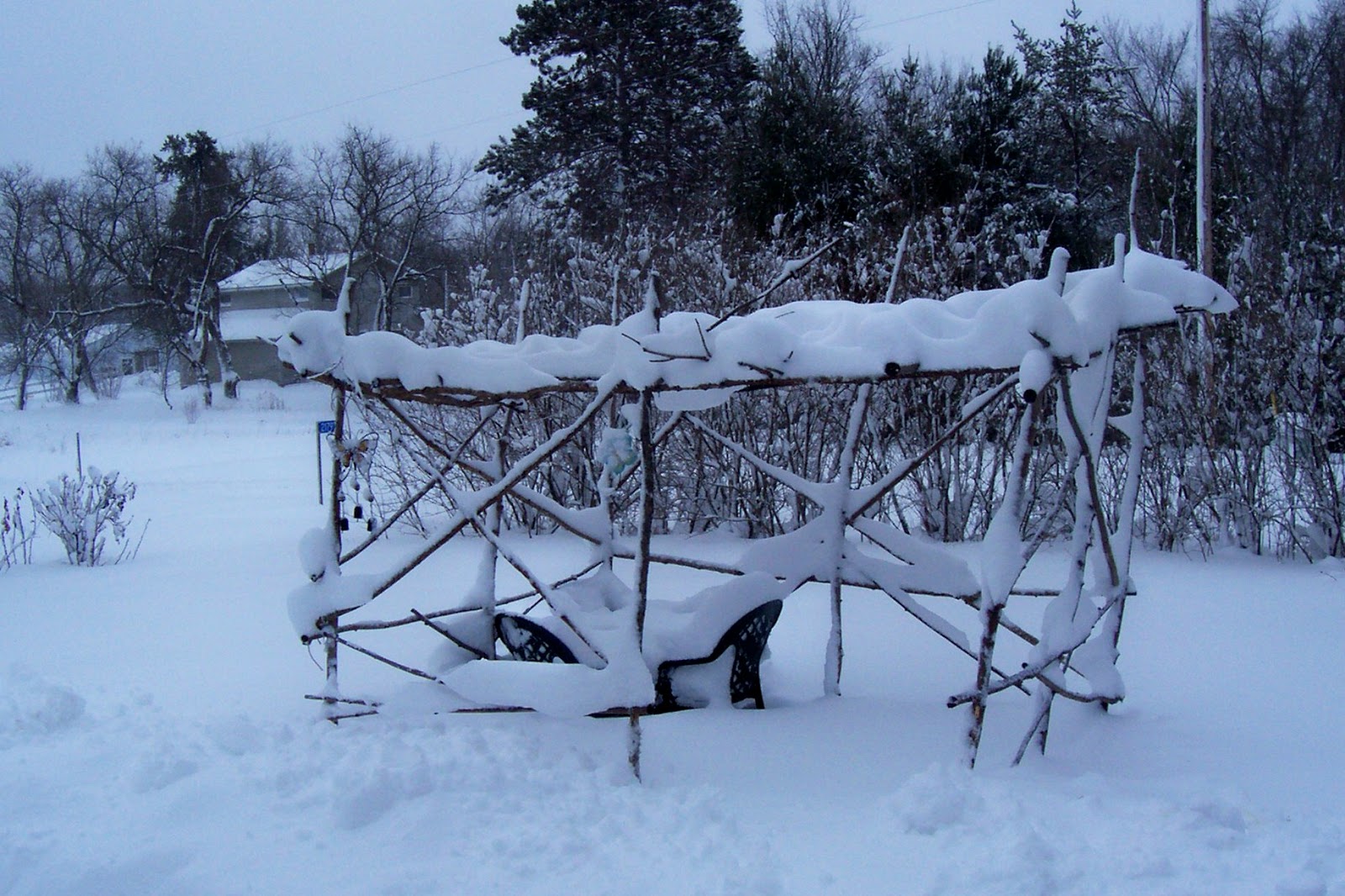
Snow on top of my sukkah frame --
I hope it doesn't collapse it  like
it did a few years ago.
Speaking of water, we have a shortage right now -- when it gets this cold, the plumbing freezes up.  Not enough to split the pipes, just enough to block water from getting from the well pump to the house upstairs.  It's an old house with an unheated basement and this is a recurring problem in the wintertime.

The pipes to the shower are in a outside wall, so we are just about guaranteed to have days with no water there -- meaning you try the faucets in the morning and take showers when the water flows.    This morning the shower was frozen but the sink was still running, so I washed up and did the dishes.  Three hours later, there was no water, period.  Hence the title of this post:  Melt Snow, Carry Water.

The bird feeders have been busy --
this downy Woodpecker
is a regular visitor.
The snow we have is light and fluffy, which makes it easy to shovel but a lot of work to melt down, because it has less water content.  Since we live out in the country away from traffic and pollution, the snow is also clean, if I get it off the beaten track.  (The trails I've cleared to and from the buildings are being used by cats, dogs, rabbits, squirrels and an occasional deer, all of whom leave their calling cards behind. So you don't want that "yellow snow" from on the trail!)

I am finding that it takes about 5 times the snow to make one unit of water.  Luckily I have a lot of big pots and kettles from canning and pickling, so I fill these with snow, then haul them in on a sled.  To save propane, I let the pots just sit at room temperature until I need some water.  The snow packs down as it melts,  making slush that I can put in a smaller pot to warm as needed.  It's a lot of work, but we are surviving.  Snow might shut down Washington D.C., but here in Minnesota we know how to deal with the white stuff.  As the saying goes, what doesn't kill you makes you stronger.

The arctic blast a couple weeks ago lasted over 60 hours below zero.  It was during that cold spell that the engine of my car died when I tried to start it at 30 below.  The timing belt broke which, if you know cars, is major engine damage that I can't afford to fix right now.  so I'm stuck in the country without a car, relying on help from others to get things we need.  Still, I'm a lot better off than all those people who have no power or heat.

Missy Cat has the right idea:
Stay inside and find a sunny window!
My ebay business,  The Happy Rooster, is suffering, though, because getting to the post office during business hours has been sporadic.  I posted a notice on the homepage and people have been very understanding about the delays.  Most of the orders have been for wildflower seeds, which nobody is planting now anyway.  But a lot of customers are "thinking spring" and planing their butterfly gardens.

In spite of all the hassles, the snow can be beautiful, and offers some interesting photographic opportunities.  Every other day we have been getting another inch or two, refreshing the landscape and adding to some interesting natural sculptures, like the "loaf of bread" below.  I take my cell phone along when I go out there, though, and I tell my wife where I'm going and when I expect to be back.  A fall or other mishap in this cold can be very dangerous.

That's all for now -- I've got to log off and go melt enough water to last me through the Sabbath (when we don't cook things) -- so stay warm, stay safe, and have faith:  Spring WILL come!  Shabbat Shalom!

That's not a giant loaf of bread --
just snow piled on top of my potting bench!

Friday, April 19, 2013

Happy Spring in Minnesota -- Ha Ha Ha!

It's like a really late April Fool's Day joke -- one that doesn't seem very funny anymore.  Just when buds were beginning to swell and I thought "Spring at last!" we get this --  knee-deep snow in my yard, with more on the way - and that was on top of the other storm we got last week!   Minneapolis got 9 inches at the airport this time around, breaking the 1984 record for snowfall on that date and making this the 4th snowiest April on record in the metro area.  St. Cloud, MN, officially got 12 inches, Duluth got 18.  Hard to say what I got, because it is still drifting  all over the place, but it is at least a foot deep in flatter areas.

Enough is enough -- I'm sick of shoveling snow!

Here is a view of my chicken coop, taken from the back porch around 7:30 this morning (To see more detail in any of these shots, click the pic to enlarge):


Needless to say, the chickens and geese will not be going outside today.  I'm not looking forward to slogging down there to feed them, either.   This is a good day for everybody to stay cooped up inside.   Since the plow has not come down my back road yet, and probably won't be here for a long while, I can't go anywhere anyway.  This certainly is not the "1-4 inches" originally predicted!


Here's a picture of my sukkah frame in the front yard.  (A sukkah is a special booth for a Jewish harvest festival.)   A couple seasons ago, I left the covering and top of the sukkah up too long, and the snow collapsed the whole thing.  (Read that story  and see a pic).  This time around, I was smart enough to remove everything down to the bare frame in the fall.  All the snow you see on top is clinging to nothing but the 2-inch diameter support poles.  Which just goes to show how very wet and sticky this stuff really is.  If it melts off too fast, there could be flooding, although since we are on a hill, we are reasonably safe from that.  But rivers are already rising in places like Iowa and Illinois, where this came down as rain.

My dog Jasmine was not too happy about the deep snow, either -- her disgust is very clear in this photo.  No way we could go for a walk today -- I just put her out on the chain to do her stuff.  She slogged out to her usual spot by the edge of the trees, then came  right back in, to flop on her bed in the mud room.

My other big dog, Gypsy, stayed out longer, but she wasn't too thrilled with deep snow, either.   She just pooped by the steps, barked in answer to the dogs down the road, then called it done.  Sherlock, our mini-schnauzer, usually goes out the front sliding door off-leash, but today he refused until I cleared the snow off the porch and shoveled an area for him at the bottom of the steps.  I can't blame him -- the snowdrifts are way over his head.

Willow tree at the edge
of my dirt road.
In spite of this late storm, there are still some visible signs of spring.  One of the first we see around here is the greening of the bark on the willow trees -- which you can see here, in spite of the blowing snow swirling past it.  While I was taking this picture I also saw pussy willows in bloom.  Normally I'd be cutting some of those to bring inside as a spring bouquet, but today I was not about to slog down there into the ditch to get them -- especially since things were starting to melt before this storm, so it could be swampy under all that snow.

The buds on this black maple are in my yard are beginning to swell.  The wind was shaking the branches so hard, the picture came out a bit blurry, but you can clearly see the reddish buds through the coating of snow.

This kind of storm does produce some really nice shots, because it sticks to everything, creating a sort of fantasyland.  Shoveling it, on the other hand, is another story.  It is heavy and sticky, clogging up the snowblowers and creating a lot of business for local chiropractors.  But since the snow is still blowing around and the plow has not been down our road yet, there's no point in clearing the driveway yet.  We're  going to just hunker down and get ready for the Sabbath this evening -- wishing everyone a Shabbat Shalom, Peace and blessings!

Thursday, April 11, 2013

Robins are back - I hope they survive this late winter storm

Three days ago I was listening to robins singing in my yard, watching a flock of juncos passing through on their way to Canada, and hearing flocks of geese overhead, honking their way back north.  Today we are getting buried in snow again -- at the same time Washington D.C. is having record breaking 90s -- in April!  Talk about global weirding.

Jet Stream, April 11, 2013
(Map courtesy of acuweather.com) 
The instability of the Jet Stream is a big contributor to all this strange weather.  I can remember when it pretty much stayed put up in there Canada, circling the arctic and dipping occasionally into Minnesota but no further south.  Now, as you can see from this map, it has gone crazy.  And with it comes all this weird  weather.  That huge dip is pulling cold air south, where it meets warm air from the Gulf and produces severe storms, including early tornadoes along the front.   It also traps warm air on the East Coast, resulting in those record-breaking 90s yesterday. (For more on how the Jet Stream is causing more severe weather lately, read this article on Climate Central.)

Last year's crab apples provide
food for spring birds
Meanwhile, birds on migration are getting caught in the storms.  The winds have been very strong today, so I suspect we will have a major bird drop around here (which is different from a bird dropping!)  A bird drop is when migrating birds come down to wait out the bad weather.  Sometimes you get to see some unusual species when the weather clears -- if the birds survive.

I find myself wondering what those robins on my land are eating today.  The Juncos can find seeds on tall grass stalks and the harrier hawk who returned a few days ago will no doubt find a rodent or two around the chicken coop.  But the ground is still too frozen for those robins to find any worms.  In the past I have seen them picking on frozen crab apples still on the trees.  So maybe that will help.

Minnesota drought map 4/11/2013
(Click pic to enlarge)
In spite of this snowstorm, we are still in the midst of a serious drought here.  Today's drought map shows my county, Pine, in the "severe" category.   (For more on the drought, click here.)

Last year it was so dry in late summer-fall that we headed into winter about 7 inches below normal in precipitation.  With the ground still frozen, all that this snow will do is run off -- which helps the wetlands downhill from my place, but won't do much for the garden.  In fact, it is so dry that, for the second year in a row, I decided not to tap my trees for maple syrup.  They grow along the edge of seasonal woodland wetlands that normally provides them with plenty of spring moisture during the melt-off, but this year it is bone dry.  I saw on the news that some syrup producers are getting a decent run -- guess it depends on where you are.  But for everybody it is very late, because of the abnormally cold spring.  In the past, syrup production would begin in mid-March and be over by now.

All of which goes to show that the climate is indeed changing.  Better get used to the new normal -- whatever that turns out to be...

Monday, August 20, 2012

Vote Romney-Ryan and Kill the Planet!

I don't usually do a lot of politics on this blog, but Mitt Romney is so dismissive of clean energy initiatives, and Paul Ryan's record on environmental issues is so shockingly abysmal, I feel I must speak up in defense of the natural world.  Because if the Romney-Ryan campaign has its way, there won't be very much nature left for our descendants to see or enjoy. 


Paul Ryan, Conspiracy Theorist

Ryan is as clueless about environmental science as he appears in this photo.  In a  December 2009 op-ed  that he wrote during international climate talks (and still proudly displays on his official Washington website), Ryan made reference to the hacked University of East Anglia Climatic Research Unit emails (so-called "Climategate") and accused climatologists of a “perversion of the scientific method, where data were manipulated to support a predetermined conclusion,” in order to “intentionally mislead the public on the issue of climate change.” Because of spurious claims of conspiracy like these, several governmental and academic inquiries were launched, all of which found the accusations to be without any merit.  (See Debunking Misinformation about Stolen Climate Emails in the Manufactured Climategate Controversy for further detailed information.)

There was no "climate conspiracy" outside of Paul Ryan's head.  Nobody was perverting the scientific method, they were using the scientific method to peer review and critique various articles that had already been published in respectable journals.  Granted, some scientists were rude to each other in their emails (and who among us hasn't done that?) but Emily Post has nothing to do with the accuracy of the science.

Climate change denial and the Ryan "snow" argument

The problem is, Ryan himself doesn't understand climate science.  In the same op-ed, he stated, "Unilateral economic restraint in the name of fighting global warming has been a tough sell in our [Wisconsin] communities, where much of the state is buried under snow."  He and other climate deniers who use snowstorms as proof that the planet is not getting warmer do not understand a basic fact of physics, namely, that warm air holds more moisture than cold air.  This is why the worst storms usually come in March-April, when the northern hemisphere is warming up.  Warm air from the south hits cold fronts from the north and bam!  We get buried.   When the Jet Stream abnormally dips all the way south to Texas and the Gulf of Mexico, it will pull lots of moist air northward, resulting in even more snow.

Yes, it is true that the winter of 2009-2010 had record snowfall in Wisconsin (and also here in Minnesota, Ryan's neighbor state) but it is ALSO true that the average temperatures have been getting steadily warmer for decades.  When I first moved to Minnesota in 1973, I regularly saw temps of 40 below zero (F) on the winter weather map -- something I have NOT seen on any map around here for at least two decades.  Instead, the winters have been so warm -- with or without snow -- that the lakes no longer freeze hard enough for safe ice fishing in many parts of Minnesota and Wisconsin.  This, in turn, is hurting tourist industries that rely on snow and ice for winter sports.

I am wondering if Ryan is still sticking by this snow argument now that climate patterns have shifted again. Wisconsin is in the midst of a severe drought that is devastating crops across the Midwest.  Neither Minnesota nor Wisconsin had much snow at all this winter (2011-2012).   Instead, it all went south and buried places like Tennessee that normally don't have much snow.  And how does Ryan explain all the record 100-degree temperatures we had across the continent this summer, and the thousands of broken heat records every day?

Climate change is not the only area where Ryan fails on the environment.  He has voted to eliminate the EPA regulations on greenhouse gases, to block the US Department of Agriculture from preparing for climate change, to eliminate light bulb efficiency standards and slash clean energy investment.  On the other hand, he voted FOR keeping oil industry subsidies and is a big supporter of coal.  (For refs in the congressional record on all these issues, click here.)

Mitt Romney, Energy Luddite

Mitt Romney isn't any better.  He not only comes down 100% on the side of Big Oil and Big Coal, he ridicules developing new energy technologies.  On the campaign trail last week, while speaking to coal miners in Ohio, he said that Obama "is only interested in energy above the ground," by which I assume he meant solar and wind energy -- something he has previously mocked by saying "you can't drive a car with a windmill on it."  (Although you can drive a car with a dog kennel on it -- something he has personally demonstrated.)

On that same day, Obama was campaigning in Iowa, which gets 19% of its electricity from wind power, ranking second in the nation for that industry.  Wind farms, Obama pointed out, have already generated 7000 new jobs in Iowa. 

With all his focus on jobs, you would think that Romney would applaud that achievement.  But no, he retorts that wind turbines -- he called them "whirlybirds" -- won't generate energy when the wind is not blowing.  (Maybe not -- but when we run out of coal and oil, nothing will be generating energy if we do not plan ahead.  And hasn't Romney ever heard of storage batteries?)

"We have 250 years of coal," Romney says, "Why in the world wouldn't we use it?"   Even if better technologies are developed?  After all, the Stone Age didn't end because we ran out of rocks.  And there were probably flint-chippers who objected to using metal-tipped spears because it would put them out of work.  "We have tons of rocks, why in the world wouldn't we use them?"  But the smarter cavemen embraced the new technology and the rest is, well, history.

In that same speech, he apparently thought it more effective to use sensationalism rather than science, misquoting Vice President Biden as saying that "coal is more dangerous than terrorists."  Biden never said that!  What he did say, in a 2007 interview, was that "hundreds of thousands of people die, or their lives are shortened, by coal plants."  Which, when you consider the pollution these plants produce (not to mention black lung disease among coal miners and other unsafe conditions), is perfectly true.  Asthma and lung cancer may not be as dramatic as a terrorist attack, but they kill far more people in the long run.  And guess what?  When Romney was governor of Massachusetts, he said much the same thing, stating that a coal plant "kills people." (Yet another flip-flop.)

I could go on and on, but I'll end with this thought:  Is Mitt Romney really a man you would want in the White House?  And do you really want Paul Ryan to be one heartbeat away from the Presidency?

* * *

(If you happen to be a Republican and still think climate change is a hoax, please read this excellent article by Republican meteorologist Paul Douglas (founder of the WeatherNation Channel) about how he came to believe it is true -- and it had nothing to do with Al Gore, just science:  http://www.huffingtonpost.com/paul-douglas/republican-climate-change_b_1374900.html? )

Wednesday, March 23, 2011

March storm is roaring like a lion!

A few days ago, it was in the mid-50s with my chickens out foraging in patches of bare ground.  There were even bits of green grass poking up, I heard robins calling and saw my first pair of Canada geese returning for the season.  Today, I slogged through knee-deep snow drifts in howling 50 mph winds to get to the coop.  As the saying goes, "If you don't like the weather in Minnesota, just wait 10 minutes."  All the poultry are shut inside --  literally "cooped up" -- happily dry and safe.  I even got 8 eggs.   My two ganders were fighting -- not too seriously, but another sign that spring is coming.

Here's a picture of  Buffy, one of our barn cats, coming out from under the evergreen in our front yard (He's a stray who wandered in, and except for really, really cold weather, he prefers to be outside.  He comes to the porch to eat and sleeps in the old garage.)

One good thing about the storm is that it will prolong the maple syrup season, since there won't be any fire danger for a while (I was getting a bit worried at how fast it was melting off last week, revealing all that long dead grass on the hillside.)   I'm not up to going out to do any photography in this wind -- but here is one of my favorite photos from a previous storm in 2007.  I call it, appropriately, "Dawn after the Storm":


And here is essentially the same view in early spring  that same year -- a sight I'm definitely looking forward to SOON!   As for why we are getting so much snow lately, see my previous blog post, "If the earth is warming up, why are we getting so much snow?"


Tuesday, February 22, 2011

If the Earth is warming up, why are we getting so much snow?

Climate change deniers have been having a field day with all the snow this winter.  If global warming is real, they say, then why are we getting buried in so much snow?  Sunday, February 20, 2011 was the largest snowfall in a single 24-hour period ever recorded in Minneapolis, and in Minnesota overall, this has been the second snowiest February on record -- and the month isn't over yet.   So, the skeptics say, how can it be getting warmer if we are buried in blizzards?  And even if it is getting warmer, how can a few degrees make any difference?

Apparently it is making a big difference.  Normally, we get cold weather in January and February here, but not much snow until March-April. But this winter, it has been as if the calendar moved up a month or two, and we are getting April's weather in February.  And this, the scientists say, is indeed due to global warming.

To understand how global warming can produce more snow, we need to understand a  basic fact of physics: warmer air holds more moisture!  More moisture can mean more precipitation, either as snow or as rain.  If you look at the Jet Stream on recent weather maps, you will see that it has repeatedly dipped way down south toward the Gulf of Mexico -- where the air is very warm and moist -- then it swings back up north, dragging all that extra moisture with it.  The warm damp air hits the cold arctic air and whammo!  Lots of snowfall on the good ol' USA.

But hasn't the Jet Stream always done this?  To some extent, yes.  But I'm over 60 years old and I can't ever remember it going down way into Texas like it has done recently.   In the past, the Jet Stream remained pretty much up in Canada, with an occasional dip into Minnesota.  It formed a relatively stable circle of air flowing around the arctic that fenced in the really cold air up there.  Now, however, the Jet Stream has become unstable and is moving up and down the northern hemisphere rather erratically, causing extreme temperature swings (here in Minnesota, we have had a range of 35 below zero (F) to 60 above in a period of a mere two weeks) and a lot more precipitation. 

Why is it doing this? According to a recent study released in January 2011, the melting of ice in the arctic is allowing the Earth to absorb more heat from the sun instead of reflecting it back into space like it used to.(Second basic physics fact: dark ocean water absorbs more sunlight that light snow and ice.)   And it is doing this at a much higher rate than previously thought.  Now, 32-degree sea water might not seem very warm to you and I, but it is a heck of a lot warmer than the below-zero snow and ice that used to be there.  And once it absorbs that sunlight, it holds the heat, melting still more ice.  This warming of the arctic is destabilizing the Jet Stream, which, as I explained above, results in more snow further south.

So, although it may seem paradoxical for warmer air to produce bigger snowstorms, the phenomenon is scientifically sound.  You can't just look at a few local storms, you have to take into account the whole pattern of changes globally.   And while a few degrees might not seem like much, we are not really talking about the difference between a 70 degree day and a 74-degree day.  We are talking about the overall warming of the entire planet.  It doesn't take much to alter the ocean and wind currents.  Scientists say an overall change of 6 degrees can be disastrous.  Already there has been a rapid increase in volcanic activity, earthquakes, severe hurricanes and other storms -- including snow! -- yet so many of us are still in denial about this!

How much do we humans contribute to climate change?  Quite a lot, according to most climate scientists.  Yes, the earth goes through natural cycles, but since the Industrial Revolution the greenhouse effect has accelerated at an unprecedented rate.  The science is pretty firm now, with the vast majority of climate scientists agreeing there is a rapidly-accelerating problem.  Yet I am often appalled at how many of people not only don't believe the science, they think it is merely a matter of politics, a sort of left-wing hoax perpetrated by the Democrats.  (If Ronald Reagan had produced An Inconvenient Truth instead of Al Gore, would the right-wingers take global warming more seriously today?  I wonder.)

James Hoggan, in his book Climate Cover-Up, presents a well-researched argument that from the 1980s onward, there has been an organized campaign on the part of Big Oil and Big Coal to convince us that global warming is a hoax. (Remember that notorious ad trying to convince us that excess carbon dioxide in the atmosphere was good?)  I'm not normally into conspiracy theories, but this one is pretty convincing.  Unfortunately, a lot of people have bought that argument, which delayed us doing anything about changing our lifestyles or lowering our carbon footprints.  But I think it is becoming pretty evident that global warming is real -- even if is does produce more snow sometimes.  Next time you are shoveling the stuff, blame it on that melting arctic ice.


Sunday, February 6, 2011

Winter nature photos -- a creative challenge


"Snowy Tree at Dawn"
 As I was looking through my winter photos, it struck me how my "eye" for nature is different in winter than summer.  During the warm months, I tend to focus on things close up:  Flowers, insects, birds, etc.  During the winter, when everything is covered with snow, my attention goes more toward sunrises and landscapes.   After all, how much plain white snow can you watch without getting terminally bored?

Nevertheless, I do sometimes spot interesting natural objects and other "found art" that get "captured" and preserved by my camera. Occasionally the snow makes a rather ordinary thing look much more interesting than usual.  Here are a few of my favorites:  

These frozen crabapples were on a volunteer tree growing behind my chicken coop.  (Either it grew from the compost, or a seed was dropped there by a bird.)  The tree was already there when we moved here in 1997, and every year it produces a crop of 1-inch fruits that hang on the tree all winter.  When spring comes, lots of birds enjoy the mushy thawed-out apples, including robins and cedar waxwings.

Very few birds hang around here all winter, but the woodpeckers do, and it's obvious that they have been busy on this old rotting stump, as well as other snags in our little woodlot.  Somebody once referred to dead trees as "fast food restaurants" for birds.  A lot of insects winter over on or inside dead trees, and winter birds rely on them for high-energy food.  So, unless the dead trees are a hazard, I leave them for the birds.  There's a dead pine that I can see from my window that almost always has a Downy Woodpecker or a Nuthatch creeping up and down the peeling bark.

My last winter pic for this post is this bunch of snow-covered dead grass.  Not a particularly rare sight --we have fields of it here! -- but it is an example of how the snow can make ordinary objects more interesting and artistic.  I like the way the blades of grass form a sort of abstract pattern, providing a contrast that you would never see without the snow:


A Winter Field in Contrast"


Tuesday, January 18, 2011

Really, really cold tonight!


This shot was taken at dawn a while back, looking through the trees across the road from our house.  I think it captures the way I feel right now --cold!  But at least it's not snowing tonight -- it snowed every day last week.  Not huge amounts each day, but it all adds up.  Tonight it's going down to -8 (F) and -20 on Thursday -- BRRRR!!!!  (UPDATE:  It actually hit 35 below zero that night.)

When it gets this cold, the snow sort of crunches under your feet, and sometimes you hear a loud crack in the woods as a tree branch "explodes" from freezing.  I also have to go to the chicken coop at sundown each evening and dump all the waterers or they freeze solid by morning.  Chickens don't eat and drink at night anyway, but for the geese, who do, I fill their bucket with hot water at sundown, and that usually stays liquid until morning, at least, the geese manage to keep a small hole open to drink from.  By morning there is a layer of ice lining the bucket.  (I use a rubber horse-watering bucket so I can knock the ice out with a stick without breaking it.  A plastic bucket would shatter in the cold.)  In the morning I give everybody warm water and it stays liquid pretty much all day inside the coop, which has a passive solar design.  Luckily the coldest days are also the sunniest, so it does warm up in there.  We are even getting a few eggs.

I noticed today that the rabbits completely stripped the bark from my new Honeycrisp apple tree I planted last year.  Yes, I had put some chicken wire around it to protect it, but the snow got so deep, the bunnies could reach over it -- and they did.  Completely girdled it.  I'm going to see if I can take cuttings from the top and root them, or maybe graft them onto another apple tree in spring.  Next time I suppose I should wrap the trunk with tree wrap or something.  Gardening here is a constant challenge here.  

Sunday, January 16, 2011

The stark silent beauty of winter

Last night (Saturday) I had to go out and shovel the huge pile of snow that the plow left at the end of the driveway.  Normally I would not be doing snow removal in the freezing cold of night, but my stepson needed a ride to work, so I had to pick him up and get him there by 7am this morning.  The snow came on the Sabbath (Friday sundown to after dark on Saturday) when I do not work, so I had no choice but to bundle up and go shovel last night.  And this brought me into a very beautiful nature experience.  The sky was clear, the moon and stars were out, the snow sparkled like diamonds, and the only sounds were an occasional car way off in the distance. Well worth braving the cold.  I only wish the sky had been that clear when we had the totla lunar eclipse back in December.  

Now, I must admit that I'm not much of a winter person, but the snow does provide some wonderful opportunities for photography.  The pic below that I took in 2007 is called "Minnesota Snowscape."  (You are looking down the hill from the trail to my chicken coop.)


And this next pic is a view along the trail through our woods that I call "Dawn Wonderland."  This was taken a few years ago after a spring snowstorm, and is one of my alltime favorites.  You only get this "fairyland" effect when the snow is wet enough to stick to the trees -- and it only lasts until the sun gets high enough to hit the branches.  So I have to get up and out there at pre-dawn when there is some light but the sun itself is not up yet.  When I do manage that, I take all the pix I can before the show is over.  I rather like the blue color, too.  Once the sun is out, the snow becomes a glary white and loses this magical quality.


Tuesday, January 11, 2011

The snow collapsed my old sukkah frame

The snow is coming down again -- the brunt of the storm is way south of us, but so far another inch or so has piled onto what we already have.  The frame of my sukkah (booth for the Festival of Sukkot) finally collapsed under the weight of the snow.  Oh well, it's supposed to be a temporary shelter anyway, so I'll just have to build a new one next year.  (Story continues below photo).


For those of my readers who are not familiar with the Festival of Sukkot, you might know it as the "Feast of Tabernacles"  in the Bible, although the English word "tabernacle" calls to mind a fancy church building, whereas, a sukkah is a primitive booth that we Jews erect in the fall for a harvest festival.  In fact, there are two completely different Hebrew words often translated "tabernacle":  mishkan, which refers to the portable sanctuary that the Jews had while traveling with Moses in the wilderness, and sukkah, the harvest booth we are tallking about here.  As you can see, a sukkah is a far cry from the Mormon Tabernacle!

My urban Jewish brethren usually make their sukkahs out of plywood or other commercially-made materials.  Many buy rather expensive prefab versions, then store them away in the garage after the holiday.  I could never afford to do that.  When I lived in the city, I used to make mine out of whatever materials I could scrounge, because it doesn't really matter what the sides are made of.  One of my more memorable sukkahs was made of old refrigerator packing crates that I found behind the appliance store.  Reduce, reuse, recycle!  Nowadays, living here in the country, I prefer to use my campcraft skills and lash the framework together from saplings that I cut myself in the woods, then cover the sides with old sheets or blankets.  I think this is much closer to what our ancestors probably used.  And it's also a whole lot more economical.  

Lashing the framework makes it a somewhat permanent structure that I don't take down after the holiday.  I used to remove the cloth sides and the pine branches on top, but then I noticed that my cats were sheltering in it while they waited to come in the house on windy winter days, the squirrels sometimes climbed on it, and birds were often hopping around on the top.  I enjoyed watching this animal activity, so for the past few years I have left it up all winter, then removed the coverings in spring and made any necessary repairs to the framework.

There will probably be Haredi Jews who read this blog and be horrified that I let animals come in the sukkah, because it is supposed to be holy -- but really, it is only a "sukkah" during the festival itself.  And what makes it a sukkah is the natural plant materials (called schkach) on top, which I replace fresh every year right before the festival.  I see no problem with it being a multi-purpose structure other times of the year.   In summer, I have sometimes hung flower planters from it. (No bird feeders, though, since we have roaming barn cats.  Most of what my cats catch are rodents from around the chicken coop, which is very helpful, but there is no point in setting up bird bait for them.)

The Torah tells us that Jacob "journeyed to Sukkot and built himself a house, and for his livestock he made shelters; he therefore named the place Sukkot (Booths)."  (Genesis 33:17).  This is the first mention in the Bible of anybody making shelters for their animals (aside from Noah's Ark, of course!) -- and those shelters were probably something like my primitive sukkah.  Which is why he named the place Sukkot.  So I feel that by letting the animals use it after I'm done with it, I am much closer to how our ancestors lived.

At any rate, come spring, I will have to completely re-do my sukkah frame, after using the old wood to boil down my annual batch of maple syrup.  I need to remove some green ash saplings that are taking over the meadow area where the milkweed grows for the monarch butterflies, so this will be a good time to do it.  I look forward to that, because it will mean some very pleasant days outdoors, cutting the poles and listening to the various sounds of the forest.  There will be grouse drumming, pheasants and other birds calling, geese flying overhead, and woodpeckers chipping holes in the dead trees that I purposely leave up for them.  But right now, we have the silence of winter -- and that's beautiful, too.