Showing posts with label politics. Show all posts

Monday, May 20, 2019

On Jewish Theology and Abortion


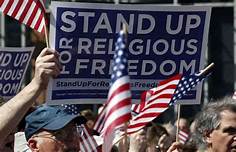
Stand up for religious freedom
Religious freedom applies to ALL religions
not just Christian fundamentalists

To begin: Judaism permits abortion


That is a given.  Different rabbis might rule differently as to when it is permitted (usually handled on a case-by-case basis) but all agree that there are circumstances where it is kosher.  In  some cases it might actually be required by Jewish law; cases which, if  abortion is universally outlawed, might infringe on the religious freedom of Jews.

The main thesis of this essay is that, because Jewish theology interprets the abortion issue differently from fundamentalist Christian theology, the US government should not be deciding questions about when the soul joins the body.  To do so violates the First Amendment.

WARNING: If you plan to hit me with antisemitic crap over this about how "wrong" the Jews are according to your religion, don't bother.  Been there, done that.  But if you are seriously interested in my more mystical take on this regarding body and soul, then read on.

When does human life begin according to the Torah? 


 Genesis 2:7 says that God "formed Adam from the dust of the earth, breathed a breath of life into his nostrils, and he became a living soul" (or a living being: Hebrew nefesh chayah) .  So we have two aspects of humans: body and soul.  The body comes from the material world, the soul from the "breath of God" or spiritual world.  For literally millennia, the first breath was considered the beginning of life as an independent human being. This is still the way that Jewish law views it. (For more details on that, see this excellent article by Danya Ruttenberg "Why are Jews so Pro-Choice?")

Anti-abortion Evangelicals quote Psalm 139:13 and Job 31:15, which speak of God saying, "I formed you in the womb." These verses are regarded as poetry by Jews and play no role in Jewish law which, as I said above, we base on Genesis in the Torah.  While Christians see the Bible as a single book, and give equal weight to all material in it, Jews understand that the Bible is really a library, with different categories of material: Torah, Prophets, and Writings.  The Torah (Genesis, Exodus, Leviticus, Numbers, and Deuteronomy) forms the basis for Jewish canon law (halachah.)  The other books are considered to be various genres of literature: mostly history, sermons by the prophets, and inspirational writings like Psalms and Proverbs.  These materials are secondary to the Torah and are not cited in legal decisions.

I actually had an Evangelical tell me that Job is the oldest book in the Bible - trying to prove that it overrides the idea that life begins with the first breath as in Genesis - but that is wrong. The literary style of Job is like a Greek play, which puts it way later than the Torah.

So lines from Job and Psalms do not count in determining the Jewish stance on abortion.  But for the sake of argument, if we are going to discuss "knew you in the womb" verses, then what about Jeremiah 1:4-5, where God says, "“Before I formed you in the womb I knew you..."? Some Christians also cite this verse to oppose abortion.  But read it again: "Before I formed you in the womb I knew you..."  How could God know Jeremiah before he was in the womb?  How can he be synonymous with an embryo that does not even exist yet?  What did God know of Jeremiah BEFORE gestation? His soul.  Which we can probably assume was "breathed in" by God at birth.

The bottom line is, the question of when the soul joined the body is theology, and gets into First Amendment issues.  Should the govt be deciding a theological question over which various religions disagree? No.

Influence of Roman Catholicism


The Catholic Church was more deeply concerned with the question of ensoulment than were the Jewish scholars.  "Life begins at conception" was not always their official doctrine, but they were moving in that direction, and in 1974 it became official.  Pope Paul VI ratified the "Declaration on Procured Abortion," making it required doctrine for all Roman Catholics that abortion is forbidden because the soul joins the body at conception.

So why do I, a Jew, care about Roman Catholic theology?  Because, with the Pope's declaration, the political debate heated up. Back in the 1970s and 80s, the anti-abortion protesters were almost always Roman Catholics.  But gradually, their theology jumped denominational lines into fundamentalist Christian groups.  Although Catholics today still oppose abortion, it is the Evangelicals who are leading the charge to legally ban it.  As Cynthia Ozick once put it, we should oppose anyone "who proposes that the church steeple ought to begin to lean on the town hall roof."  Which is exactly what is happening now.  Hence the reason that Jews are concerned.

Today, the Catholic stance that "life begins at conception" has pretty much taken over the Pro-life movement. As an outsider looking in, I find it ironic that fundamentalist Christians, who have historically been anti-Catholic, are now basing their argument against abortion on a declaration by the Pope. Or are they?

The impact of embryology and DNA studies


Parallel to the Catholic Church's decision on abortion was the science of embryology.  Even in antiquity, people had seen miscarriages at various stages of development, but the process was not well understood.  When Watson and Crick unraveled the double-helix mystery of DNA in 1954, which led to the completion of the Human Genome Project in 2003, we suddenly had a better understanding of how the human body develops.  We could finally explain, scientifically, exactly what happens when the sperm and egg unite.   And we understood, at least to some extent, how genes carry our hereditary traits.

So the Pro-lifers seized on conception as the moment of full personhood, claiming that everything you are going to be is created in the union of sperm and egg through your DNA.

Again ironic, because we now have very religious people -- many of whom are anti-science in other areas -- relying on science to argue that the fetus is fully a person either at physical conception, or when there is a heartbeat.  Both of these are purely materialistic arguments. If you believe you are nothing but your physical body, that your DNA is all there is to your human existence, then the heartbeat argument works. An odd stance for a religious person. no?

Body and soul -- again


But what if you believe a human being is not simply a matter of biochemistry? What if you believe there is such a thing as a human soul?  Then we are back in the realm of theology.  When does the soul join the body? And how do you prove that?  You can't, really.  Which is why Jewish law bases life on the first breath, which can be observed without the use of theology or mysticism.  Even atheists can agree whether a child is breathing or not.

I suspect this is also why Republicans focus on the heartbeat benchmark, because it can now be measured by ultrasound.  But what about the brain? Nowadays brain activity is a better marker for life. Does a six-week-old embryo with a heartbeat think?  A brain dead person has a heartbeat, but are they still alive?  Is there a difference between an adult kept alive by machines and a not-yet-viable fetus kept alive by a womb?

In the case of the brain dead person, family members get to decide, along with their doctors and clergy, whether to terminate life support - even though the patient still has a heartbeat. So why is that not also true of an embryo in the womb? Why is it murder to end the life of an embryo without a thinking brain but not an adult who is brain dead?

In fact, Judaism does not consider the death of an unborn child to be murder, based on  Exodus 21:22-25, which the New American Standard Bible (NASB) renders this way: "And if men struggle with each other and strike a woman with child so that she has a miscarriage, yet there is no [further] injury [to her], he shall surely be fined as the woman's husband may demand of him; and he [the guilty one] shall pay as the judges decide."  Fined, not executed for murder.  "Thou shalt not murder" simply does not apply here.

In conclusion 


We are back to the original questions once again: When does the soul join with the body? When does it leave? Is the body the whole essence of a person, or is it a merely a garment for the soul? These are questions we should leave to the clergy, not the politicians. True, abortion is ultimately a woman's choice, sometimes along with the father of the child or other family members, sometimes not.  Religious women will also take their faith's teachings into consideration.  And they should be free to do so according to their own theologies, not dictated to by fundamentalist Christianity.

* * *

Addenda: Seems I am not the only one thinking in this vein.  A recent New York Times article discussed whether Jewish and Muslim doctors and women should get religious exemptions in Alabama under their new strict anti-abortion law.  After all, Christians have claimed exemptions from Civil Rights laws (such as refusing to bake cakes for gay couples) based on their faith.  So why shouldn't religions that allow abortions also get similar exemptions? Good question.

Monday, November 20, 2017

Franken's Apology: A Jewish Perspective

By now the whole world has heard about Leeann Tweeden's accusation that, in 2006, not-yet-Senator Al Franken kissed her too aggressively during a skit rehearsal and later posed for an embarrassing "joke" photo where it appears he is groping her. There is plenty of discussion about these events all over the Internet, so I'm not going to go into more details here.

Rather, I want to look at the ethics of his apology from a Jewish perspective. Why Jewish per se?  Because Franken himself is Jewish and has said that his Jewish roots are part of his approach to public service. (Read more on that...)    Although I am not his rabbi, I did know Rabbi Shapiro of Temple Israel in Minneapolis (who was), and can attest that Al Franken grew up in a positive Jewish environment. So I think it is fair to look at the issue from the standpoint of Jewish law & ethics.

But first, three disclaimers:

(1)  I do not speak for Senator Franken, and I have not discussed religion with him.  Therefore,  all opinions in this post are my own.

(2)  I am not in any way, shape, or form trying to claim that what Franken did to Ms. Tweeden was OK.  If I thought that, there would be no need to discuss apologies.

(3) I have been a Franken supporter since his first campaign in 2008 and I still am.  However, this does not mean I am blind to his faults, or that I enjoy raunchy sexual humor (Not!)  No leader is perfect.  Even Moses made mistakes.

Forgiveness and apologies in Judaism

Judaism teaches that for sins between human beings and God, it is enough to simply pray to God for forgiveness.  So, for example, if I eat a ham sandwich, all I need to do is acknowledge the sin, ask God for forgiveness, and hopefully not do it again.  However, if I harm another person - whether physically, monetarily, or through embarrassment --  I cannot be forgiven by God until I have made amends directly to that person.  In this, Judaism recognizes the right of victims to have their pain and suffering directly acknowledged.

This is exactly how Franken has handled the Tweeden accusation against him. Within 24 hours of Tweeden stating her case on CNN, Franken issued a full public apology to reporters, as well as sending an apology directly to Ms. Tweeden, which she read and discussed on The View.  During that interview she said she accepted his apology and stated, "I sincerely think he took it in and realized that -- man, he looks at it now and says 'I'm disgusted by my actions'..." She also stated that it is not her intent to get him to resign, that the people of Minnesota should decide this.  All in all, she accepted his apology and change of heart as genuine. (Watch the full interview on YouTube)

Unlike Weinstein, Moore, Trump and others, Franken did not retreat into denial.  There was no degrading of Tweeden, no calling her derogatory nicknames, no threats of defamation lawsuits,  no Twitter storm attempting to divert attention from himself, no coverup.  Franken fully owned his guilt and manned up to apologize. Twice.  I respect that.

Publicly humiliating someone is a sin

Let me point out that Jewish law takes a very dim view of embarrassing someone in public; it is, in fact, a serious sin that the Talmud compares to shedding blood (Bava Metzia 58b).   So even if Franken did intend the now-infamous photo to be a practical joke, the fact that it humiliated her made it a sin that he must atone for.  The same goes for the kiss, about which he says, "I certainly don't remember the rehearsal for the skit in the same way, but I send my sincerest apologies to Leeann." Some people have nitpicked this statement, claiming that he is denying her story.  I don't see it that way.  It is perfectly possible for two people to remember the same event in different ways.  What seems trivial in one person's mind can loom large in the mind of another.  For him it was probably just a rehearsal.  To her, it was devastating and made her angry for years.

So why didn't he apologize back in 2006?  Because apparently he did not realize the seriousness of its impact on her until she told her story last week.  Some people have implied that he only apologized because he got caught, but this contradicts her own story on CNN, where she says she saw the photo after they got back from the USO trip.  For whatever reason, she did not confront him about it back then.  What matters now is that as soon as he became aware of the impact on her, he owned it.

However, we should note that pillorying Franken  in a social media feeding frenzy is also wrong.  Ms. Tweeden has stated that it was not her intention to get him fired, she simply wanted to tell her story and get an apology.  She got that and has accepted it.  If the victim does not want to press it further, shouldn't we respect that?  Must we continue to drag both of them through the media?

Loshon hara (evil gossip) is also a serious sin: "You shall not go back and forth as a talebearer among your people." (Leviticus 19:16) Reporting the news is one thing. Vicious gossip is quite another.

Is "joking around" an excuse?

This brings us to the question of whether "it was clearly a joke" could be an excuse. The Jewish answer is no, not if it causes harm to the brunt of the joke.  In a discussion about embarrassment and nicknames, the Talmud (Baba Metzia 58b) says that one who calls someone a derogatory nickname -- even if he or she is used to it -- will spend eternity in Gehenna.  This may be hyperbole, but it does indicate the seriousness of humiliating somebody in public. (President Trump should listen to this.  Although he is not Jewish, one would hope that his Jewish daughter and son-in-law would point out it him.  Maybe they have but he doesn't listen?)

Humor is always tricky.  What is funny to one generation can be downright disgusting to another.  Even from group to group or person to person, what is acceptable can vary widely.  To be sure, much of Franken's humor back in his Saturday Night Live (SNL) days was very raunchy and misogynist.  (Read more...)  SNL today remains a venue where comedy often crosses the line into offensiveness.  This is not to make excuses, it just is what it is.  Perhaps we should all take a long hard look at ourselves and how we feed into this national obsession with raunchy sexist humor.

Again drawing on Jewish thought, Psalm 1:1 tells us not to "sit in the seat of the scorners," i.e., those who mock others. Good humor does not put others down.

Franken's humor and the 2008 Senate race

Here in Minnesota, when Franken ran for the Senate in 2008, his humor became an issue during the campaign.  The Republicans jumped on various articles and skits he had written or participated in (or sometimes just pitched but never produced) as "proof" that he was morally unfit to lead.  Even among Democrats, there was concern about his public image . Focus groups said loud and clear that they did not want Minnesota represented by a clown, especially a raunchy one.

Here again, Franken looked at his behavior and sincerely apologized: “For 35 years I was a writer," he said at his nomination speech. "I wrote a lot of jokes. Some of them weren’t funny. Some of them weren’t appropriate. Some of them were downright offensive. I understand that. And I understand that the people of Minnesota deserve a senator who won’t say things that will make you feel uncomfortable."

So a lot of the bad comedy material from the past that his enemies are now dredging up is old news to us Minnesotans, who elected him in 2008.  In 2014 he won the Democratic primary with 94.5% of the vote and the general election with 53.2% of the vote.  Obviously, Minnesota feels he has grown beyond his past off-color humor and is now doing a good job representing us.

Unfortunately, the rest of the country apparently hasn't followed Minnesota politics that closely.  A whole new generation, who weren't even born in 1975 when SNL began, are discovering anew that Al Franken the comedian wrote offensive jokes before he became a senator.  What they are missing is that during the campaign he promised to turn over a new leaf --and he did.  He went so far as to not tell jokes -- even acceptable ones -- suppressing his inner clown to take on the seriousness of governing in the Senate.  (Read more...)

Is Franken unfit to lead?

Now that the Tweeden story is out, certain people are calling for Franken's resignation.  Abby Honold, the Minnesota rape victim who helped Franken craft a bill that would help train First Responders to better help victims of sexual assault, called Franken to say he was no longer fit to sponsor it.  For the good of the cause, Franken turned it over to Senator Amy Klobuchar.

But I find myself wondering if Honold is really right.  Is Franken really unfit to lead on women's issues or anything else?

Recall again that the Tweeden case, as well as his sexist humor in general, occurred before he was elected to the Senate. According to the Minneapolis Star Tribune, 14 women staffers who worked for Franken signed a statement saying that he never acted inappropriately towards them:

“Many of us spent years working for Senator Franken in Minnesota and Washington,” their statement read. “In our time working for the senator, he treated us with the utmost respect. He valued our work and our opinions and was a champion for women both in the legislation he supported and in promoting women to leadership roles in our office."

(UPDATE 11/21/2017:   Three dozen women who worked with Franken on SNL also signed a letter defending him: "Saturday Night Live" Women Defend Franken after Groping Allegations, stating "not one of us experienced any inappropriate behavior.")

So it would seem that he really has turned over a new leaf.  I find myself thinking about how, in many recovery programs, the best outreach counselors are those who have been there.  Ex-alcoholics, ex-addicts, ex-gang members, ex-convicts -- the list goes on of people who can speak convincingly to offenders precisely because they once were offenders themselves.

In a follow-up interview on CNN, Tweeden herself blames our culture, and said that change is going to come "not from the victims coming out, and talking about it, I think its gonna come from the people who may be doing the abusing that don't even realize they are abusing because it is so a part of the culture..." . (Watch the  video)

Take Alan Alda, for instance.  If  you watch the early seasons of M.A.S.H., there's a great deal of material that comes across as sexual harassment.  Then, partway through the series,  Alda became a feminist. And if you watch the episodes in order, you can see the show evolve into a more respectful treatment of female characters.  Having followed Franken's career here in Minnesota, I have seen a similar evolution in Franken's attitude.

So why can't Franken be an advocate for women's rights?  It would seem that a man who himself once degraded women on the stage and in his writing -- but who has since repented and reformed -- would be the ideal person to convince other men to do the same.  In other areas we support --even praise! -- ex-offenders who do such education and outreach.  Why should  this be any different?

As I write this, the news just broke that Senator Franken does not intend to resign.  Frankly (pun intended), I'm glad.  So far, he is the only one of the many powerful men recently accused of sexual misconduct who has had the guts to take full responsibility and admit his mistakes.  That shows  courage and strength of character. We need more of that kind of leadership.

*  *  *

UPDATE: Listen to Al Franken's Full 18-minute interview with Cathy Wurzer on NPR, Sunday, November 26, 2017

Friday, July 1, 2016

Why I avoid the word "Zionism"

"If you would converse with me, define your terms." -- Voltaire


The word "Zionism" is used online in so many different ways nowadays -- often with totally conflicting definitions -- that I believe it has become useless for any kind of real dialogue.

The Meriam-Webster dictionary defines Zionism as "an international movement originally for the establishment of a Jewish national or religious community in Palestine and later for the support of modern Israel." The Jewish Virtual Library has a more expanded version of this definition, which is pretty standard in the mainstream Jewish community.  Zionism was, and still is, primarily a political movement.

But in addition to this positive version, urbandictionary.com adds a secondary negative definition for Zionist that is all too common online: "A substitute word for Jew used by antisemites who, for whatever reason, wish to hide their racist intent."  And I have indeed come across people who use it that way, often the same people who use expressions like "jew the price down."  But is every criticism of Israel or Zionism automatically racist?  And are Jews and Zionists always synonymous?

On the other side, there are those who argue that Zionism itself is a racist ideology.  Again, what exactly does that mean?

Hitler defined Jews as a race, but he was hardly an authoritative source.  Biologically, Jews are not a race.  Anthropologically, Jews are more like a tribal people, with the "12 Tribes" actually being 12 clans within a tribe.  Converting to Judaism is more like being adopted into a tribe than just taking on a "religion."  So many people of all races and nationalities have done that over the centuries that Jews now come in every possible race and nationality.  So what, exactly, is meant by "Zionism is racism?"  What "race" would it be promoting?

As you can see, we are already in a tangle of confusion, and it doesn't end there.  Still others talk of a conspiracy theory where a secret organization called "The Elders of Zion" or "Zionist Occupying Government" (ZOG) is supposedly controlling the world (or the media, or the banks, or Congress, or Hollywood, or whatever else people are mad about at the moment.)

So,  for my Twitter and Facebook readers who are constantly asking me where I stand on the subject of Israel and Zionism, here's a brief rundown of the various ways the word is used, and why I now shy away from using "Zionist" altogether.

Nathan Birnbaum
Where does the word "Zionism" come from, anyway?

The term Zionism was coined by Nathan Birnbaum in 1890.  Birnbaum was an Austrian journalist and freethinker who played a major role in the First Zionist Congress, but, ironically, he did not remain in the Zionist movement.  His life had three main phases, representing a progression in his thinking: 1) A Zionist phase; 2) a Jewish cultural autonomy phase which included the promotion of the Yiddish language; and 3) a religious phase when he turned to Orthodox Judaism and became staunchly anti-Zionist. (More on anti-Zionist Jews below.)

 The word "Zion" itself was taken from the name of Mount Zion, a hill in Jerusalem, but the exact location has shifted in the minds of the people over time.  (The Wikipedia page discusses three different sites.)   The Prophet Isaiah referred to Zion as being synonymous with Jerusalem, the seat of government in the time of King David, and prophesied that:

Many peoples will come and say, "Come, let us go up to the mountain of the LORD, to the temple of the God of Jacob. God will teach us his ways, so that we may walk in God's paths." The law will go out from Zion, the word of the LORD from Jerusalem. (Isaiah 2:3)

This quote and others like it in the Bible may partially account for the antisemitic idea that Jews are out to rule the world.  However, the Jewish interpretation is that A) this is something that will happen in messianic times and B) the people will voluntarily "walk in God's paths," not be forced to convert to Judaism.  Jews do not have missionaries like some other religions do.  (For more on the Jewish concept of the Messianic Age, read here. Jews also do not believe everyone must be Jewish in order to be saved. You can find God through your own religion.)

It is important to keep in mind that Isaiah was preaching at a time when the Jews had been conquered by the Assyrians and Babylonians.  So what he was prophesying was a return to self-rule, a future time of peace when the nations of the world would "beat their swords into plowshares, and their spears into pruning hooks; nation shall not lift up sword against nation, neither shall they learn war anymore." (Isaiah 2:4) 

And is that not the hope of most people on earth, to have world peace?

Is criticizing Israel always antisemitic?

Not if you are criticizing specific policies.  Israelis themselves are quite critical of their own government and society, as anybody who reads the Israeli press certainly knows.  Unfortunately these criticisms do not get much coverage in the mainstream American press, but if you follow publications like The Jewish Daily Forward, the English version of the Jerusalem Post, or Haaretz you will see a wide diversity of opinions on Middle East affairs.

In Israel and the Jewish community at large, "Zionism" has a lot of different meanings, the same as "Americanism" means different things to different Americans.  There are religious Zionists, secular Zionists, left-wing Zionists, right-wing Zionists, militant Zionists, pacifist Zionists, Green Party Zionists --  and everything in between.

There are even non-Jewish Zionists, often Christians who support Israel as fulfillment of  the "Holy Land" prophecies in their own religion.  (Read more on Christian Zionism.)  However, not all Christian groups agree with this stance, and many actively oppose it.

As you can see, all of these different kinds of Zionists have a lot of differences among themselves --and often criticize each other quite strongly.

On the other hand, if you oppose the very existence of Israel and call for its total destruction, then you will be perceived as antisemitic as well as anti-Israel.  Calling for the destruction of any country is taken as a threat of war -- and what country would sit by and calmly let themselves be annihilated? In the same vein, what country would not fight back if people were lobbing bombs over the border? What country would not arrest people who throw stones or knife civilians on the street?  Here is not the place to go into the Israel-Palestinian conflict, but it is important to keep in mind that even in this conflict, there is a wide variety of opinions.  So the rule of thumb seems to be to criticize policies of Israel all you want, but don't deny the right of Israel to exist.

What about anti-Zionist Jews?  Who are they?

It may be hard to believe today, but Zionism was not met with great enthusiasm by most Jews in its early days.  The majority of rabbis objected to the idea of establishing a secular state, believing that to do so without the Messiah was blasphemy.  The original Zionists were, with very few exceptions, secularized Jews who no longer observed "the religion," although they felt connected to the Jewish people as a culture.

At the time, many Europeans thought of Jews as a bunch of homeless parasites, (the old "wandering Jew" stereotype) and antisemitism was on the rise.  The early Zionists believed that if Jews had a country of their own, then the non-Jews would see them as simply another nationality like Irish or French, and antisemitism would cease to exist.

Unfortunately that did not work.  Antisemites simply transferred their hatred for "the Jews" to "the Zionists," carrying over all the old negative stereotypes from one to the other.  More on that later.

Satmar Hasidim protesting the Israeli draft
After World War II, when the State of Israel became a reality, most Jews ceased to oppose it.  However, there are still some very Orthodox groups, most notably the Satmar Hasidim, who do not recognize the State of Israel as a "Jewish" state, but see it the same as any other secular government they have lived under in the past.  These groups do not object to living in Israel -- some families have been in Jerusalem for centuries -- but they are opposed to Zionism as such and refuse to serve in the Israeli army. (More on that...)

In the past these anti-Zionist groups were marginalized in the Jewish community, but since the advent of the Internet you can find them posting on Facebook and Twitter.  On March 3, 2015, 3000 Satmar Jews protested in NYC against Israeli Prime Minister Netanyahu's speech claiming he spoke for all Jews.  They do not see Israel or Netanyahu as representing them.

Some anti-Zionist Orthodox rabbis go so far as to say that Zionists are not true Jews -- a stance I disagree with, because halachah (Jewish law) does not define Jewishness according to one's politics.  According to Jewish law, if your mother is Jewish or if you have formally converted, then you are Jewish, period, regardless of your level of religious observance and/or politics.

Display of Religious Zionist yarmulkes
However, there are some Jews who practice what they call "religious Zionism," a more recent movement that combines the biblical idea of the Holy Land with the present government.  An old saying has it that "God, the Torah, and Israel are one."  The "Israel" here refers to the Jewish people, after the new name, Israel, given to Jacob by the angel. (Genesis 35:10.)  Religious Zionists re-define it as referring to the State of Israel, giving it a nationalist twist.  Some go so far as make loyalty to Israel as a requirement for being a good Jew.  The anti-Zionist Orthodox groups, on the other hand, see this as a heresy.

There are also non-Orthodox and secular anti-Zionist Jews.  These are individuals who are opposed to the occupation of Palestinian lands, and who see Israel as an extension of Western colonialism.  This is, of course, a very simplistic definition, because there are also Zionist groups that oppose the Occupation, such as J Street and others.  Opposing the Occupation does not automatically make one into an anti-Zionist.  It may, however, get you called a "self-hating Jew" by the mainstream Jewish press.

What about the "Elders of Zion" who secretly rule the world? 

They don't exist!  There is no secret cabal of Jewish Illuminati or ZOG conspiracy "shadow government."  The idea dates to a  book called The Protocols of the meetings of the learned Elders of Zion (called The Protocols for short) published in Russia in 1903.  The book, which claims to be the minutes from a secret meeting of these "Elders," is a proven forgery that also contains a lot of plagiarism from other non-Jewish sources.   (The Wikipedia page on this topic goes into more detail about this plagiarism.)  Nevertheless the book was promoted by Hitler, and more recently has been passed around in both Arab and white supremacist circles.

Typical ZOG cartoon implying that Jews
control the American government
Anybody who knows anything about real Judaism can immediately see that The Protocols is not only a vicious forgery, it is ludicrous in terms of style and dialogue.  Unfortunately there are still gullible people who believe anything they read, and with the advent of the Internet, a lot of old junk -- much of it long discredited -- is getting resurrected from the past and posted.  And since the Net is worldwide, people on the other side of the world who have never met a Jew and have no historical context for this bogus text sometimes mistake it for fact.

Among other things, this book is a source of the false definition of the Hebrew word goy as meaning "pig" or "subhuman" for non-Jews.  (More than ironic, since the white supremicists who distribute The Protocols consider Jews and non-white races to be inferior and see themselves as a "master race .")

The word goy simply means "nation" in biblical Hebrew and occurs 550 times in reference to both Jews and gentiles.  Genesis 10:5 uses it in a neutral way applying to non-Israelite nations.  In Genesis 12:2 God promises Abraham that his descendants with be goy gadol, "a great nation."  Exodus 19:6 refers to the Jewish people as goy kadosh, a "holy nation." The prophet Isaiah uses it universally when he prophesies that "nation (goy) shall not lift up sword against nation (goy) neither shall they learn war anymore." (Isaiah 2:4)

While it is true that in recent years goy has sometimes been used as an insult (same as "Jew" is used by some people as an insult), that is vulgar street usage and not the true meaning of the word.  However, many Jews nowadays shy away from using it to avoid misunderstanding, and prefer "gentile" or "non-Jew" instead. (Most of the time when I see it online it is being thrown at me by antisemites trying to look informed about Jews.  Again pretty ironic.)

On the other hand, the recently-coined term "goysplaining" is sometimes used, meaning when a non-Jewish "expert" explains Jewish beliefs/issues to a Jew and gets it wrong. (read more on that...)

So where do I stand on all this?

As I said above, the word "Zionism" is now used in so many different ways that it confuses more than clarifies.  Therefore I try to avoid it altogether.  But if you insist, then politically I have  called myself a "non-Zionist."  Zionism and the State of Israel simply do not play much of a role in my Jewish identity, which centers more on God, spirituality, and love of humanity, rather than on nationalism.  I have no theological objection to the existence of the State of Israel, but I do not see it as the fulfillment of messianic prophecies, either. The land of Israel is holy, but the State, to me, is a secular government.  As such it can be criticized and questioned the same as any other government.

(This article was updated on January 11, 2017 by the author)

Tuesday, April 26, 2016

On heroes and political correctness: Nobody's perfect!

Lately there has been a lot of discussion about removing the names of political figures from various monuments, schools, and buildings, because the people so honored are not politically correct by 21st century standards.  For example, there was the recent demand by some students at Princeton University to rename the Woodrow Wilson public policy school because of Wilson's "racist" attitudes.  Students claimed that the very presence of Wilson's name was offensive and made them feel "unsafe." In the end, the board of regents at Princeton decided to keep the name but also do more education and discussion about Wilson's mixed legacy.

In my opinion, this was the right choice.  Wilson, like everyone else on earth, was not perfect.  He is best known as the 38th U.S. President, who helped found the League of Nations, and also received a Nobel Prize.  But it is also true that he supported and encouraged segregation.  However, nobody would argue that Wilson is being honored at Princeton for his racism.  That was a flaw in his personality that we can justly criticize.  But to allow this flaw to overwrite and erase all the good he did is, in my opinion, taking things too far.  If we start doing that, where will it end?

Charles Lindbergh & his plane, 1927
In Minnesota, where I live, Charles Lindbergh's name probably crops up as often as Wilson's at Princeton.   He is fondly remembered as the first person to fly solo across the Atlantic Ocean in his little single-engine plane, the Spirit of St. Louis.  In 1957, a film by that name was released, with James Stuart playing the role of Lindbergh.  There's a Charles A. Lindbergh State Park and a Charles A. Lindbergh Historic Site, both in Little Falls, MN, where he spent his childhood.  Then there's the Minneapolis-St. Paul Airport, where a terminal is named after him, and a reproduction of his plane (one used in the film) is on display.  The original plane is at the Smithsonian's Aeronautics and Space Museum.  Clearly, this daring flight is why we remember and honor Lindbergh.

But there is a dark side to this story.  Lindbergh was also a Nazi sympathizer and an antisemite -- a fact that was recently well-documented in the PBS American Experience segment, Fallen Hero: Charles Lindbergh in the 1940s.  In 1936, Lindbergh visited Nazi Germany and was so impressed with the country's industry and revitalized economy that by 1938 he and his family were making plans to move to Berlin.  Also in 1938, Lindbergh was awarded the Service Cross of the German Eagle for his contributions to aviation -- presented by Hermann Goering on behalf of the Fuehrer.  Lindbergh became so convinced that Hitler would inevitably win the war, he advocated for America to follow an isolationist policy and stay out of it.  And he blamed the Jews for getting us into it.

As a Jew myself, I most certainly do find this side of Lindbergh offensive.  But I do not feel "unsafe" in the Lindbergh Terminal because of it.  Nor do I advocate erasing his name from our history or renaming the terminal.*  As with Wilson, Lindbergh is not being honored for his racism.  I see him as a genius in one area, and a flawed human being in other areas.  

Insisting that historical figures of the past must stand up to the scrutiny of 21st-century values is a very slippery slope.  For that matter, a lot of modern heroes don't measure up in every way, either. If we insist that all of our heroes be absolutely perfect, then we shall soon have no role models at all.  Sometimes it is necessary, as Rabbi Meir in the Talmud once said, to keep the kernel and throw away the chaff.


*  * *

*Although in a way it was renamed, as Terminal 1, because apparently out-of-state people could not distinguish between the Lindbergh Terminal and the Humphrey Terminal and got lost.  But apparently they can tell the difference between 1 and 2.  As of this writing, there is currently a movement to rename Lindbergh Terminal-1 after Prince: see http://minnesota.cbslocal.com/2016/04/22/msp-terminal-prince-petition/

*  *  *

See also my Nov 20, 2017 article, Franken's Apology: A Jewish Perspective, which explores the question of repentance and forgiveness for flawed leaders (and the rest of us, too.).

Friday, September 4, 2015

Kim Davis and Religious freedom: A Jewish Perspective

Kim Davis, the county clerk in Kentucky who is refusing to issue marriage licenses because she does not believe in same-sex marriages, sees herself as a martyr to her faith.  As a religious Jew watching this story unfold, I have another perspective.  Namely, that Christians like her are very new at being a minority, and have not figured out how to balance public and private life.  For centuries in the Western World, Christianity was the dominant culture.   Now that is no longer so, and this is creating a crisis that we Jews already dealt with centuries ago.

In my own life I have also had this struggle, especially around Christmas time, when there is extreme pressure to conform.  I can remember a time when suburban Jews had "Hanukkah bushes" just to avoid being harassed by Christian neighbors.  Ditto for putting up "holiday lights."  If you were the only family on the block that did not, you heard about it.  It was simply assumed that everyone was Christian.

Now the shoe is on the other foot.  Puritan Christians are no longer in control.  And suddenly people like Kim Davis are finding out what it is like to be asked to do something you do not believe in.  Only with a difference.  Because Judaism has a principal called, in Hebrew, dina malchut dina, "The law of the land is the law."  Jews do not insist the whole world live according to our beliefs.  When it comes to secular issues, we obey the laws of the country we live in.  In the case of Kim Davis, as a public official, Judaism would say that she is required to issue those licenses.

I have tried to think of a similar issue for me as rabbi and came up with this:  Jewish law forbids intermarriage between a Jew and a non-Jew.  Many synagogues will not accept such families as members.  That is their right as religious institutions.  But what would I do if such a couple showed up at the courthouse asking me to issue a license, and I knew for a fact it would be a "forbidden" intermarriage?  I would issue the license.  I would not perform the ceremony.  I might not go to the wedding. But in terms of the secular law, I would be required to fulfill my duty.  This would not be a breach of my own faith, since I would be doing it as a public official, not as a rabbi.

Christians need to learn how to make this distinction between public and private.  They need to accept the fact that are not the majority anymore, and they no longer run the whole show.  Kim Davis could best demonstrate her faith by resigning her post and seeking another job.

Sunday, January 18, 2015

No Rabbi Heschel in "Selma" movie? Inexcusable!

I was looking forward to seeing the new movie, Selma.  Emblazoned in my heart is the iconic photo of Dr. Martin Luther King marching with Rabbi Abraham Joshua Heschel in the front row.  A photo that for my generation has come to symbolize the unity between Jews and African Americans during the 1960s.  For years I have told friends, family, and students to "watch for the man with the bushy white hair and beard" in the original Selma footage.  Unfortunately, in the new movie Rabbi Heschel does not appear in this scene or anywhere else!  The omission has me -- along with a lot of the Jewish community -- wondering why not.

Marching from Selma to Montgomery: 
John Lewis of SNCC, an unidentified nun, 
Rev. Ralph Abernathy; Rev. Martin Luther King, Jr., 
Ralph Bunche (former U.S. Ambassador to the UN), 
Rabbi Abraham Joshua Heschel, and Rev. Fred Shuttleswort


I can understand film director Ava DuVernay's desire to make a film that focuses strongly on Black leadership.  There have been too many civil rights films already with white sympathizers as the main characters.  (I have the same complaint about Holocaust films that focus on non-Jewish supporters -- of which there are also too many.)

And this is not the only revisionism in the film.  The King estate did not allow the filmmakers to use King's real speeches, so his words are paraphrases. That's not so bad, viewers say.  But to omit showing Rabbi Heschel -- or any rabbis for that matter -- is puzzling.  I find it hard to believe that DuVernay could not have known who Heschel was, given how close he was to Dr. King in those years.  Surely she did her research?  Or did she think the guy with the bushy beard was just some sort of hippie?  (Read more on that theory...)

The appearance of Heschel (second from the right) in that famous photo was not tokenism.  Rabbis and lay Jews alike were involved in the lunch-counter sit-ins, the Freedom Rides. the early protests.  Andrew Goodman and Michael Schwerner -- both martyred on the same night as James Cheyney -- were both Jewish.  And while it is true that Southern rabbis tended to lay low publicly, for fear of antisemitism and violence against their congregations (some synagogues were actually fire bombed) many helped behind the scenes.

Rabbis from other parts of the country were more vocal.  Peter Dryer, in his January 17, 2015 article in the Huffington Post, Selma's Missing Rabbi,  lists the following rabbis who came to Selma (Plus Rabbi Leon Jick, who is not on Dryer's list but was at Selma, according to this article):

Rabbi Abraham Joshua Heschel (grey beard on the left),
Dr. King (center) and Rabbi Maurice Eisendrath
(holding the Torah) in front of the State Capitol in
Montgomery, Alabama
Israel Dreisner (Temple Sha'arei Shalom, Springfield, NJ)
Maurice Eisendrath (president of the Union of American Hebrew Congregations)
Albert Friedlander (rabbi for Jewish students at Columbia University)
Herbert Teitelbaum (who led a congregation in Redwood City, California)
Gerald Raiskin (Peninsula Temple Sholom in Burlingame, California)
Joseph Gumbiner (director of UC-Berkeley's Hillel)
Joseph Weinberg (Congregation Emanu-El in San Francisco)
Saul Berman (Berkeley's Congregation Beth Israel)
Mathew Simon (spiritual leader of a Los Angeles congregation)
Steven Riskin (New York City's Lincoln Square Synagogue)
William Braude (Temple Beth-El, Providence, R.I.)
Saul Leeman (Cranston Jewish Center in Rhode Island)
Nathan Rosen (director of Brown University's Hillel center)
Maurice Davis (Indianapolis Hebrew Congregation)
Arthur Lelyveld (Cleveland's Fairmount Temple)
William Frankel (Beth Hillel Congregation, Wilmette, Illinois)
Sidney Shanken (Temple Beth-El, Cranford, N.J.)
Allan Levine ( Temple Emanuel of Rochester, N.Y.)
Andre Ungar (Temple Emanuel of Pascack Valley, N.J.)
Perry Nussbaum (whose synagogue, Temple Beth Israel in Jackson, MS, was bombed in 1967)
Leon Jick,  Professor of American Jewish history at Brandeis University

And that doesn't count unknown Jewish laypersons.  But most visible of all was Rabbi Heschel, right up there in the front row, only one person away from Dr. King.  Messing with this image is, to me, a sort of historical sacrilege, like changing the profile of the flag raising on Iwo Jima or the 13 stars on Betsy Ross's flag.  Some things are not meant to be changed.  I'm not asking that Jews be given equal time.  All it would have taken was to have an actor made up like Heschel for this scene.  Would that have been so hard?

King and Heschel had met at a conference on "Religion and Race" at the National Conference of Christians and Jews in 1963, where Heschel gave the opening speech and King gave the keynote address.   After the first Selma March, known as "Bloody Sunday" (March 7, 1965), Heschel led a delegation of 800 people to FBI headquarters in New York City, protesting the lack of protection for the marchers.   King invited him to come to Selma for the next march and he did.

Afterward, Heschel made that moving statement that has become a watchword among Jews and gentiles alike:

"For many of us the march from Selma to Montgomery was about protest and prayer.  Legs are not lips and walking is not kneeling. And yet our legs uttered songs. Even without words, our march was worship. I felt my legs were praying."

Heschel and King remained close friends and continued to work together.  When King won the Jewish Peace Award, it was Heschel who presented it.  In fact, King was looking forward to attending a Passover Seder at Heschel's home, but was assassinated before that could happen.  Rabbi Heschel was the only rabbi to speak at King's funeral.


A still from the movie.  That guy on the far right sure doesn't
look like Heschel, even though he is in the same place.
So, with all these iconic images and events, why don't we see Rabbi Heschel -- or any other rabbi -- in the movie, when we do see King embrace a Greek Orthodox priest, and can recognize a Roman Catholic priest, a Protestant minister, and other clergy in the front row?  One reviewer does make mention of "an elderly Jew in a yarmulke" -- and there is such a gentleman standing in the place occupied by Heschel in the original photo.  But Heschel usually wore a beret -- not a yarmulke.  And this stand-in, if indeed he is supposed to be Heschel, lacks the bushy hair and beard of the real Heschel.  So much so, that Jewish reviewers do not see him as such.  Neither do I.

Which brings us to another production detail that was pointed out by Ulrich Rosenhagen in The People's Legs Are Not Praying: Why "Selma" was not the Interfaith Movie I was Hoping For.  In the original film footage, King and others are wearing flower leis. given to them by a Hawaiian delegate.  In Hawaiian culture, the leis are a symbol of peace between rival or warring clans.  By extension, a symbol of racial and religious unity.  But as Rosenhagen writes:

"In the movie the protesters aren't wearing flower leis. I don't point this out to quibble with the director's costume choice but rather to draw attention to the curious absence of the spiritual sentiment that held these marchers together. They firmly believed that only a religious faith capable of transcending clannish religious divisions could challenge the deep injustices of American society. This confidence in a divine love that made the overcoming of such religious parochialism possible swelled in the hearts of the marchers and anchored the close friendship between King and Heschel. The activists truly felt that the many faces of God had their eyes on Selma."

Maybe the leis are gone for costuming reasons, out of concern that modern viewers might find them strange or puzzling.  Then again, that could have been solved by showing the Hawaiian representative giving them and explaining the significance.   Or maybe -- sadly -- the spiritual-political unity my generation felt back in the 1960s is gone.  Maybe the film unconsciously (?) ended up reflecting that.  In recent years there has been a lot of tension between the Black and Jewish communities, something that makes me very sad.

I had hoped this movie might bring back the story of how Jews and African Americans had once worked together for freedom.  But with Jews omitted from the script, that message is lost.  And that, too, makes me very sad.

(This article was updated by the author on May 6, 2019)

* * * SEE ALSO * * *


What Selma Meant to my Dad, Abraham Joshua Heschel -- Suzannah Heschel in The Forward, also reprinted in several other Jewish pubs

Following in My Father's Footsteps - Suzannah Heschel.  Interesting personal memories.

Why My Grandfather -- and my Dad - Marched in Selma -- Zoe Hick in Haaretz

Another Failure of the Selma movie: Why Did It Leave Out Rabbi Abraham Joshua Heschel? -- Jeff Dunetz in The Lid.  Has nice photos, including  a telegram Heschel sent to King in the Birmingham jail.

Negro Marchers from Selma wear Yarmulkes in Deference to Rabbis -- reprint of a March 22, 1965 article about a little-known show of solidarity

Jewish Voices from the Selma Montgomery March  -- some interesting firsthand stories -- including a Sabbath service -- about Jewish participation at Selma, from the Duke University Library, which houses the collection of Heschel's papers.

When we marched together in Selma - S.L. Wisenberg in The Forward.  Some Selma history plus a look toward hope for the future.

Praying with my Legs  -- a two-hour upcoming documentary on the life and teachings of Rabbi Heschel.  A worthwhile project -- and definitely needed, as all of this controversy over Selma will attest.  Visit the site and consider donating to the project.

On Anniversary of Selma, Remembering the Civil Rights Activism of Rabbi Heschel (VIDEO)


Sunday, November 2, 2014

John Kline's attack on Obermueller over "bird breeding book" is misleading

Minnesota Representative John Kline (R) recently ran an ad attacking his opponent, Mike Obermueller (D), accusing him of wasteful "pork" votes, including "a book about bird breeding." That caught my attention in the political maelstrom of attack ads, because I live in rural Minnesota and I care about birds.   So I decided to find out exactly what this "bird breeding" book was about.

I found the allocation vote in the Journal of the Minnesota House of Representatives, Tuesday, February 16, 2010.  It's in section (c) of bill H.F. 2624 and  reads:

"$372,000 is from the trust fund to continue development of a statewide survey of Minnesota breeding bird distribution and create related publications, including a book and online atlas with distribution maps and breeding status.  Of this appropriation, $211,000 is to the commissioner of natural resources for an agreement with Audubon Minnesota and $161,000 is to the Board of Regents of the University of Minnesota for the Natural Resources Research Institute.  The atlas must be available for downloading on the Internet free of charge."

So this wasn't some little book about how to breed your parakeets.  This is a major ecological study to produce a state-wide resource guide that will be available to the public free of charge.   The project site describes it this way:

"The Minnesota Breeding Bird Atlas (MNBBA) is a critical bird conservation project designed to document every species that currently breeds in Minnesota and where in the state each species breeds. Surprisingly, Minnesota is one of only seven states, and the only state along the Mississippi Flyway, that has not developed a breeding bird atlas."

Get that?  We were the only state along the Mississippi Flyway that had not done this kind of survey. And one of only seven states in the whole country lacking such an atlas.  So this was not -- excuse the pun -- a fly by night project.  (For more on the Minnesota Bird Breeding Atlas project, now completed, click here.)

My next question was, how was this project funded?  The "trust fund" referred to in the appropriation cited above is The Environmental and Natural Resources Trust Fund, established in 1988 by constitutional amendment (with 77% approval) "for the public purpose of protection, conservation, preservation, and enhancement of the state's air, water, land, fish, wildlife, and other natural resources."  So this project is coming from money that is already earmarked for environmental projects.

John Kline's ad ends with saying, "Mike Obermueller:  Wherever you look, it costs you money," followed by the usual "I'm John Kline and I approve this message."  So we know it isn't some PAC claiming this, it's the man himself.  But is it really costing you money?  Where does the money for the Trust Fund come from?  Is it really a waste of taxpayer dollars like the Kline ad claims?


Hardly.   It's funded by the Minnesota State Lottery, not your taxes.  Playing the lottery is completely voluntary.  So if you don't want your money going to help the environment by producing things like the Bird Breeding Atlas, then don't play the lottery.  It's that simple.  Nobody is forcing anybody to pay for this project!  (More on where the Minnesota lottery funds go...)

But beyond the question of the accuracy of the ad is the greater concern: John Kline apparently doesn't care about Minnesota birds or the environment.  He doesn't even care enough to do the simple online research it took for me to write this article before "approving" his ad to air.  Not even after it aired and many others besides me have pointed out the error.  On Minnesota's At Issue program this week, during a discussion between Kline and Obermueller, moderator Tom Hauser asked Kline if he still stands by the ad and he said "yes." (Although I do note that a more recent attack ad about "pork" left out the reference to birds.  Apparently his campaign managers are more savvy than he is.)

The very fact that he would choose this project to ridicule Obermueller is in itself telling. Apparently Kline has no idea how we Minnesotans really feel about the natural resources of our state.  After all, 77% of Minnesotans voted for the Amendment that created the Trust Fund that paid for this and other environmental projects. And he is certainly not aware of the economic impact of birds on our economy. Tourism, travel, and purchases related to birds account for an estimated $400 million to our state economy. Not to mention other outdoor activities not directly related to birds, but where the presence of birds certainly enhances the experience, such as camping, hiking, skiing, boating, etc.  Maybe he has been in Washington so long he has forgotten what most of Minnesota looks like.

Oh, and by the way, John Kline voted for the infamous Alaskan "bridge to nowhere" and also voted to continue funding NASCAR sponsorships -- wasteful things that really did come from taxpayer money. That's a whole lot more pork than a survey of wild birds funded by the lottery.

Tuesday, June 17, 2014

Vegetarianism leads to terrorism, says Rabbi Eliezer Melamed

Refuting this absurd claim...

On June 8, 2014, the Israel National News published a follow-up article by Rabbi Eliezer Melamed entitled The Significance of Eating Meat, in answer to criticisms of his previous article on May 26, Vegetarianism for Moral Reasons.  As I pointed out in my rebuttal on this blog, the first article was actually an attack on the entire vegetarian movement.   As is the second article.   Rabbi Melamed believes it is morally wrong to teach vegetarianism.  In his latest article, he goes even further, linking the vegetarian movement with supporting terrorism.  In his mind, being kind to animals leads to cruelty to people.  In order to understand his basis for this bizarre claim, we must first take a foray into Jewish mysticism.

"Raising holy sparks" and eating meat

Rabbi Eliezer Melamed,
head of the Har Bracha
yeshiva in Israel
In The Significance of Eating Meat, he opens with a long kabbalistic explanation of the concept of "raising holy sparks" through eating meat  to effect a tikkun, or cosmic repair of the universe.  This is pretty standard Jewish mystical thought, so I won't go into it here, except to say that he misses two crucial points:  1) the process is cumulative, not self-perpetuating, and 2) it is individualized, that is, each person is born to raise particular "sparks" and not others.

This implies that, as more and more sparks are raised and the process nears completion,  there will be fewer and fewer people assigned by "heaven" to raised sparks in meat.  This may well account for the rise in vegetarianism in recent years.  It may also account for the rampant cruelty in the meat industry.  Could it be that there are no longer any holy sparks in meat, and what is left is only negative energy (klippot)?

Rabbi Melamed would strongly disagree with this stance.  He feels that  it is still necessary for humans to eat meat ("extremely vital for man" in his words), in order to complete the tikkun.   By preaching vegetarianism, he says, the activists are impeding the whole process of repairing the universe -- which puts them on the side of wickedness in his eyes.  "Accordingly," he states, "at the present stage of time, individuals can conduct themselves with an additional measure of piety and not eat meat, but they must refrain from preaching vegetarianism, so as not to harm the primary effort of tikkun olam (repairing the universe.)"  

This is an argument I have heard before.  So much so, that I posted a video on this topic  on YouTube.  (There is also a dialogue with me on "raising sparks" and vegetarianism in Professor Richard Schwartz's 2010 book, Who Stole My Religion?  The entire interview can be downloaded for free at this link.)   Ironically, this argument has the same sort of apocalyptic energy as the Christian fundamentalists who claim the Jews are impeding the "Second Coming" by refusing to convert to Christianity.  It's pretty hard to reason with somebody who thinks you are out to destroy the universe.

 Who is qualified to say what is cruel?

Rabbi Melamed then goes on to discuss what he calls "allegations of cruelty in the meat industry."  He does acknowledge the possibility of such cruelties, but severely limits who can determine what is or is not cruel:

"Indeed, if it becomes clear that in a certain place, animals are treated with immense cruelty, it is proper to instruct people not to purchase the meat. However, this matter must be clarified by Torah scholars who are knowledgeable and familiar with raising animals and the laws of shechita (ritual slaughtering), [to be sure he is not referring to a mistaken understanding of the shechita itself, ed.]. But someone who is not familiar with raising animals lacks the criterion required to determine what exactly excessive cruelty is."

OK, I can go along with that -- in any type of decision-making, it is important to consult with experts.  And it is true that some people define kosher slaughter itself as cruelty.  (We should note here that even PETA has affirmed that, when done properly, it is humane.)  But what about the conditions on the farm before slaughter?  Or the conditions under which animals are transported to the slaughterhouse?  Who, in his opinion, are the experts to determine whether these things are cruel?

He defines them as "Torah scholars who are knowledgeable with raising animals and the laws of shechita [kosher slaughtering.]"  That narrows it down to his own circle of colleagues.  Given this definition, he apparently puts no trust whatsoever in secular animal scientists who might have valid opinions about what does or does not constitute cruelty, since they are not Torah scholars.  Forget about consulting animal behavioral scientists like Temple Grandin (who, by the way, has upheld kosher slaughter -- but not the often inhumane conditions prior to it.)   And since experts in shechita are most likely meat eaters who are connected to the kosher meat industry in one way or another, this becomes a case of the fox guarding the henhouse.

But don't consult any animal rights people...

In the Haredi [rigidly Orthodox] world that this rabbi lives in, science is not well-regarded anyway, so it comes as no surprise that he writes off secular researchers with a few taps of the keyboard.  That's bad enough.  But he goes even further about whom he would disqualify as an "expert":

"And certainly, animal rights activists should not be relied on in this matter, seeing as they are exactly the ones to whom the argument of morality is addressed, for they have confused and obscured the boundaries of morality, turning an act of divrei chassidut (an additional measure of piety i.e. vegetarianism) into an absolute requirement, and in consequence, come to despise the foundations of morality, and offend their friends who do eat meat. And thus, their practice of vegetarianism has no sensitivity to it whatsoever, but rather, arrogance and wickedness."

So now we know that this really is an attack on the vegetarian movement and not just my own paranoia.  He repeats his allegations from his first article, namely, his belief that  teaching vegetarianism leads people to "despise the foundations of morality."   What he apparently means by that is that it is "moral" to be doing tikkun olam by eating meat, and "immoral" to refuse to eat meat.  Nowhere does he discuss other ways that one might help with repairing the universe.

Nor does he say how he would react to a vegetarian activist who is also  a Torah scholar and who knows about raising animals.  Presumably the supposed "arrogance and wickedness" of such a person would, in Rabbi Melamed's mind, overrule any expertise he might have.   Or he would probably rely on the principle of going with the majority -- who, in his circles, would be meat-eaters.  Either way, vegetarians have no voice, period.

Be a vegetarian -- but shut up about it?

It comes as no surprise to me that a Haredi rabbi would discount the opinions of anyone who is not also a Haredi rabbi.  This happens all the time.  But what really sticks out here is how he feels vegetarian activists "offend their friends who do eat meat" and therefore, in his eyes, their vegetarianism "has no sensitivity whatsoever" but rather is full of "arrogance, wickedness."  I find myself wondering if this whole diatribe might have been triggered by some vegetarian guest who came out of the closet and "offended" Rabbi Melamed at the Sabbath table by not eating the meat.  He certainly does seem to have a lot of emotional energy invested in the issue.

It may well be true that standing up for a cause -- any cause -- might "offend" your friends and neighbors.  That is the nature of protest.   Segregationists in the American South were so "offended" by the Civil Rights movement in the 1950s and 60s that they beat up, jailed, and sometimes even lynched the protesters.  But in the long run, the Civil Rights activists were proven right, even if they were at first in the minority.  Being in the majority does not always mean you are on the right side.

Yes, it is true that some segments of the vegetarian movement do act in self-righteous and arrogant ways.  In fact, I myself have sometimes been offended by the more extreme elements in the movement, as well as blatant ignorance about Jews and Judaism.  (Read more...)  A great deal of my activist energy lately has gone into educating gentiles about Jews -- and not just the vegetarians, either.  But this does not invalidate the movement itself.   As they say, ignorance is curable.

Unfortunately, it is the extremists who always get the media coverage.  Then the whole movement is judged by the actions of a few.  But this is the case with just about any movement you can name.  Every group has its extremists.  [One of whom is Rabbi Melamed himself for his own political cause -- more on that below.]  But does that mean we should never speak out against animal cruelty because it might offend somebody?  Does that mean we should all just shut up and sit on our hands and say nothing?  Isn't that what people did during the Holocaust?   Remember all those "good Germans" who did not speak out against cruelty toward Jews for fear of offending their neighbors -- or worse?

Apparently Rabbi Melamed does think exactly that way, because earlier in the article, in a section called "The Place of Vegetarians," he does acknowledge that "there are individuals whose delicate, moral sensitivities touch their hearts deeply and thus refrain from eating meat, and most certainly they avoid offending others who do eat meat."  (I am not sure how he determines this.  Does he personally know any of these inoffensive vegetarians?  How would he meet them if, as he says, they should not talk about vegetarianism?)  Thus he presents vegetarianism as a mystical stance that one might adopt for onesself, but not one that a person should try to teach to others.  So it would seem that as long as we keep quiet and "know our place" he has no objections to individuals being a vegetarians -- just don't talk about it with anybody, lest you offend your meat-eating listeners.  (On the other hand, he has no problem offending vegetarians with accusations of arrogance and -- get this -- terrorism!  Read on...)

Linking vegetarianism with terrorism -- OY VEY!

However, "offending" people is not the real agenda for Rabbi Melamed's vehemence against vegetarians.  His attack is based in Israeli politics, because in the next paragraph he goes on to say:

"Here in Israel, quite a few vegetarian activists support the terrorist organizations of the P.L.O. and Hamas, while at the same time, claiming that the settlers are the biggest culprits, hindering peace of the world.  Incidentally, this type of evil is the most serious and dangerous, because it wraps itself in the guise of righteousness.  In the same way that some of the greatest villains in history took pride in their compassion for animals."

Here he takes of the velvet gloves and swings with both fists.  Read that paragraph again.  Rabbi  Melamed is claiming that teaching vegetarianism will lead to people to support terrorism!  He really believes this!  A patently absurd assumption that turns psychology on its head.   Kindness to animals does not lead to violence towards humans.  The opposite is true: cruelty to animals leads to cruelty toward humans.

One of the first signs of a developing psychopath is a tendency toward torturing animals.  Part of the initiation into Hitler's Death's Head SS squads was to be given a dog to raise and train, then be ordered to shoot it.  The purpose being, to teach the young soldiers to follow orders and have no compassion whatsoever, nor even for their friends.    It was not kindness to the dogs that hardened their hearts; it was the act of betraying those dogs in order to be accepted into the group.   The same kind of callous behavior can be seen in gang initiations today.

Hitler was NOT a vegetarian!

No doubt Rabbi Melamed would counter with the claim that Adolf Hitler was a vegetarian.  Hitler is most likely one of those "greatest villains in history" that his article refers to.   The rabbi apparently believes in the classical example of false logic (I actually saw this in a math book once):  "Hitler was evil.  Hitler was a vegetarian.  Therefore all vegetarians are evil."

But, false logic aside,  Hitler was neither a vegetarian nor an animal rights activist.  Although he sometimes refrained from eating meat because of problems with flatulence, he was also fond of liver dumplings, sausage, and roast pigeon.  When he came to power, he outlawed all the vegetarian organizations in the Reich.  Film footage of Hitler and his dog show the dog cowering in fear.  And Hitler absolutely hated cats -- probably because you can't bully them around the way you can a dog.  When deciding how he would commit suicide if captured, he tested the cyanide on his own dog first.   So he was hardly a man who had compassion for animals, not even his own pets.  Yet this urban legend about Hitler's supposed vegetarianism  continues to circulate, sucking in gullible people like Rabbi Melamed.

Vegetarianism does NOT cause terrorism

In fact, I'm willing to bet that the vast majority of terrorists eat meat.  I certainly have not heard of any Al Qaeda videos advocating vegetarianism!   True, there are some vegetarians -- as well as many, many avid meat-eaters -- who advocate negotiating with the Palestinians for a two-state solution to the conflict.  And since Hamas and the PLO are now the elected governments in the West Bank and Gaza, any treaty signed would have to include them, whether you consider them terrorists or not.  As Moshe Dayan said decades ago, you do not make peace by talking to your friends.  You have to talk with your enemies.  And you have to be willing to hear both sides.  There are many cases in history where the bitterest of enemies  sat down and made peace.  And most of them were carnivores.

This I believe, is the rabbi's true reason for attacking the vegetarian movement: he hates the very idea a Palestinian state, and by extension he opposes anybody -- vegetarian or not -- who advocates a two-state solution.  As I explained in my previous article, Rabbi Melamed is a disciple of the late Rabbi Zvi Yehuda Kook, founder of the Gush Emunim settlement movement in Israel.   Although Gush Emunim as a political party is now defunct, their philosophy lives on in the settler movement itself.  They believe that the Jews have a God-given right to "greater Israel," that all Arabs are evil and out to kill the Jews, and that Israel should not give back one single inch of the land captured in the 1967 war.  Anybody who disagrees with this extreme stance is labeled a heretic and a traitor.  Or worse.

Rabbi Melamed is certainly entitled to his political opinions.  But scapegoating the vegetarian movement makes no logical sense.  In his mind, cause and effect have become strangely warped.  He seems to think that people become vegetarians, then go off and join "terrorist" groups.  But this rarely happens in the real world.  Most of the time, people first become involved in various political and peace movements (whether they are "terrorists" is beyond the scope of this article) and only later do they begin to develop any sensitivity to animals -- if at all.   To claim that vegetarianism leads to terrorism is simply not true. 

2005 cartoon lampooning "Homeland Security"