The first night of Sukkot (Feast of Booths) always falls on the full moon of the Hebrew month of Tishri. This year it was not only a full moon, it was a super-moon, because the moon's orbit brought it closer to Earth than usual. But even more special, it was also a total eclipse where I live. All of which made this a Sukkot night to remember.
My wife Caryl and I began eating in the Sukkah around 7:30, when the eclipse was just beginning. We could see the moon through the natural branches on the Sukkah roof, but after the meal we decided to move our chairs outside for a better view. The sky was not perfectly clear. There were clouds moving across the sky, which sometimes obscured the moon. Each time it appeared through a hole in the clouds, it looked a bit different as the eclipse progressed. This added to the mystique, I think.
The night itself was perfect. Not too cold, yet cool enough to be comfortable. One interesting thing we noticed was that during totality, there were no mosquitoes. Do they become less active in total darkness? Normally the bugs are most active at dawn and dusk in the twilight. As the eclipse came out of totality, there were again a few mosquitoes buzzing around us. An interesting phenomenon.
Sitting there together under the eclipse light was a romantic experience for Caryl and me, and we began talking about how long it had been since we had simply sat together in quiet sharing. Watching the eclipse became a calm, gentle meditation for both of us.
We stayed outside the whole 3.5+ hours it lasted here in Sandstone, MN. We could not take any photos because that is forbidden on a Jewish holy day, but the beautiful images of the experience are forever saved in our hearts.
Musings, insights, stories and nature observations from a Hasidic Jew living in the Great North Woods.
(And respectfully seeking to help my fellow Jews recover from "Nature Deficit Disorder.")
Showing posts with label Sukkot. Show all posts
Thursday, October 1, 2015
Wednesday, October 8, 2014
Blood Moon was beautiful on the morning before Sukkot starts, 5775
Tonight the Festival of Sukkot (booths) begins. Because the Jewish calendar is lunar, Sukkot always begins on a full moon. So nothing unusual about that. What was special this year was the beautiful "blood moon" eclipse this morning (October 8, 2014). It reached totality at 5:55 AM here in Minnesota, and is currently trending all over the Net. In some places, people gathered for "blood moon parties" to watch and enjoy it. That would have been fun, but out here in rural Minnesota, it was a solitary experience for me.
Here on our little hobby farm, I was up at 4 AM cooking food for the Festival so that I could use the daylight hours to finish setting up my sukkah booth. The local news stations were covering the eclipse, so every half hour or so there was a live update during the weather report.
Just before totality, I went outside to take a look. The sky was clear but the trees were in the way, so I had to walk out to the road to get a good view. (We have a much better view of the sky in the east, where I often take wonderful dawn photos. But this time around, the eclipse was happening as the moon was setting in the west, where we have a windbreak of trees and bushes.)
We live out of town on a dirt road with zero traffic this time of night, so I could stand there moon gazing, but it was also pretty cold -- in the mid 30s -- so I didn't stay out long. In fact, it was so chilly that there were no crickets chirping. Nor were there any other nature sounds. The wind, which had been blowing hard the last few days, was now still. No traffic sounds, either -- even the freeway, which I can sometimes faintly hear at night if a noisy truck goes by, was silent.
Then, for some reason known only to himself, one of my roosters crowed.
According to an old superstition, a rooster crowing at night is a bad omen. So is a blood moon in some cultures. So a blood moon and a rooster crowing at the same time -- oy vey, is that a double whammy?
Hardly. I'm not superstitious. I see these things as natural phenomena, period. One of my favorite stories is the one about the Jewish archer in the Roman army who asked why they had stopped marching. His commanding officer pointed to a certain bird in a tree and said that it was an omen telling them to stop. Whereupon the archer shot the bird and said, "That bird could not even protect itself from my arrow, so how can it protect an army?" (Sad that the bird had to die, but the point was made: Looking for omens in natural events is not a Jewish practice.)
Returning to the eclipse, I did take time to make the brochah (blessing) osseh ma-asseh bereshit -- praising "The One (God) Who creates the works of Creation" -- that Jews are supposed to say upon seeing a wonder of nature. It may not be an omen, but it is a wonderful thing to look at.
My wife, who has difficulty walking and some balance problems when walking in the dark, opted to stay inside. So I downloaded this beautiful photo on space.com taken in Nebraska by John W. Johnson of the Virtual Telescope Project. I set it up as the desktop wallpaper on the computer, where we can both enjoy it today, as we continue to prepare for the holiday tonight.
Here on our little hobby farm, I was up at 4 AM cooking food for the Festival so that I could use the daylight hours to finish setting up my sukkah booth. The local news stations were covering the eclipse, so every half hour or so there was a live update during the weather report.
Just before totality, I went outside to take a look. The sky was clear but the trees were in the way, so I had to walk out to the road to get a good view. (We have a much better view of the sky in the east, where I often take wonderful dawn photos. But this time around, the eclipse was happening as the moon was setting in the west, where we have a windbreak of trees and bushes.)
We live out of town on a dirt road with zero traffic this time of night, so I could stand there moon gazing, but it was also pretty cold -- in the mid 30s -- so I didn't stay out long. In fact, it was so chilly that there were no crickets chirping. Nor were there any other nature sounds. The wind, which had been blowing hard the last few days, was now still. No traffic sounds, either -- even the freeway, which I can sometimes faintly hear at night if a noisy truck goes by, was silent.
Then, for some reason known only to himself, one of my roosters crowed.
According to an old superstition, a rooster crowing at night is a bad omen. So is a blood moon in some cultures. So a blood moon and a rooster crowing at the same time -- oy vey, is that a double whammy?
Hardly. I'm not superstitious. I see these things as natural phenomena, period. One of my favorite stories is the one about the Jewish archer in the Roman army who asked why they had stopped marching. His commanding officer pointed to a certain bird in a tree and said that it was an omen telling them to stop. Whereupon the archer shot the bird and said, "That bird could not even protect itself from my arrow, so how can it protect an army?" (Sad that the bird had to die, but the point was made: Looking for omens in natural events is not a Jewish practice.)
Returning to the eclipse, I did take time to make the brochah (blessing) osseh ma-asseh bereshit -- praising "The One (God) Who creates the works of Creation" -- that Jews are supposed to say upon seeing a wonder of nature. It may not be an omen, but it is a wonderful thing to look at.
My wife, who has difficulty walking and some balance problems when walking in the dark, opted to stay inside. So I downloaded this beautiful photo on space.com taken in Nebraska by John W. Johnson of the Virtual Telescope Project. I set it up as the desktop wallpaper on the computer, where we can both enjoy it today, as we continue to prepare for the holiday tonight.
Peace and blessings!
Friday, January 24, 2014
Minnesota Zen: Melt Snow, Carry Water!

If you have been watching the weather on the news lately (and who hasn't?) you know that the upper Midwest has been going in and out of the arctic deep freeze for weeks. Here in Minnesota we normally have cold winters, but even for us, it has been record-breaking. Yesterday it was 20 below zero (F) at dawn, and it never got above zero all day.
The dogs went out, did their business, and came right back in within minutes, looking at me as if to say, "Do you really expect me to stay out in that?" No, I don't. All ten of our cats are in the house now, too, and showing no sign of wanting to go outside. Who can blame them? We are all beginning to feel that "snow" and "cold" really are four-letter words.
The chickens, geese and guineas are snug inside their coop, which I designed with a passive solar collector on the south side that helps keep their water liquid during the day. Out of the wind with the sun shining in, the air inside is actually above freezing at noon. Still, I have to go down there and empty all the waterers at sundown, or they will be frozen solid by morning.
![]() |
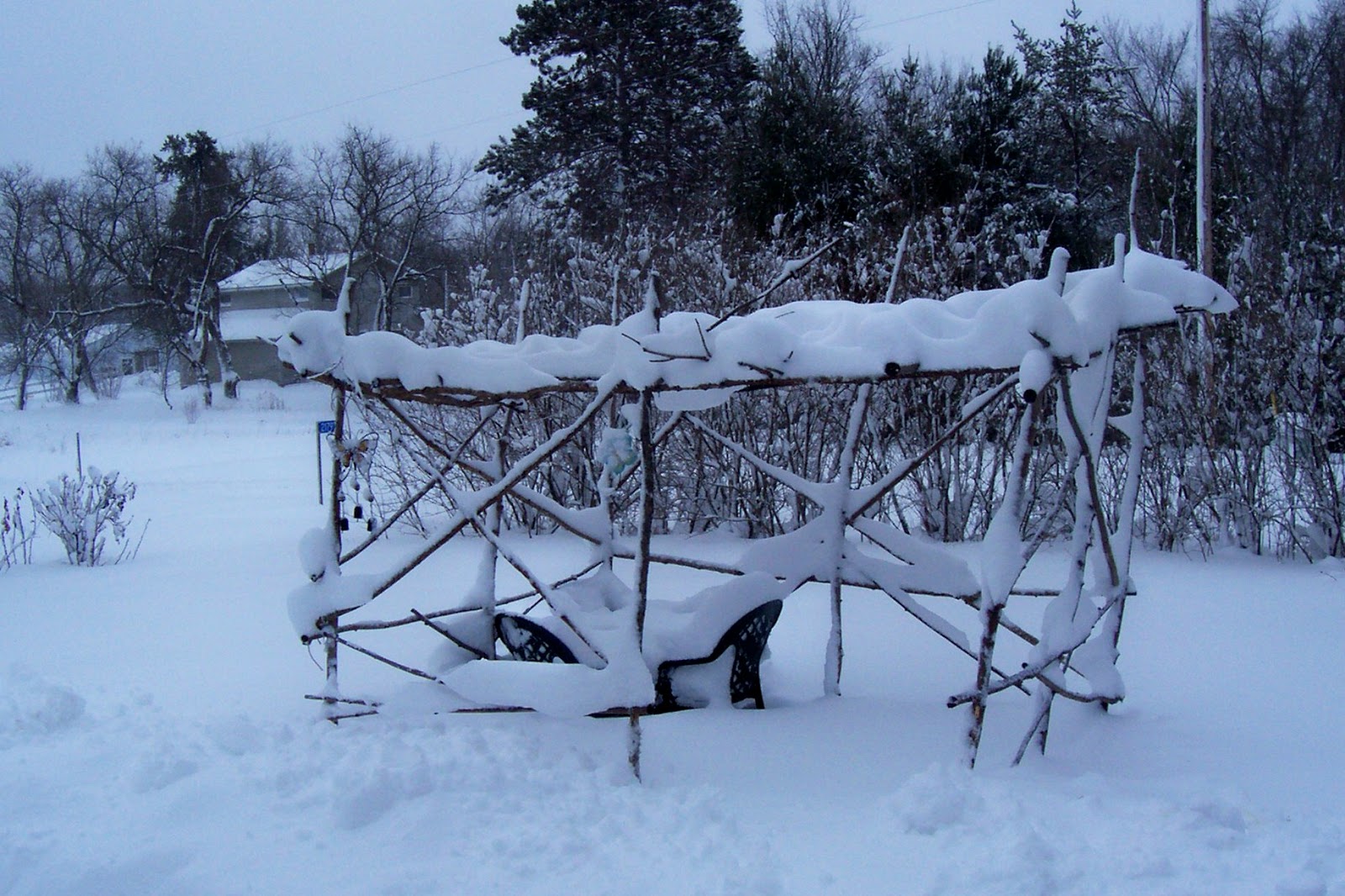
| Snow on top of my sukkah frame -- I hope it doesn't collapse it like it did a few years ago. |
The pipes to the shower are in a outside wall, so we are just about guaranteed to have days with no water there -- meaning you try the faucets in the morning and take showers when the water flows. This morning the shower was frozen but the sink was still running, so I washed up and did the dishes. Three hours later, there was no water, period. Hence the title of this post: Melt Snow, Carry Water.
![]() |
| The bird feeders have been busy -- this downy Woodpecker is a regular visitor. |
I am finding that it takes about 5 times the snow to make one unit of water. Luckily I have a lot of big pots and kettles from canning and pickling, so I fill these with snow, then haul them in on a sled. To save propane, I let the pots just sit at room temperature until I need some water. The snow packs down as it melts, making slush that I can put in a smaller pot to warm as needed. It's a lot of work, but we are surviving. Snow might shut down Washington D.C., but here in Minnesota we know how to deal with the white stuff. As the saying goes, what doesn't kill you makes you stronger.
![]() |
| Missy Cat has the right idea: Stay inside and find a sunny window! |
In spite of all the hassles, the snow can be beautiful, and offers some interesting photographic opportunities. Every other day we have been getting another inch or two, refreshing the landscape and adding to some interesting natural sculptures, like the "loaf of bread" below. I take my cell phone along when I go out there, though, and I tell my wife where I'm going and when I expect to be back. A fall or other mishap in this cold can be very dangerous.
That's all for now -- I've got to log off and go melt enough water to last me through the Sabbath (when we don't cook things) -- so stay warm, stay safe, and have faith: Spring WILL come! Shabbat Shalom!
![]() |
| That's not a giant loaf of bread -- just snow piled on top of my potting bench! |
Labels:
animals,
Minnesota,
photography,
rural life,
seasons,
snow,
storms,
sukkah,
Sukkot,
winter
Friday, April 19, 2013
Happy Spring in Minnesota -- Ha Ha Ha!
It's like a really late April Fool's Day joke -- one that doesn't seem very funny anymore. Just when buds were beginning to swell and I thought "Spring at last!" we get this -- knee-deep snow in my yard, with more on the way - and that was on top of the other storm we got last week! Minneapolis got 9 inches at the airport this time around, breaking the 1984 record for snowfall on that date and making this the 4th snowiest April on record in the metro area. St. Cloud, MN, officially got 12 inches, Duluth got 18. Hard to say what I got, because it is still drifting all over the place, but it is at least a foot deep in flatter areas.
Enough is enough -- I'm sick of shoveling snow!
The buds on this black maple are in my yard are beginning to swell. The wind was shaking the branches so hard, the picture came out a bit blurry, but you can clearly see the reddish buds through the coating of snow.
This kind of storm does produce some really nice shots, because it sticks to everything, creating a sort of fantasyland. Shoveling it, on the other hand, is another story. It is heavy and sticky, clogging up the snowblowers and creating a lot of business for local chiropractors. But since the snow is still blowing around and the plow has not been down our road yet, there's no point in clearing the driveway yet. We're going to just hunker down and get ready for the Sabbath this evening -- wishing everyone a Shabbat Shalom, Peace and blessings!
Enough is enough -- I'm sick of shoveling snow!
Here is a view of my chicken coop, taken from the back porch around 7:30 this morning (To see more detail in any of these shots, click the pic to enlarge):
Needless to say, the chickens and geese will not be going outside today. I'm not looking forward to slogging down there to feed them, either. This is a good day for everybody to stay cooped up inside. Since the plow has not come down my back road yet, and probably won't be here for a long while, I can't go anywhere anyway. This certainly is not the "1-4 inches" originally predicted!
Here's a picture of my sukkah frame in the front yard. (A sukkah is a special booth for a Jewish harvest festival.) A couple seasons ago, I left the covering and top of the sukkah up too long, and the snow collapsed the whole thing. (Read that story and see a pic). This time around, I was smart enough to remove everything down to the bare frame in the fall. All the snow you see on top is clinging to nothing but the 2-inch diameter support poles. Which just goes to show how very wet and sticky this stuff really is. If it melts off too fast, there could be flooding, although since we are on a hill, we are reasonably safe from that. But rivers are already rising in places like Iowa and Illinois, where this came down as rain.
My dog Jasmine was not too happy about the deep snow, either -- her disgust is very clear in this photo. No way we could go for a walk today -- I just put her out on the chain to do her stuff. She slogged out to her usual spot by the edge of the trees, then came right back in, to flop on her bed in the mud room.
My other big dog, Gypsy, stayed out longer, but she wasn't too thrilled with deep snow, either. She just pooped by the steps, barked in answer to the dogs down the road, then called it done. Sherlock, our mini-schnauzer, usually goes out the front sliding door off-leash, but today he refused until I cleared the snow off the porch and shoveled an area for him at the bottom of the steps. I can't blame him -- the snowdrifts are way over his head.
![]() |
| Willow tree at the edge of my dirt road. |
In spite of this late storm, there are still some visible signs of spring. One of the first we see around here is the greening of the bark on the willow trees -- which you can see here, in spite of the blowing snow swirling past it. While I was taking this picture I also saw pussy willows in bloom. Normally I'd be cutting some of those to bring inside as a spring bouquet, but today I was not about to slog down there into the ditch to get them -- especially since things were starting to melt before this storm, so it could be swampy under all that snow.
The buds on this black maple are in my yard are beginning to swell. The wind was shaking the branches so hard, the picture came out a bit blurry, but you can clearly see the reddish buds through the coating of snow. This kind of storm does produce some really nice shots, because it sticks to everything, creating a sort of fantasyland. Shoveling it, on the other hand, is another story. It is heavy and sticky, clogging up the snowblowers and creating a lot of business for local chiropractors. But since the snow is still blowing around and the plow has not been down our road yet, there's no point in clearing the driveway yet. We're going to just hunker down and get ready for the Sabbath this evening -- wishing everyone a Shabbat Shalom, Peace and blessings!
Labels:
Minnesota,
nature,
photography,
rural life,
snow,
spring,
storms,
sukkah,
Sukkot
Sunday, September 30, 2012
A Small Miracle: The Extra Lulav and Esrog
On the Festival of Sukkot (Feast of Booths), Jews not only put up the Sukkah (booth) to eat our meals in (about which I have written before) we also wave the Four Species -- palm, myrtle, willow and estrog (also spelled etrog) fruit -- in the six directions on each day of the holiday (more on the meaning of that later). Special sets of these are imported from Israel, and must be ordered in advance. And therein lies a tale that proves how God works in mysterious ways.
Because I live in a remote area of Minnesota, 75 miles from the nearest synagogue, the easiest way for me to get my lulav set is to order online. A guy named shmuly770 was selling them on eBay and since I also sell on eBay, I ordered from him. According to plan, the lulav should have arrived by UPS on or before Thursday, September 27, well in time for the holiday, which begins this year on Sunday night.
However, there was a problem with UPS being late, and on Thursday morning UPS tracking still showed the package as "in transit," with the last known station still out in California. Shmuly was worried that I would not get my set on time and not be able to do the mitzvah. Out of the goodness of his heart, he sent a second set by Priority Mail at his own expense -- without me even asking. (Such a mensch!) As it turned out, both sets arrived on time But here is WHY Shmuly had to send that extra set:
I volunteer at the federal prison just outside of Sandstone to visit Jewish inmates. Today I am scheduled to go there to put the shchach (natural plant materials) on the sukkah that is erected each year inside the compound, and be sure everything is kosher. (The sukkah walls can be put up by anybody, and at the prison this is done by a work crew, but the shchach must be put on by Jews. So I always go to personally supervise this.)
When I called the chaplain's office on Friday to be sure the sukkah was up and the greens were cut, he said yes, all that was ready, but their lulav set had not arrived yet. (It was also coming by UPS). If it came Saturday he would not be able to get it from the warehouse because it is not open on weekends. The chaplain himself was going to be gone Monday through Wednesday, which meant the soonest he could get it would be Thursday -- three days after the holiday started -- oy vey! (Apparently only the chaplain can retrieve packages for the chapel, for security reasons.) But YES, I could bring in and donate the extra set I "just happen" to have on hand now -- which I will do today! So this is why my first package was late, and why Shmuly had to send me an extra set! Such a great mitzvah!
Now for the meaning of the Four Species. Actually, there are several interpretations (as is often the case in Judaism), but I like this one best:
The Palm is tall and beautiful but has no scent. It represents the Jew who has scholarly learning, but is lacking in actually doing the mitzvot.
The Myrtle is a scrubby bush with a lovely scent. It represents the Jew who has very little Torah learning, but does many mitzvahs, acts of charity, and has compassion.
The Willow has no scent, but it is flexible. This is the Jew who has neither Torah learning nor is he (or she) observant, but has humility and bends before God like a willow.
The esrog fruit is both beautiful and has a lovely scent. It represents the Jew who has both Torah learning and mitzvot, but may be tempted to become proud and distance him/herself from the rest of the community.
In the ceremony, the first three species -- palm, myrtle, and willow -- are bound together and held in one hand, while the esrog is held separately in the other. Only when all four species are brought together, with the esrog touching the other three, do we have the ceremonial Four Species. In the same way, only when all the Jews, learned or not, observant or not, come together as one, do we have the complete Jewish community.
In addition, all four of these species grow near water, and on the first day of Sukkot we add the prayer for rain to the liturgy. The word "Hosannah" come from the Hebrew ho-sha-nah, meaning "save us now," and is taken from the Sukkot prayer for rain. In Israel, this is normally the beginning of the rainy season, and here in Minnesota we usually get fall rains also. However, we are in the middle of a severe drought right now and there has been no rain on my land for two months. Israel, too, is suffering from drought. So as I wave my lulav this year, I will indeed focus on rain for the land and water for all God's creatures who live upon it. (Strangely enough, rain often does come during Sukkot, no matter when it falls during the month.)
Because I live in a remote area of Minnesota, 75 miles from the nearest synagogue, the easiest way for me to get my lulav set is to order online. A guy named shmuly770 was selling them on eBay and since I also sell on eBay, I ordered from him. According to plan, the lulav should have arrived by UPS on or before Thursday, September 27, well in time for the holiday, which begins this year on Sunday night.
However, there was a problem with UPS being late, and on Thursday morning UPS tracking still showed the package as "in transit," with the last known station still out in California. Shmuly was worried that I would not get my set on time and not be able to do the mitzvah. Out of the goodness of his heart, he sent a second set by Priority Mail at his own expense -- without me even asking. (Such a mensch!) As it turned out, both sets arrived on time But here is WHY Shmuly had to send that extra set:
I volunteer at the federal prison just outside of Sandstone to visit Jewish inmates. Today I am scheduled to go there to put the shchach (natural plant materials) on the sukkah that is erected each year inside the compound, and be sure everything is kosher. (The sukkah walls can be put up by anybody, and at the prison this is done by a work crew, but the shchach must be put on by Jews. So I always go to personally supervise this.)
When I called the chaplain's office on Friday to be sure the sukkah was up and the greens were cut, he said yes, all that was ready, but their lulav set had not arrived yet. (It was also coming by UPS). If it came Saturday he would not be able to get it from the warehouse because it is not open on weekends. The chaplain himself was going to be gone Monday through Wednesday, which meant the soonest he could get it would be Thursday -- three days after the holiday started -- oy vey! (Apparently only the chaplain can retrieve packages for the chapel, for security reasons.) But YES, I could bring in and donate the extra set I "just happen" to have on hand now -- which I will do today! So this is why my first package was late, and why Shmuly had to send me an extra set! Such a great mitzvah!
Now for the meaning of the Four Species. Actually, there are several interpretations (as is often the case in Judaism), but I like this one best:
The Palm is tall and beautiful but has no scent. It represents the Jew who has scholarly learning, but is lacking in actually doing the mitzvot.
The Myrtle is a scrubby bush with a lovely scent. It represents the Jew who has very little Torah learning, but does many mitzvahs, acts of charity, and has compassion.
The Willow has no scent, but it is flexible. This is the Jew who has neither Torah learning nor is he (or she) observant, but has humility and bends before God like a willow.
The esrog fruit is both beautiful and has a lovely scent. It represents the Jew who has both Torah learning and mitzvot, but may be tempted to become proud and distance him/herself from the rest of the community.
In the ceremony, the first three species -- palm, myrtle, and willow -- are bound together and held in one hand, while the esrog is held separately in the other. Only when all four species are brought together, with the esrog touching the other three, do we have the ceremonial Four Species. In the same way, only when all the Jews, learned or not, observant or not, come together as one, do we have the complete Jewish community.
![]() |
| Raindrops photo by Linda F. Palmer Courtesy of Wikimedia Commons |
Labels:
God,
Jews,
Judaism,
lulav,
Minnesota,
rain,
rural life,
seasons,
spirituality,
sukkah,
Sukkot
Sunday, October 16, 2011
Building my own Sukkah from stuff in the woods
Last week I spent three days building my sukkah, the little booth that Jews erect for the Festival Sukkot. The sukkah has many meanings. First of all, it reminds us of the days of wandering in the wilderness with Moses. It also teaches us that this life is a journey through a world that is not permanent. And it is a celebration of the harvest, the time when we have gathered in our crops and can enjoy the fruits of our labors.
The basic requirements for building a sukkah are simple: It must have 3 walls, and the shchach (roof covering) must be made of natural materials cut from the earth. The sides can be made from anything handy, including the wall of an existing building if you build it against the house or other structure. However, the location must be open to the sky, not under a tree or other obstruction.
Nowadays you can buy prefab sukkah kits made out of plywood or various other materials in a variety of designs. However, these are rather pricey and way beyond our tight budget. Besides, my wife and I are getting a bit old to be hauling heavy plywood panels in and out of the shed each year. So, I called upon my old Boy Scout skills to lash together a framework of saplings that I cut from the woods on my own land.
I use nylon twine instead of the old sisal kind, because, although it is harder to tie permanent knots with, it does not rot or stretch, although some kinds will degrade in a couple years from exposure to sunlight. But for a sukkah it's fine. Through trial and error, I found that tying it off with a square knot, followed by three overhand knots up tight against the first knot, pretty much keeps the ends from untying.
This creates a rather permanent frame that I leave up after the holiday, making repairs each year as needed. However, last winter the snow was so unusually heavy, it collapsed the whole thing (read that story), so I had to start over from scratch. But I can't really complain, because the old sukkah frame had lasted over 10 years. Still, it is a lot of work to drag all those new poles in from the woods. Not to mention finding appropriate trees in the first place.
Luckily, I had a bit of help from a road maintenance crew. About two weeks before I began my sukkah-building project, they came through and cut down a bunch of trees and brush along our road for fire control. This gave me a set of nice straight maple poles -- all the verticals in the new sukkah frame are made from this free material. I also got a good supply of white pine branches from trees they trimmed that were overhanging the road. That, plus prunings from my own white pine that had bent down too low to mow under, gave me enough shchach to cover the sukkah. Not only was this economical, it was also ecological, because I used materials that would otherwise have gone to waste. Reduce, Reuse, Recycle!
Here is what the sukkah looked like after I got the basic framework up. Four cinder blocks help to anchor it in place. It still needs some more diagonal braces, which I installed after this picture was taken. (I used a flash at early dawn, to show up the frame better against the trees in the background.)
![]() |
| White pine for shchach -- courtesy of road maintenance! |
Nowadays you can buy prefab sukkah kits made out of plywood or various other materials in a variety of designs. However, these are rather pricey and way beyond our tight budget. Besides, my wife and I are getting a bit old to be hauling heavy plywood panels in and out of the shed each year. So, I called upon my old Boy Scout skills to lash together a framework of saplings that I cut from the woods on my own land.
I use nylon twine instead of the old sisal kind, because, although it is harder to tie permanent knots with, it does not rot or stretch, although some kinds will degrade in a couple years from exposure to sunlight. But for a sukkah it's fine. Through trial and error, I found that tying it off with a square knot, followed by three overhand knots up tight against the first knot, pretty much keeps the ends from untying.
This creates a rather permanent frame that I leave up after the holiday, making repairs each year as needed. However, last winter the snow was so unusually heavy, it collapsed the whole thing (read that story), so I had to start over from scratch. But I can't really complain, because the old sukkah frame had lasted over 10 years. Still, it is a lot of work to drag all those new poles in from the woods. Not to mention finding appropriate trees in the first place.
![]() |
| Andy Cat, one of my "helpful" construction workers who loves string! |
Here is what the sukkah looked like after I got the basic framework up. Four cinder blocks help to anchor it in place. It still needs some more diagonal braces, which I installed after this picture was taken. (I used a flash at early dawn, to show up the frame better against the trees in the background.)
Covering the sukkah was a challenge this year, because most of the old sheets and bedspreads I used before were either torn or moldy. My wife is very allergic to mold, so I had to throw most of it out and start over. Because Rosh HaShanah had come back-to-back with the Sabbath, and Yom Kippur was on the Sabbath itself this year, I could not take advantage of all those Friday garage sales to find more used cloth. Not to worry -- I did have a lot of feed sacks and some clear plastic on hand, so I used those instead. To keep the wind from tearing these rather fragile materials off the frame, I put a strip of corrugated cardboard over the plastic where I was stapling to the wood. That reinforced it very well. The cardboard, of course, came from old boxes I got at the grocery.
Here is how the sukkah turned out. The outside table has a bucket of water for the ritual handwashing, and there is room for more chairs around the card table if needed. The side table is very handy for setting dishes aside. Both of the low gray tables, by the way, are ones we already had for flea market sales, A fourth wall could be added in front, perhaps by hanging a blanket, but that would have prevented me photographing the inside for this blog post. Besides, we enjoy looking out at the scenery.
Definitely primitive, but functional. And much closer to what Moses actually used. He certainly didn't have any plywood on hand. Then again, he didn't have any plastic, either. (He probably used animal skins.) But still, this sukkah did well to evoke the story of wandering in the wilderness. Spiritually, what I got from this whole project is that we are to bloom where we are planted, and that God will provide for us, be we must also be creative in using what is available. "Who is rich? He who is satisfied with his portion!" (Talmud, Pirkei Avot.) And by the way: The whole thing only cost me about $15 out of pocket, for the nylon twine and some staples. Thoreau would have been so proud!
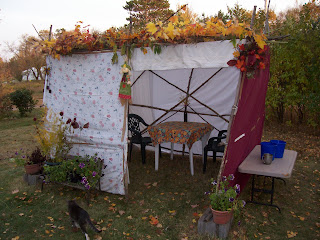
(UPDATE 2012: This year, the sukkah got an upgrade: I was able to find enough old sheets at the thrift store to cover it with cloth instead of old feed sacks. Since we took "salvage" quality rejects, we got enough for the whole sukkah for $5. The schach this year is tall grass and goldrenrod stalks. My wife added the "woman's touch" with some fall-themed decorations. It was also her idea to use the flowered sheet for the front -- making it nice and homey-looking. And BTW, although the frame now leans a bit where it has settled in since last year, it is still good and sturdy, although I did add a few more diagonal braces.)
![]() |
| The sukkah upgraded in 2012 |
Here's a picture from 2019. When we put in a ramp a couple years ago, we had to move the sukkah. The only place near the house not shaded by a tree was farther away, so we set up a row of solar garden lights leading to it, and a solar spotlight inside. Also got a better folding table.
![]() |
| Revised version with solar lights |
Tuesday, January 11, 2011
The snow collapsed my old sukkah frame
The snow is coming down again -- the brunt of the storm is way south of us, but so far another inch or so has piled onto what we already have. The frame of my sukkah (booth for the Festival of Sukkot) finally collapsed under the weight of the snow. Oh well, it's supposed to be a temporary shelter anyway, so I'll just have to build a new one next year. (Story continues below photo).
For those of my readers who are not familiar with the Festival of Sukkot, you might know it as the "Feast of Tabernacles" in the Bible, although the English word "tabernacle" calls to mind a fancy church building, whereas, a sukkah is a primitive booth that we Jews erect in the fall for a harvest festival. In fact, there are two completely different Hebrew words often translated "tabernacle": mishkan, which refers to the portable sanctuary that the Jews had while traveling with Moses in the wilderness, and sukkah, the harvest booth we are tallking about here. As you can see, a sukkah is a far cry from the Mormon Tabernacle!
My urban Jewish brethren usually make their sukkahs out of plywood or other commercially-made materials. Many buy rather expensive prefab versions, then store them away in the garage after the holiday. I could never afford to do that. When I lived in the city, I used to make mine out of whatever materials I could scrounge, because it doesn't really matter what the sides are made of. One of my more memorable sukkahs was made of old refrigerator packing crates that I found behind the appliance store. Reduce, reuse, recycle! Nowadays, living here in the country, I prefer to use my campcraft skills and lash the framework together from saplings that I cut myself in the woods, then cover the sides with old sheets or blankets. I think this is much closer to what our ancestors probably used. And it's also a whole lot more economical.
Lashing the framework makes it a somewhat permanent structure that I don't take down after the holiday. I used to remove the cloth sides and the pine branches on top, but then I noticed that my cats were sheltering in it while they waited to come in the house on windy winter days, the squirrels sometimes climbed on it, and birds were often hopping around on the top. I enjoyed watching this animal activity, so for the past few years I have left it up all winter, then removed the coverings in spring and made any necessary repairs to the framework.
There will probably be Haredi Jews who read this blog and be horrified that I let animals come in the sukkah, because it is supposed to be holy -- but really, it is only a "sukkah" during the festival itself. And what makes it a sukkah is the natural plant materials (called schkach) on top, which I replace fresh every year right before the festival. I see no problem with it being a multi-purpose structure other times of the year. In summer, I have sometimes hung flower planters from it. (No bird feeders, though, since we have roaming barn cats. Most of what my cats catch are rodents from around the chicken coop, which is very helpful, but there is no point in setting up bird bait for them.)
The Torah tells us that Jacob "journeyed to Sukkot and built himself a house, and for his livestock he made shelters; he therefore named the place Sukkot (Booths)." (Genesis 33:17). This is the first mention in the Bible of anybody making shelters for their animals (aside from Noah's Ark, of course!) -- and those shelters were probably something like my primitive sukkah. Which is why he named the place Sukkot. So I feel that by letting the animals use it after I'm done with it, I am much closer to how our ancestors lived.
At any rate, come spring, I will have to completely re-do my sukkah frame, after using the old wood to boil down my annual batch of maple syrup. I need to remove some green ash saplings that are taking over the meadow area where the milkweed grows for the monarch butterflies, so this will be a good time to do it. I look forward to that, because it will mean some very pleasant days outdoors, cutting the poles and listening to the various sounds of the forest. There will be grouse drumming, pheasants and other birds calling, geese flying overhead, and woodpeckers chipping holes in the dead trees that I purposely leave up for them. But right now, we have the silence of winter -- and that's beautiful, too.
Subscribe to:
Posts (Atom)

.jpg)