When I went outside this morning, the sun was out and the yard was full of birdsong. I heard blue jays, robins, juncos, starlings, finches, pheasants, a drumming grouse and some geese overhead. I also spotted a thrush in the bushes. And best of all, the phoebe who nests in the open garage each year is back! So glad they all survived the storm.
Of course, I'm not 100% sure the phoebe is the same bird -- maybe a descendant? -- but we have had phoebes nesting in the rafters of that building for years. We've also had them nesting under the eaves of the chicken coop -- a good choice of location, since there are always lots of flies around there. In 2009 I was lucky enough to get this picture of the coop family, which I made into a postcard:
I called it "Phoebe Fledglings Ready to Fly" -- and they certainly were. The next day they were gone. (You can buy a copy of this postcard online in my eBay store, The Happy Rooster.)
Now it's warming up into the 70s this weekend (it's 61 as I wrote this) and the snow is melting off fast. A walk around the yard showed me bulbs starting to pop up and buds swelling. I better get out the hummingbird feeders, because those little jewels will be arriving soon, too. Since the flowers are very late this year, they will be hungry!
Musings, insights, stories and nature observations from a Hasidic Jew living in the Great North Woods.
(And respectfully seeking to help my fellow Jews recover from "Nature Deficit Disorder.")
Showing posts with label spring. Show all posts
Friday, April 26, 2013
Friday, April 19, 2013
Happy Spring in Minnesota -- Ha Ha Ha!
It's like a really late April Fool's Day joke -- one that doesn't seem very funny anymore. Just when buds were beginning to swell and I thought "Spring at last!" we get this -- knee-deep snow in my yard, with more on the way - and that was on top of the other storm we got last week! Minneapolis got 9 inches at the airport this time around, breaking the 1984 record for snowfall on that date and making this the 4th snowiest April on record in the metro area. St. Cloud, MN, officially got 12 inches, Duluth got 18. Hard to say what I got, because it is still drifting all over the place, but it is at least a foot deep in flatter areas.
Enough is enough -- I'm sick of shoveling snow!
The buds on this black maple are in my yard are beginning to swell. The wind was shaking the branches so hard, the picture came out a bit blurry, but you can clearly see the reddish buds through the coating of snow.
This kind of storm does produce some really nice shots, because it sticks to everything, creating a sort of fantasyland. Shoveling it, on the other hand, is another story. It is heavy and sticky, clogging up the snowblowers and creating a lot of business for local chiropractors. But since the snow is still blowing around and the plow has not been down our road yet, there's no point in clearing the driveway yet. We're going to just hunker down and get ready for the Sabbath this evening -- wishing everyone a Shabbat Shalom, Peace and blessings!
Enough is enough -- I'm sick of shoveling snow!
Here is a view of my chicken coop, taken from the back porch around 7:30 this morning (To see more detail in any of these shots, click the pic to enlarge):
Needless to say, the chickens and geese will not be going outside today. I'm not looking forward to slogging down there to feed them, either. This is a good day for everybody to stay cooped up inside. Since the plow has not come down my back road yet, and probably won't be here for a long while, I can't go anywhere anyway. This certainly is not the "1-4 inches" originally predicted!
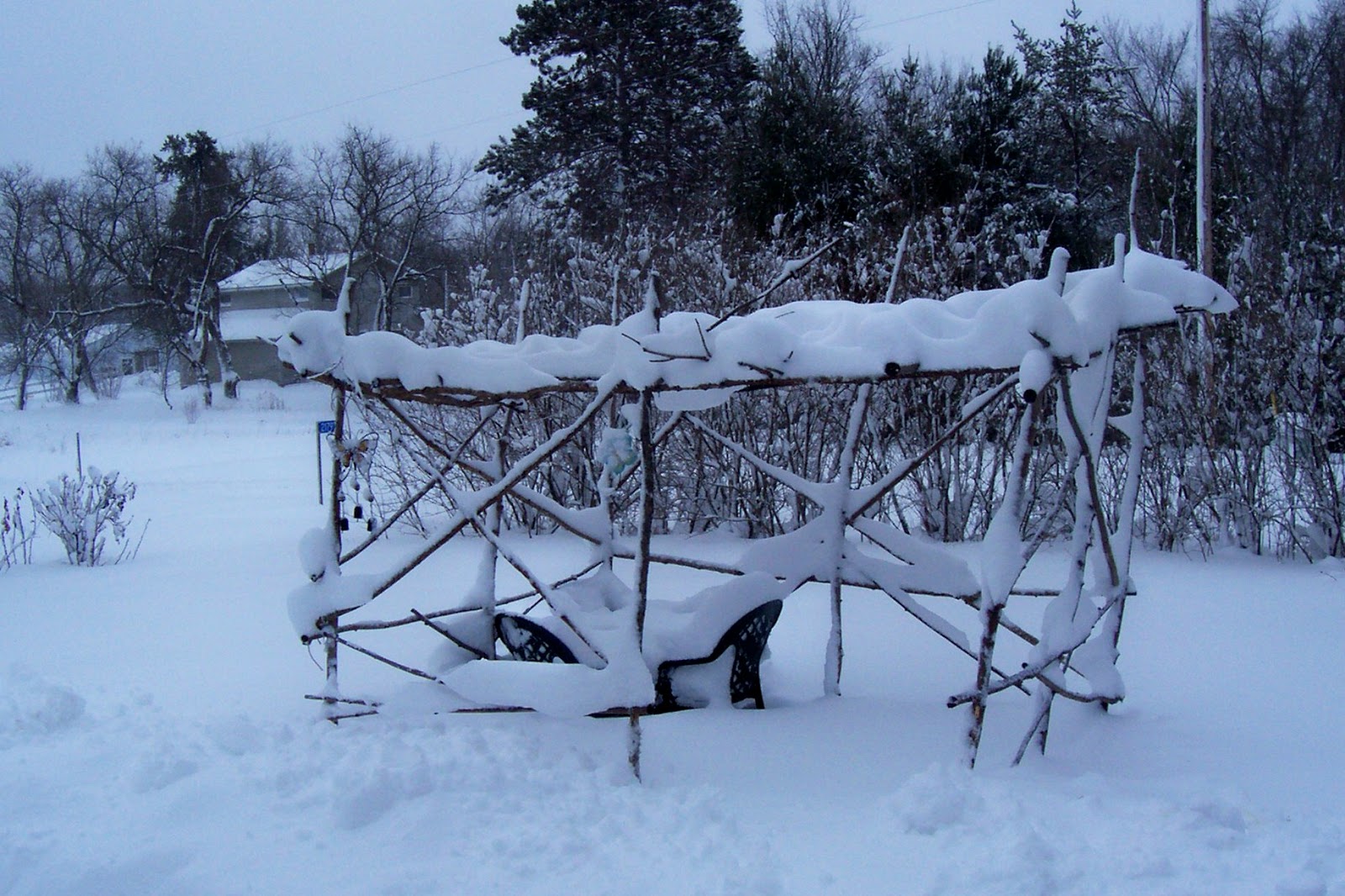
Here's a picture of my sukkah frame in the front yard. (A sukkah is a special booth for a Jewish harvest festival.) A couple seasons ago, I left the covering and top of the sukkah up too long, and the snow collapsed the whole thing. (Read that story and see a pic). This time around, I was smart enough to remove everything down to the bare frame in the fall. All the snow you see on top is clinging to nothing but the 2-inch diameter support poles. Which just goes to show how very wet and sticky this stuff really is. If it melts off too fast, there could be flooding, although since we are on a hill, we are reasonably safe from that. But rivers are already rising in places like Iowa and Illinois, where this came down as rain.
My dog Jasmine was not too happy about the deep snow, either -- her disgust is very clear in this photo. No way we could go for a walk today -- I just put her out on the chain to do her stuff. She slogged out to her usual spot by the edge of the trees, then came right back in, to flop on her bed in the mud room.
My other big dog, Gypsy, stayed out longer, but she wasn't too thrilled with deep snow, either. She just pooped by the steps, barked in answer to the dogs down the road, then called it done. Sherlock, our mini-schnauzer, usually goes out the front sliding door off-leash, but today he refused until I cleared the snow off the porch and shoveled an area for him at the bottom of the steps. I can't blame him -- the snowdrifts are way over his head.
![]() |
| Willow tree at the edge of my dirt road. |
In spite of this late storm, there are still some visible signs of spring. One of the first we see around here is the greening of the bark on the willow trees -- which you can see here, in spite of the blowing snow swirling past it. While I was taking this picture I also saw pussy willows in bloom. Normally I'd be cutting some of those to bring inside as a spring bouquet, but today I was not about to slog down there into the ditch to get them -- especially since things were starting to melt before this storm, so it could be swampy under all that snow.
The buds on this black maple are in my yard are beginning to swell. The wind was shaking the branches so hard, the picture came out a bit blurry, but you can clearly see the reddish buds through the coating of snow. This kind of storm does produce some really nice shots, because it sticks to everything, creating a sort of fantasyland. Shoveling it, on the other hand, is another story. It is heavy and sticky, clogging up the snowblowers and creating a lot of business for local chiropractors. But since the snow is still blowing around and the plow has not been down our road yet, there's no point in clearing the driveway yet. We're going to just hunker down and get ready for the Sabbath this evening -- wishing everyone a Shabbat Shalom, Peace and blessings!
Labels:
Minnesota,
nature,
photography,
rural life,
snow,
spring,
storms,
sukkah,
Sukkot
Thursday, April 11, 2013
Robins are back - I hope they survive this late winter storm
Three days ago I was listening to robins singing in my yard, watching a flock of juncos passing through on their way to Canada, and hearing flocks of geese overhead, honking their way back north. Today we are getting buried in snow again -- at the same time Washington D.C. is having record breaking 90s -- in April! Talk about global weirding.
The instability of the Jet Stream is a big contributor to all this strange weather. I can remember when it pretty much stayed put up in there Canada, circling the arctic and dipping occasionally into Minnesota but no further south. Now, as you can see from this map, it has gone crazy. And with it comes all this weird weather. That huge dip is pulling cold air south, where it meets warm air from the Gulf and produces severe storms, including early tornadoes along the front. It also traps warm air on the East Coast, resulting in those record-breaking 90s yesterday. (For more on how the Jet Stream is causing more severe weather lately, read this article on Climate Central.)
Meanwhile, birds on migration are getting caught in the storms. The winds have been very strong today, so I suspect we will have a major bird drop around here (which is different from a bird dropping!) A bird drop is when migrating birds come down to wait out the bad weather. Sometimes you get to see some unusual species when the weather clears -- if the birds survive.
I find myself wondering what those robins on my land are eating today. The Juncos can find seeds on tall grass stalks and the harrier hawk who returned a few days ago will no doubt find a rodent or two around the chicken coop. But the ground is still too frozen for those robins to find any worms. In the past I have seen them picking on frozen crab apples still on the trees. So maybe that will help.
In spite of this snowstorm, we are still in the midst of a serious drought here. Today's drought map shows my county, Pine, in the "severe" category. (For more on the drought, click here.)
Last year it was so dry in late summer-fall that we headed into winter about 7 inches below normal in precipitation. With the ground still frozen, all that this snow will do is run off -- which helps the wetlands downhill from my place, but won't do much for the garden. In fact, it is so dry that, for the second year in a row, I decided not to tap my trees for maple syrup. They grow along the edge of seasonal woodland wetlands that normally provides them with plenty of spring moisture during the melt-off, but this year it is bone dry. I saw on the news that some syrup producers are getting a decent run -- guess it depends on where you are. But for everybody it is very late, because of the abnormally cold spring. In the past, syrup production would begin in mid-March and be over by now.
All of which goes to show that the climate is indeed changing. Better get used to the new normal -- whatever that turns out to be...
![]() |
| Jet Stream, April 11, 2013 (Map courtesy of acuweather.com) |
![]() |
| Last year's crab apples provide food for spring birds |
I find myself wondering what those robins on my land are eating today. The Juncos can find seeds on tall grass stalks and the harrier hawk who returned a few days ago will no doubt find a rodent or two around the chicken coop. But the ground is still too frozen for those robins to find any worms. In the past I have seen them picking on frozen crab apples still on the trees. So maybe that will help.
![]() |
| Minnesota drought map 4/11/2013 (Click pic to enlarge) |
Last year it was so dry in late summer-fall that we headed into winter about 7 inches below normal in precipitation. With the ground still frozen, all that this snow will do is run off -- which helps the wetlands downhill from my place, but won't do much for the garden. In fact, it is so dry that, for the second year in a row, I decided not to tap my trees for maple syrup. They grow along the edge of seasonal woodland wetlands that normally provides them with plenty of spring moisture during the melt-off, but this year it is bone dry. I saw on the news that some syrup producers are getting a decent run -- guess it depends on where you are. But for everybody it is very late, because of the abnormally cold spring. In the past, syrup production would begin in mid-March and be over by now.
All of which goes to show that the climate is indeed changing. Better get used to the new normal -- whatever that turns out to be...
Wednesday, March 20, 2013
Baby Chicks are not Easter Toys!
Or Passover toys. Both Easter and Passover are spring festivals (In the Northern Hemisphere at least). Jews are not as strongly focused on chicks and bunnies this time of year, so I suppose this post is directed more at my non-Jewish readers, but my plea to both is the same: Please don't buy baby animals that you can't keep for their entire lifetime. It's not fair to your kids, and not fair to the animals.
Those cute fuzzy chicks are going to grow up -- very quickly -- into full-sized chickens, most likely roosters, because the hatcheries keep the more valuable females for the egg trade. In addition, you really can't keep just one chick, because these are flock birds who do not thrive in solitude. That sharp, incessant peeping of a lone chick is a signal of extreme loneliness and distress. He is calling for help from his flock mates -- who aren't there.
Chicks hatching under a mother hen bond with her and their nest mates even before hatching. The hen clucks softly to her eggs, and the chicks begin peeping softly to each other from inside their eggs -- a very different sound than the distress call. By the time the hatch is over, they are already a bonded family unit. Incubator chicks can't bond with a machine, but they probably do bond with each other.
Separation from the flock is very traumatic. So is being kept under bright lights in a pet shop, because normally the chicks would periodically take shelter in the warmth and darkness under their mother's wings. Being exposed to bright light and strange people all day long is like being out in the open and constantly threatened by a predator, with no place to hide.
A minimum of three chickens is needed for a happy flock. Unless you live on a farm, just what are you going to do with three roosters? Every year, animal shelters are inundated with unwanted chickens and ducks after the holiday, birds that have grown too big and too noisy for urban backyards. These birds are very hard to re-home, because most people don't want a crowing rooster anymore than you and your neighbors do.
Even worse, some people release them into the wild, mistakenly thinking they will get along just fine. They might for a while -- but when winter comes, they will freeze to death, because domestic ducks cannot fly south like their wild cousins, and chickens are jungle birds, not well adapted to snow like pheasants or grouse. A number of years ago I rescued two half-grown chicks that somebody had dumped at a freeway rest stop. (Read that story) And I found my white gander, Prince, waddling down our country dirt road. He is still with us at the age of 13 and may live to be 30. None of these birds would have survived in the wild.
There is also a very real danger that children can accidentally kill a baby chick or duckling simply by holding it wrong. Birds do not breathe the same way we do. They have no diaphragm. Instead, they must rely on the expansion and contraction of their little chests to breathe. If you hold a chick too tightly -- as children often do -- he can smother in minutes. Unfortunately, this happens more often than we want to hear about. There is nothing more traumatic than having a child's pet die in her hands.
The bottom line is: Jewish law says that you should not acquire any animal unless you can feed and care for it properly. As readers of my blog know, I myself have chickens, and I am not against keeping them, if you can properly care for them for their full lifespans -- which is an average of 8 to 10 years. If not, then it is better to buy your kids a plush toy.
![]() |
| Day-old incubator chicks (Photo courtesy of USDA) |
Chicks hatching under a mother hen bond with her and their nest mates even before hatching. The hen clucks softly to her eggs, and the chicks begin peeping softly to each other from inside their eggs -- a very different sound than the distress call. By the time the hatch is over, they are already a bonded family unit. Incubator chicks can't bond with a machine, but they probably do bond with each other.
![]() |
| A mother hen sitting on her nest in my backyard. The pale yellow spot by her breast is a new chick. (click photo to enlarge) |
A minimum of three chickens is needed for a happy flock. Unless you live on a farm, just what are you going to do with three roosters? Every year, animal shelters are inundated with unwanted chickens and ducks after the holiday, birds that have grown too big and too noisy for urban backyards. These birds are very hard to re-home, because most people don't want a crowing rooster anymore than you and your neighbors do.
![]() |
| This little chick was hatched by the hen above, and grew up knowing his mother |
There is also a very real danger that children can accidentally kill a baby chick or duckling simply by holding it wrong. Birds do not breathe the same way we do. They have no diaphragm. Instead, they must rely on the expansion and contraction of their little chests to breathe. If you hold a chick too tightly -- as children often do -- he can smother in minutes. Unfortunately, this happens more often than we want to hear about. There is nothing more traumatic than having a child's pet die in her hands.
The bottom line is: Jewish law says that you should not acquire any animal unless you can feed and care for it properly. As readers of my blog know, I myself have chickens, and I am not against keeping them, if you can properly care for them for their full lifespans -- which is an average of 8 to 10 years. If not, then it is better to buy your kids a plush toy.
Tuesday, February 26, 2013
Are eagles nesting too early this year?
This is a still shot from the Minnesota DNR EagleCam, which is focused on a nest in Minneapolis. As you can see, there is already an eagle incubating eggs -- according to the website, there are 3 of them, laid around January 1st. You can also see that the nest was full of snow, which the eagles have covered with straw.
Given that the incubation period for a Bald Eagle is about 35 days, these eggs are long overdue to hatch -- if they ever do. January is awfully early for nesting here in Minnesota -- even now the lakes are still frozen, so it would be hard for eagles to catch fish (one of their favorite foods). They do eat carrion -- I have seen them on deer carcasses -- but would the chicks do OK on that? And what about getting chilled? Since those eggs were laid, it has gone below zero several times. I'll be watching this nest to see what happens.
Eagles are not the only birds who might be mixed up by the crazy weather this year. There was a pair of mourning doves that apparently never migrated from here because of the long, snowless, unusually warm fall. Then it went to 20 below zero (F) one night and stayed below zero for several days. I have not seen the doves since. Did they freeze to death? And today I could swear I heard a robin -- no worms for it to eat yet. Maybe it will survive on frozen crab apples still on the trees.
If climate change deniers would pay more attention to nature, it would become obvious that something is happening. A friend of mine in Pennsylvania said she has had pigeons breeding all winter, when normally they stop until spring. I read recently that birds in Europe are arriving 2-3 weeks early, long before the insects that they normally feed on have emerged. This certainly messes up the breeding season, since those birds evolved to feed their young on insects.
Back here in Minnesota, we are getting a wildly fluctuating freeze-thaw-freeze-thaw, while most of our snow is going south. In spite of the fact that there's about a foot of the stuff in my yard, we are still technically in a drought, because there was so little rain last fall that the ground under that snow is very dry. And frozen, so when the snow does melt, it is just going to run off. According to the weatherman, this leaves us with the strange possibility of having drought and flooding at the same time.
Friday, May 25, 2012
On singing frogs and the Revelation at Sinai
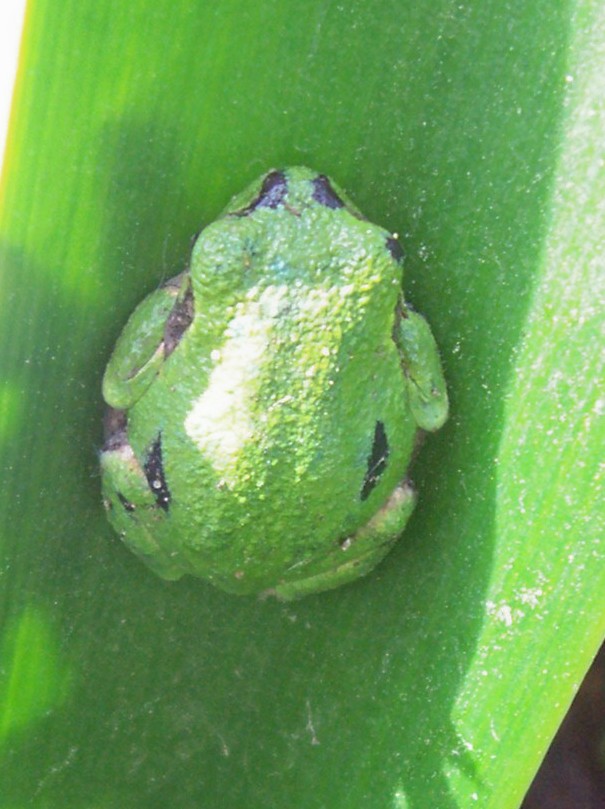
Can you find the frog in this picture?
![]() |
| Click photo to enlarge |
In addition to hopping into in my garden, frogs also appear in Jewish folklore. There is a story in Perek Shirah, the classical Jewish text about how everything is praising God, which goes like this:
The Sages said concerning King David that when he completed the Psalms, he became proud. He said before the Holy One, Blessed be He, "Is there any creature You have created in Your World that says more songs and praises than I?"
At that moment, a frog happened across David's path, and it said to him, "David! Do not become proud, for I recite more songs and praises than you do. Furthermore, every song I say contains three thousand parables, as it says, 'And he spoke three thousand parables, and his songs were one thousand and five' (I Kings 5:12)."
It must have been very humbling for David, the Sweet Singer of Psalms, to be outclassed by a frog. But anyone who has ever heard a spring chorus of singing frogs can see that this is true. David certainly did not sing constantly all night, every night, like the frogs do!
On the other hand, when the Torah was given at Mt. Sinai, the Midrash (Exodus Rabba 24:9) tells us, there was absolute silence:
Rabbi Abbahu said in the name of Rabbi Yochanan: When the Holy One, Blessed be He, gave the Torah, not a bird cried out, not a fowl flew, not an ox bellowed, the angels did not fly, the seraphim did not say Holy, Holy, Holy, the sea did not stir, the human creatures did not speak, but the world was still and silent. Then the Voice went forth: "I am the Lord Thy God" (Exodus 20:2)
The purpose of this silence was so that the people gathered at the foot of Sinai would not mistake some animal sound for the Voice of God and be misled into worshipping nature. We need only look at the plethora of animal gods that have been worshipped throughout history to see how easy this is to do. Animals are wonderful creations, as are plants, rocks, oceans and deserts -- but they are not deities to be worshipped. The One God of Sinai is beyond all physical forms, all earthly sounds -- and only in silence can you really hear God's Voice.
This is why, when Elijah went to the cave to meditate (I Kings 19:11-13), he learned that God is not in the wind, or the earthquake, or the fire. These are powerful natural phenomena, they can inspire awe or terror -- in fact, most of our natural disasters come, in one way or another, from earth, wind, or fire. But they are not the voices of gods. The true God speaks to our hearts and minds from the Primal Silence.
Labels:
animals,
frogs,
God,
Judaism,
King David,
midrash,
Minnesota,
nature,
perek shirah,
rain,
Shavuot,
silence,
Sinai,
spirituality,
spring
Tuesday, March 20, 2012
2012 heat wave: Spring has never been so early here!
Lately the news has been full of photos of cherry blossoms and daffodils blooming a month early in places like Washington, DC. Here in Pine County, Minnesota, things are not that far along yet, but signs of spring are still unseasonably early.
On the right you see a bouquet of budding twigs that include (from left to right) forsythia, false spirea, pussy willows and black maple. For many years it has been our custom to cut a bouquet like this for Passover, then watch as the buds slowly open during the eight days of the festival. Well, this year we are going to have to do something different, because Passover is still almost three weeks away and buds are swelling now.
Nor are budding trees the only early signs of spring. The Canada geese are back, along with robins, starlings, red-wing blackbirds, song sparrows, juncos, mourning doves, and the phoebe who nests in the rafters of our shed each year. Pheasants are calling, grouse are drumming, and last night -- believe it or not -- I heard spring peeper frogs and the ones we call "clacking frogs" calling in the marsh across the road. This is the absolute earliest that any of this has happened here as far as I can remember.
Those swelling maple buds meant that I didn't get any maple syrup. Normally you start tapping the trees when the days are around 40 degrees and the nights are still below freezing. But when the temperature soars into the high 70s like it has done this March (smashing local records for days in a row), the nights stay warm, the trees bud out, and the sap flow stops. Everybody I've talked to around here says the same thing: Their maple trees dried up overnight. I never even bothered to tap mine. Which is probably just as well, because we are also in a drought. All of our snow seems to have moved way down south. Arizona is getting buried, while Minnesota stays high and dry. We only got one decent snowstorm here all winter, and within days it had melted away. Yesterday we got a nice steady rain, which was a good thing, because with all that dried grass around, not to mention some very early lightning storms, the fire danger was extremely high.
All of which adds up to one thing: Climate change is real, and it is here.
On the right you see a bouquet of budding twigs that include (from left to right) forsythia, false spirea, pussy willows and black maple. For many years it has been our custom to cut a bouquet like this for Passover, then watch as the buds slowly open during the eight days of the festival. Well, this year we are going to have to do something different, because Passover is still almost three weeks away and buds are swelling now.
Nor are budding trees the only early signs of spring. The Canada geese are back, along with robins, starlings, red-wing blackbirds, song sparrows, juncos, mourning doves, and the phoebe who nests in the rafters of our shed each year. Pheasants are calling, grouse are drumming, and last night -- believe it or not -- I heard spring peeper frogs and the ones we call "clacking frogs" calling in the marsh across the road. This is the absolute earliest that any of this has happened here as far as I can remember.
Those swelling maple buds meant that I didn't get any maple syrup. Normally you start tapping the trees when the days are around 40 degrees and the nights are still below freezing. But when the temperature soars into the high 70s like it has done this March (smashing local records for days in a row), the nights stay warm, the trees bud out, and the sap flow stops. Everybody I've talked to around here says the same thing: Their maple trees dried up overnight. I never even bothered to tap mine. Which is probably just as well, because we are also in a drought. All of our snow seems to have moved way down south. Arizona is getting buried, while Minnesota stays high and dry. We only got one decent snowstorm here all winter, and within days it had melted away. Yesterday we got a nice steady rain, which was a good thing, because with all that dried grass around, not to mention some very early lightning storms, the fire danger was extremely high.
All of which adds up to one thing: Climate change is real, and it is here.
Friday, April 15, 2011
Spring is here, cleaning for Passover, birds are back!
I haven't had much time to write on my blog lately -- between making maple syrup, cleaning out the chicken coop, and cleaning the house for Passover, I haven't been online much in the past couple weeks. So this is just a quick note to let all my readers know I'm fine, and very much enjoying the return of the birds. The bird migration north is in full swing. The phoebes that nest on my land (one in the open garage and the other under the eaves of the chicken coop) are back. Of course, I have no way to know if they are the exact same birds that nested here last year, but we have had phoebe nests in the same areas for about 5 years now, so it is either them or their descendants.
This is a photo I took of the young birds in a phoebe nest in 2009 -- they fledged the next day. I liked it so much, I made it up as a souvenir postcard (you can still buy a copy in my ebay store, The Happy Rooster):
The Canada geese are back in droves, and I've seen Sandhill Cranes flying over several times now. Monday on the way to Hinckley, my wife and I saw two pair of Snow Geese standing in two different flooded fields -- an unusual sight, we usually see them flying over on their way to Canada but rarely on the ground. But Sunday night it was very windy so I supsect we had a bird drop (which is different from a bird dropping) because overnight there were suddenly lots of migrating birds in the trees and bushes. On the same day, the pond across the street was full of ducks, and I also heard them back in our seasonal woodland wetlands area, where it floods every spring. All waiting out the high winds, I guess.
Plus there are robins, flocks of Juncos, and song sparrows, pheasants calling, grouse drumming. I also saw a red-tailed hawk and a pair of Bald Eagles. And the pair of starlings that nests in a hole in the eaves every year is back. I keep meaning to get up there and plug it up, but I'm a bit old for climbing second-story ladders now. Starlings are not really a big problem here, this is the only pair we ever see and I enjoy enjoy seeing them sitting on the power lines and flying back and forth to feed their young. When I do get the eaves fixed, I plan to put a birdhouse for them up there. Otherwise, they might go compete with the Bluebirds or Tree Swallows.
Starlings, you have probably heard, were purposely released in the USA by a guy who wanted to introduce all the birds mentioned in Shakespeare's plays. There's a chapter about this in a new book, "How Shakespeare Changed Everything," due out on May 10. (I got an advance review copy. Since I'm not a Shakespeare expert, I found it very informative -- basically a good book with odd facts to get teenagers or newbies interested in the classics.) The starling release has over-succeeded. In many place they are serious pests. But up here in the North Woods, they are just another species returning for spring.
Crocuses are blooming, the daffodils are coming up, and the frogs are out, too -- across the road is a marsh where the Spring Peepers are almost deafening, along with a species I call "clacking frogs" because that's the sound they make, likeone of those kids' clacker toys. I've never actually seen them do it, so I'm not sure what the species is. No singing toads yet, but I expect to hear them soon. Last year a big toad took up residence in the flower garden outside the front window and we heard him all summer.
Yesterday I dug up my horseradish for the "bitter herbs" at our Seder (on Monday and Tuesday nights) and today I get to vacuum the rugs. Sunday we kosher the kitchen to get rid of all leavening, bring down the Passover dishes from the attic, etc. (We order matzoh online -- it has already arrived.) Monday we go buy fresh veggies and begin cooking for the first Seder Monday night. So I might not get around to blogging again for a while -- until then, wishing you all a Happy Spring (or fall if you are reading this Down Under.)
This is a photo I took of the young birds in a phoebe nest in 2009 -- they fledged the next day. I liked it so much, I made it up as a souvenir postcard (you can still buy a copy in my ebay store, The Happy Rooster):
The Canada geese are back in droves, and I've seen Sandhill Cranes flying over several times now. Monday on the way to Hinckley, my wife and I saw two pair of Snow Geese standing in two different flooded fields -- an unusual sight, we usually see them flying over on their way to Canada but rarely on the ground. But Sunday night it was very windy so I supsect we had a bird drop (which is different from a bird dropping) because overnight there were suddenly lots of migrating birds in the trees and bushes. On the same day, the pond across the street was full of ducks, and I also heard them back in our seasonal woodland wetlands area, where it floods every spring. All waiting out the high winds, I guess.
Plus there are robins, flocks of Juncos, and song sparrows, pheasants calling, grouse drumming. I also saw a red-tailed hawk and a pair of Bald Eagles. And the pair of starlings that nests in a hole in the eaves every year is back. I keep meaning to get up there and plug it up, but I'm a bit old for climbing second-story ladders now. Starlings are not really a big problem here, this is the only pair we ever see and I enjoy enjoy seeing them sitting on the power lines and flying back and forth to feed their young. When I do get the eaves fixed, I plan to put a birdhouse for them up there. Otherwise, they might go compete with the Bluebirds or Tree Swallows.
Starlings, you have probably heard, were purposely released in the USA by a guy who wanted to introduce all the birds mentioned in Shakespeare's plays. There's a chapter about this in a new book, "How Shakespeare Changed Everything," due out on May 10. (I got an advance review copy. Since I'm not a Shakespeare expert, I found it very informative -- basically a good book with odd facts to get teenagers or newbies interested in the classics.) The starling release has over-succeeded. In many place they are serious pests. But up here in the North Woods, they are just another species returning for spring.
Crocuses are blooming, the daffodils are coming up, and the frogs are out, too -- across the road is a marsh where the Spring Peepers are almost deafening, along with a species I call "clacking frogs" because that's the sound they make, likeone of those kids' clacker toys. I've never actually seen them do it, so I'm not sure what the species is. No singing toads yet, but I expect to hear them soon. Last year a big toad took up residence in the flower garden outside the front window and we heard him all summer.
Yesterday I dug up my horseradish for the "bitter herbs" at our Seder (on Monday and Tuesday nights) and today I get to vacuum the rugs. Sunday we kosher the kitchen to get rid of all leavening, bring down the Passover dishes from the attic, etc. (We order matzoh online -- it has already arrived.) Monday we go buy fresh veggies and begin cooking for the first Seder Monday night. So I might not get around to blogging again for a while -- until then, wishing you all a Happy Spring (or fall if you are reading this Down Under.)
Wednesday, March 23, 2011
March storm is roaring like a lion!
A few days ago, it was in the mid-50s with my chickens out foraging in patches of bare ground. There were even bits of green grass poking up, I heard robins calling and saw my first pair of Canada geese returning for the season. Today, I slogged through knee-deep snow drifts in howling 50 mph winds to get to the coop. As the saying goes, "If you don't like the weather in Minnesota, just wait 10 minutes." All the poultry are shut inside -- literally "cooped up" -- happily dry and safe. I even got 8 eggs. My two ganders were fighting -- not too seriously, but another sign that spring is coming.
Here's a picture of Buffy, one of our barn cats, coming out from under the evergreen in our front yard (He's a stray who wandered in, and except for really, really cold weather, he prefers to be outside. He comes to the porch to eat and sleeps in the old garage.)
One good thing about the storm is that it will prolong the maple syrup season, since there won't be any fire danger for a while (I was getting a bit worried at how fast it was melting off last week, revealing all that long dead grass on the hillside.) I'm not up to going out to do any photography in this wind -- but here is one of my favorite photos from a previous storm in 2007. I call it, appropriately, "Dawn after the Storm":
Here's a picture of Buffy, one of our barn cats, coming out from under the evergreen in our front yard (He's a stray who wandered in, and except for really, really cold weather, he prefers to be outside. He comes to the porch to eat and sleeps in the old garage.) And here is essentially the same view in early spring that same year -- a sight I'm definitely looking forward to SOON! As for why we are getting so much snow lately, see my previous blog post, "If the earth is warming up, why are we getting so much snow?"
Wednesday, March 16, 2011
Warm days, cold nights -- maple syrup time!
It has been two years since I've been able to make maple syrup -- 2009 we were in a drought and I did not want to stress my trees. Spring 2010 there was no snow left (believe it or not) and a burning ban was in effect. But this year should be perfect! We had a wet summer in 2010, plenty of snow cover, and now the sap is running!
This is always one of the most pleasant times for me to be outside. The weather is mild, and the birds are starting to claim their territories. On Monday, when I was putting the spiles (taps) in my trees, I heard chickadees and blue jays calling, woodpeckers drumming, and a flock of crows having an argument out in the woods. No grouse drumming or turkeys gobbling yet, but it won't be long.
Commercial syrup producers would probably die laughing at my primitive backyard setup. But it gives us enough syrup for our own use, and saves a lot of money. When I checked in the grocery store recently, pure maple syrup was $7.99 for an 8-ounce bottle -- and that was for a local product. (The Audubon Center of the North Woods, only a couple miles from my home, makes it every year as a fundraiser.) I imagine if commercial shipping were also involved, the price would be even higher. We usually get a gallon or more of syrup a year, which I can in pint Mason jars. Add that up, and it's a pretty valuable crop!

These are some pictures I took in 2008, which show the process. For "buckets" I use gallon milk jugs, which are free. For spiles I have the old-fashioned metal kind I got years ago. I cut the top off the jug to make it more like a bucket, then add a wire loop for a handle. This works well, and at the end of the season I just remove the wire, wash the jug and recycle it. The spiles I save for next year.
By the way, you don 't have to use sugar maple trees. ALL maples have sugary sap, and many make great syrup. Mine are boxelders (also known as "split-leaf maple"), which many people consider "trash trees" but I see as a valuable resource. The syrup I get from these trees is excellent. Plus, the leaves are the food plant for Cecropia moth caterpillars.
My boiling apparatus is simplicity itself: two rows of cinder blocks with some old refrigerator grates on top. Then I build a trench-style fire between the blocks. For pans, I use disposable aluminum baking pans. (The best kind have wire handles, although the ones in the pix don't -- I can't always find them here.) I suppose this isn't as ecological as using heavier kitchen pans and washing them, but if you have ever tried to clean a pan that was used over an open fire, you will know why I prefer this for cleanup. (Yes, I know about soaping the bottoms of campfire pans, but again, it's a horrible mess to bring into the house. And don't worry about that dead grass you see near the fire -- it's actually wet straw I stomped into the mud to avoid slipping on the layer of melting mud that forms over the still-frozen soil. Believe me, it was way too soggy to be a fire hazard.)
As you can see, syrup in the early boiling stages doesn't look very golden. There is a sort of whitish stuff that precipitates out -- this has to be filtered out later or the syrup will be bitter. I use a piece of ordinary felt inside a kitchen strainer. Timing is very important: If you strain too soon, the white stuff slips though, but if you wait too long, the syrup is too thick to go through the felt. Some people use a hygrometer and measure the specific gravity, or a candy thermometer to measure the temperature. I just go "seat of the pants," having learned from years of doing this. If it's still too thin after straining, I just boil some more.
It takes a lot of sap to make syrup -- about 30 gallons for one gallon of product, so you have to keep adding sap all day. During this time, I do a lot of yard cleanup. The firewood comes from stuff I saved up last year, plus any dead wood that the wind might have brought down, etc. You need a continuous hot fire for this, so smaller stuff such as lower dead branches work great. In this next pic, you can see that the pan on the left (pan A) has a higher sugar content than the one on the right (pan B). That's because as the sap boils down, I ladle it from B to A, then fill pan B with more sap. I also pre-heat the cold sap in big tomato juice cans before adding it to pan A. This keeps thing boiling constantly.
To keep the syrup from boiling over as the sugar content rises, you need to add some sort of oil to break the tension on the surface. Native peoples used various animal fats, and the pioneers used to hang a strip of bacon over the pan and let is slowly drip in. Nowadays a lot of people use butter or margarine (which is why Mrs. Butterworth's syrup advertised itself as being made with real butter - an innovation in its day.) This is why, if you keep kosher, maple syrup is off-limits unless it has kosher certification. I use 100% vegetable oil so I can gift the syrup to both my kosher and vegan friends. So, if you buy syrup and are concerned about animal products in your food, then it is a good idea to ask what kind of oil or grease they are using. Especially at flea markets and roadside stands!
This pan is just about ready to take inside for finishing. At this point, I ladle it through a tea strainer to get as much ash out as possible (with a wood fire, that's inevitable) into a stainless steel deep kitchen pot (one with a heavy copper bottom, less likely to scorch). I then douse the fire and carry the syrup into the kitchen, where I finish boiling and straining it. I let it sit overnight so any leftover impurities settle to the bottom.
In the morning it's easy to pour off the clear syrup, leaving any sludge behind. (I add the sludge to the chicken mash -- they like a sweet treat, too!) I then sterilize my canning jars and can it the same as for jelly. Done right, it keeps for years -- but once you open a jar, refrigerate it or it will get moldy.
This is always one of the most pleasant times for me to be outside. The weather is mild, and the birds are starting to claim their territories. On Monday, when I was putting the spiles (taps) in my trees, I heard chickadees and blue jays calling, woodpeckers drumming, and a flock of crows having an argument out in the woods. No grouse drumming or turkeys gobbling yet, but it won't be long.
Commercial syrup producers would probably die laughing at my primitive backyard setup. But it gives us enough syrup for our own use, and saves a lot of money. When I checked in the grocery store recently, pure maple syrup was $7.99 for an 8-ounce bottle -- and that was for a local product. (The Audubon Center of the North Woods, only a couple miles from my home, makes it every year as a fundraiser.) I imagine if commercial shipping were also involved, the price would be even higher. We usually get a gallon or more of syrup a year, which I can in pint Mason jars. Add that up, and it's a pretty valuable crop!

These are some pictures I took in 2008, which show the process. For "buckets" I use gallon milk jugs, which are free. For spiles I have the old-fashioned metal kind I got years ago. I cut the top off the jug to make it more like a bucket, then add a wire loop for a handle. This works well, and at the end of the season I just remove the wire, wash the jug and recycle it. The spiles I save for next year.
By the way, you don 't have to use sugar maple trees. ALL maples have sugary sap, and many make great syrup. Mine are boxelders (also known as "split-leaf maple"), which many people consider "trash trees" but I see as a valuable resource. The syrup I get from these trees is excellent. Plus, the leaves are the food plant for Cecropia moth caterpillars.
My boiling apparatus is simplicity itself: two rows of cinder blocks with some old refrigerator grates on top. Then I build a trench-style fire between the blocks. For pans, I use disposable aluminum baking pans. (The best kind have wire handles, although the ones in the pix don't -- I can't always find them here.) I suppose this isn't as ecological as using heavier kitchen pans and washing them, but if you have ever tried to clean a pan that was used over an open fire, you will know why I prefer this for cleanup. (Yes, I know about soaping the bottoms of campfire pans, but again, it's a horrible mess to bring into the house. And don't worry about that dead grass you see near the fire -- it's actually wet straw I stomped into the mud to avoid slipping on the layer of melting mud that forms over the still-frozen soil. Believe me, it was way too soggy to be a fire hazard.)
As you can see, syrup in the early boiling stages doesn't look very golden. There is a sort of whitish stuff that precipitates out -- this has to be filtered out later or the syrup will be bitter. I use a piece of ordinary felt inside a kitchen strainer. Timing is very important: If you strain too soon, the white stuff slips though, but if you wait too long, the syrup is too thick to go through the felt. Some people use a hygrometer and measure the specific gravity, or a candy thermometer to measure the temperature. I just go "seat of the pants," having learned from years of doing this. If it's still too thin after straining, I just boil some more.
It takes a lot of sap to make syrup -- about 30 gallons for one gallon of product, so you have to keep adding sap all day. During this time, I do a lot of yard cleanup. The firewood comes from stuff I saved up last year, plus any dead wood that the wind might have brought down, etc. You need a continuous hot fire for this, so smaller stuff such as lower dead branches work great. In this next pic, you can see that the pan on the left (pan A) has a higher sugar content than the one on the right (pan B). That's because as the sap boils down, I ladle it from B to A, then fill pan B with more sap. I also pre-heat the cold sap in big tomato juice cans before adding it to pan A. This keeps thing boiling constantly.
To keep the syrup from boiling over as the sugar content rises, you need to add some sort of oil to break the tension on the surface. Native peoples used various animal fats, and the pioneers used to hang a strip of bacon over the pan and let is slowly drip in. Nowadays a lot of people use butter or margarine (which is why Mrs. Butterworth's syrup advertised itself as being made with real butter - an innovation in its day.) This is why, if you keep kosher, maple syrup is off-limits unless it has kosher certification. I use 100% vegetable oil so I can gift the syrup to both my kosher and vegan friends. So, if you buy syrup and are concerned about animal products in your food, then it is a good idea to ask what kind of oil or grease they are using. Especially at flea markets and roadside stands!
This pan is just about ready to take inside for finishing. At this point, I ladle it through a tea strainer to get as much ash out as possible (with a wood fire, that's inevitable) into a stainless steel deep kitchen pot (one with a heavy copper bottom, less likely to scorch). I then douse the fire and carry the syrup into the kitchen, where I finish boiling and straining it. I let it sit overnight so any leftover impurities settle to the bottom.
In the morning it's easy to pour off the clear syrup, leaving any sludge behind. (I add the sludge to the chicken mash -- they like a sweet treat, too!) I then sterilize my canning jars and can it the same as for jelly. Done right, it keeps for years -- but once you open a jar, refrigerate it or it will get moldy.
So there you have it -- the first crop of the year on my land. But enough blather -- time to go out and collect that sap!
Subscribe to:
Posts (Atom)