For those of my readers who are not familiar with the Festival of Sukkot, you might know it as the "Feast of Tabernacles" in the Bible, although the English word "tabernacle" calls to mind a fancy church building, whereas, a sukkah is a primitive booth that we Jews erect in the fall for a harvest festival. In fact, there are two completely different Hebrew words often translated "tabernacle": mishkan, which refers to the portable sanctuary that the Jews had while traveling with Moses in the wilderness, and sukkah, the harvest booth we are tallking about here. As you can see, a sukkah is a far cry from the Mormon Tabernacle!
My urban Jewish brethren usually make their sukkahs out of plywood or other commercially-made materials. Many buy rather expensive prefab versions, then store them away in the garage after the holiday. I could never afford to do that. When I lived in the city, I used to make mine out of whatever materials I could scrounge, because it doesn't really matter what the sides are made of. One of my more memorable sukkahs was made of old refrigerator packing crates that I found behind the appliance store. Reduce, reuse, recycle! Nowadays, living here in the country, I prefer to use my campcraft skills and lash the framework together from saplings that I cut myself in the woods, then cover the sides with old sheets or blankets. I think this is much closer to what our ancestors probably used. And it's also a whole lot more economical.
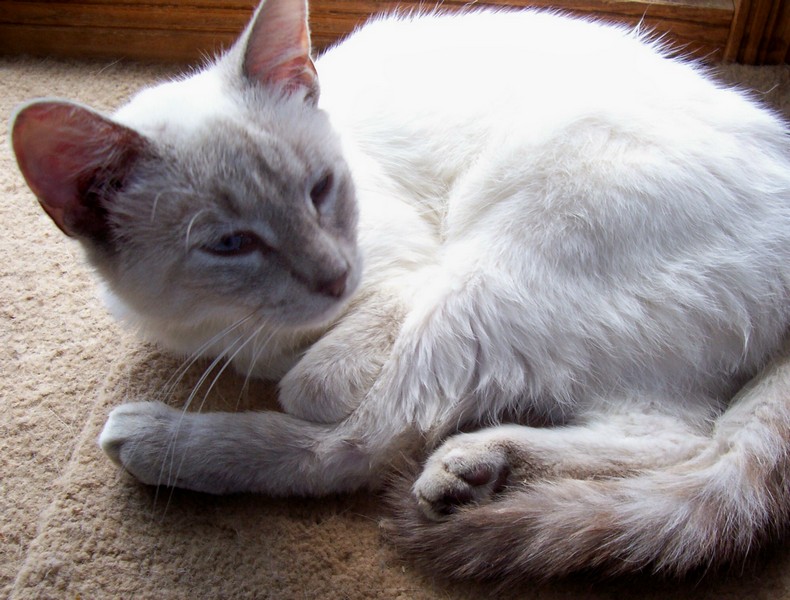
Lashing the framework makes it a somewhat permanent structure that I don't take down after the holiday. I used to remove the cloth sides and the pine branches on top, but then I noticed that my cats were sheltering in it while they waited to come in the house on windy winter days, the squirrels sometimes climbed on it, and birds were often hopping around on the top. I enjoyed watching this animal activity, so for the past few years I have left it up all winter, then removed the coverings in spring and made any necessary repairs to the framework.
There will probably be Haredi Jews who read this blog and be horrified that I let animals come in the sukkah, because it is supposed to be holy -- but really, it is only a "sukkah" during the festival itself. And what makes it a sukkah is the natural plant materials (called schkach) on top, which I replace fresh every year right before the festival. I see no problem with it being a multi-purpose structure other times of the year. In summer, I have sometimes hung flower planters from it. (No bird feeders, though, since we have roaming barn cats. Most of what my cats catch are rodents from around the chicken coop, which is very helpful, but there is no point in setting up bird bait for them.)
The Torah tells us that Jacob "journeyed to Sukkot and built himself a house, and for his livestock he made shelters; he therefore named the place Sukkot (Booths)." (Genesis 33:17). This is the first mention in the Bible of anybody making shelters for their animals (aside from Noah's Ark, of course!) -- and those shelters were probably something like my primitive sukkah. Which is why he named the place Sukkot. So I feel that by letting the animals use it after I'm done with it, I am much closer to how our ancestors lived.
At any rate, come spring, I will have to completely re-do my sukkah frame, after using the old wood to boil down my annual batch of maple syrup. I need to remove some green ash saplings that are taking over the meadow area where the milkweed grows for the monarch butterflies, so this will be a good time to do it. I look forward to that, because it will mean some very pleasant days outdoors, cutting the poles and listening to the various sounds of the forest. There will be grouse drumming, pheasants and other birds calling, geese flying overhead, and woodpeckers chipping holes in the dead trees that I purposely leave up for them. But right now, we have the silence of winter -- and that's beautiful, too.


 by Richard Louv. “Nature deficit disorder” is not a medical diagnosis; it’s a term he made up to describe what he sees as a very serious deficit in childhood experience nowadays. The book examines some serious psychological research and concludes that direct exposure to nature is essential for healthy childhood development and for the physical and emotional health of children and adults.
  , he describes a robin living in a hole on the tree -- but robins do not live in holes! Even Artscroll's beautiful coffeetable version of
  misidentifed a photo of a Grackle as a Starling, and one of the rooster pix is really a hen. Nor are these the only nature-oriented bloopers I've found in recent Jewish books. Although the Psalms and siddur (Jewish prayerbook) contain many verses about God's beautiful creation and how everything in nature is praising God, these have become mere words to be recited at breakneck speed with little thought as to their meaning in the real world.
 ) tells how, when he was at an outdoor Sukkot gathering, the kids saw some ducks and said "Let's schecht (slaughter) them." This is a far cry from when I was a kid and we used to go feed the ducks in the park. When was the last time you and your kids did that?