Showing posts with label seasons. Show all posts

Tuesday, September 23, 2014

Got allergies? Don't blame the goldenrod!

It's mid-September and the goldenrod is now in full bloom -- right about the same time that the pollen count hits the roof.  Over and over, I hear people blaming their hay fever on goldenrod.   But they are wrong!  Read on...

A field of goldenrod on my land in Minnesota --
haven for many butterflies & other insects
 Everyone can see the bright yellow of a field of goldenrod plants in full bloom.  As they look at all those yellow flowers along the road, they visualize clouds of pollen choking the air.  Just the sight of it all is enough to make some people sneeze.

But the fact is, goldenrod pollen is not spread by the wind at all.  This is why weather reports that include a pollen count never even mention goldenrod as a source.

A Goldenrod flower
Don't believe me?  See for yourself: Touch a goldenrod flower and you will not have any pollen on your hands.  Shake one and you won't see any clouds of pollen hitting the air.  It just doesn't blow around.   It spreads by sticking to the bodies of insects.  Unless you are a bug with lots of tiny hairs on your body to pick up the pollen, it doesn't leave the plant very easily.  Ecologically speaking, Goldenrod is an important nectaring flower for wasps, bees, butterflies, and other beneficial insects.  So please -- don't yank it out!

Ragweed plant in full bloom
The real culprit is ragweed, a coarse weedy green plant that blends into the background in fields and woodland edges.  Unlike the showy flowers of goldenrod, the rather nondescript flower stalks of ragweed are just loaded with pollen, and it does indeed spread on the wind.

Ragweed is not particular about habitat, and will grow just about anywhere.  The plant in this photo grew next to my compost pile, so it got to be over 6 feet tall from all that rich chicken manure.  Along the road you might see flowering ragweed only about a foot high, eking out an existence in the hard-packed gravel on the shoulder.  But once you learn to recognize it, you'll see it growing just about everywhere.

(Well, maybe not in the high desert -- but it crops up in irrigated areas like Las Vegas.  In fact, according to The 30 Worst Cities for Ragweed, Las Vegas ranks #2.  The top city on the list is Phoenix, Arizona.)

The stuff is very easy to pull up, so if you learn to to recognize it before it pollens out, you can at least eliminate it from your garden.  But with all the acres and acres of wild areas where it can flourish, you will probably have to wait until frost kills the plants before your "hay fever" finally goes away for the season.  Just don't blame your misery on the innocent goldenrod!

Typical distribution of ragweed pollen in
the USA in September

Friday, January 24, 2014

Minnesota Zen: Melt Snow, Carry Water!


If you have been watching the weather on the news lately (and who hasn't?) you know that the upper Midwest has been going in and out of the arctic deep freeze for weeks.  Here in Minnesota we normally have cold winters, but even for us, it has been record-breaking.  Yesterday it was 20 below zero (F) at dawn, and it never got above zero all day.

The dogs went out, did their business, and came right back in within minutes, looking at me as if to say, "Do you really expect me to stay out in that?"  No, I don't.  All ten of our cats are in the house now, too, and showing no sign of wanting to go outside.  Who can blame them?  We are all beginning to feel that "snow" and "cold" really are four-letter words.

The chickens, geese and guineas are snug inside their coop, which I designed with a passive solar collector on the south side that helps keep their water liquid during the day.  Out of the wind with the sun shining in, the air inside is actually above freezing at noon.  Still, I have to go down there and empty all the waterers at sundown, or they will be frozen solid by morning.

Snow on top of my sukkah frame --
I hope it doesn't collapse it  like
it did a few years ago.
Speaking of water, we have a shortage right now -- when it gets this cold, the plumbing freezes up.  Not enough to split the pipes, just enough to block water from getting from the well pump to the house upstairs.  It's an old house with an unheated basement and this is a recurring problem in the wintertime.

The pipes to the shower are in a outside wall, so we are just about guaranteed to have days with no water there -- meaning you try the faucets in the morning and take showers when the water flows.    This morning the shower was frozen but the sink was still running, so I washed up and did the dishes.  Three hours later, there was no water, period.  Hence the title of this post:  Melt Snow, Carry Water.

The bird feeders have been busy --
this downy Woodpecker
is a regular visitor.
The snow we have is light and fluffy, which makes it easy to shovel but a lot of work to melt down, because it has less water content.  Since we live out in the country away from traffic and pollution, the snow is also clean, if I get it off the beaten track.  (The trails I've cleared to and from the buildings are being used by cats, dogs, rabbits, squirrels and an occasional deer, all of whom leave their calling cards behind. So you don't want that "yellow snow" from on the trail!)

I am finding that it takes about 5 times the snow to make one unit of water.  Luckily I have a lot of big pots and kettles from canning and pickling, so I fill these with snow, then haul them in on a sled.  To save propane, I let the pots just sit at room temperature until I need some water.  The snow packs down as it melts,  making slush that I can put in a smaller pot to warm as needed.  It's a lot of work, but we are surviving.  Snow might shut down Washington D.C., but here in Minnesota we know how to deal with the white stuff.  As the saying goes, what doesn't kill you makes you stronger.

The arctic blast a couple weeks ago lasted over 60 hours below zero.  It was during that cold spell that the engine of my car died when I tried to start it at 30 below.  The timing belt broke which, if you know cars, is major engine damage that I can't afford to fix right now.  so I'm stuck in the country without a car, relying on help from others to get things we need.  Still, I'm a lot better off than all those people who have no power or heat.

Missy Cat has the right idea:
Stay inside and find a sunny window!
My ebay business,  The Happy Rooster, is suffering, though, because getting to the post office during business hours has been sporadic.  I posted a notice on the homepage and people have been very understanding about the delays.  Most of the orders have been for wildflower seeds, which nobody is planting now anyway.  But a lot of customers are "thinking spring" and planing their butterfly gardens.

In spite of all the hassles, the snow can be beautiful, and offers some interesting photographic opportunities.  Every other day we have been getting another inch or two, refreshing the landscape and adding to some interesting natural sculptures, like the "loaf of bread" below.  I take my cell phone along when I go out there, though, and I tell my wife where I'm going and when I expect to be back.  A fall or other mishap in this cold can be very dangerous.

That's all for now -- I've got to log off and go melt enough water to last me through the Sabbath (when we don't cook things) -- so stay warm, stay safe, and have faith:  Spring WILL come!  Shabbat Shalom!

That's not a giant loaf of bread --
just snow piled on top of my potting bench!

Thursday, April 11, 2013

Robins are back - I hope they survive this late winter storm

Three days ago I was listening to robins singing in my yard, watching a flock of juncos passing through on their way to Canada, and hearing flocks of geese overhead, honking their way back north.  Today we are getting buried in snow again -- at the same time Washington D.C. is having record breaking 90s -- in April!  Talk about global weirding.

Jet Stream, April 11, 2013
(Map courtesy of acuweather.com) 
The instability of the Jet Stream is a big contributor to all this strange weather.  I can remember when it pretty much stayed put up in there Canada, circling the arctic and dipping occasionally into Minnesota but no further south.  Now, as you can see from this map, it has gone crazy.  And with it comes all this weird  weather.  That huge dip is pulling cold air south, where it meets warm air from the Gulf and produces severe storms, including early tornadoes along the front.   It also traps warm air on the East Coast, resulting in those record-breaking 90s yesterday. (For more on how the Jet Stream is causing more severe weather lately, read this article on Climate Central.)

Last year's crab apples provide
food for spring birds
Meanwhile, birds on migration are getting caught in the storms.  The winds have been very strong today, so I suspect we will have a major bird drop around here (which is different from a bird dropping!)  A bird drop is when migrating birds come down to wait out the bad weather.  Sometimes you get to see some unusual species when the weather clears -- if the birds survive.

I find myself wondering what those robins on my land are eating today.  The Juncos can find seeds on tall grass stalks and the harrier hawk who returned a few days ago will no doubt find a rodent or two around the chicken coop.  But the ground is still too frozen for those robins to find any worms.  In the past I have seen them picking on frozen crab apples still on the trees.  So maybe that will help.

Minnesota drought map 4/11/2013
(Click pic to enlarge)
In spite of this snowstorm, we are still in the midst of a serious drought here.  Today's drought map shows my county, Pine, in the "severe" category.   (For more on the drought, click here.)

Last year it was so dry in late summer-fall that we headed into winter about 7 inches below normal in precipitation.  With the ground still frozen, all that this snow will do is run off -- which helps the wetlands downhill from my place, but won't do much for the garden.  In fact, it is so dry that, for the second year in a row, I decided not to tap my trees for maple syrup.  They grow along the edge of seasonal woodland wetlands that normally provides them with plenty of spring moisture during the melt-off, but this year it is bone dry.  I saw on the news that some syrup producers are getting a decent run -- guess it depends on where you are.  But for everybody it is very late, because of the abnormally cold spring.  In the past, syrup production would begin in mid-March and be over by now.

All of which goes to show that the climate is indeed changing.  Better get used to the new normal -- whatever that turns out to be...

Sunday, September 30, 2012

A Small Miracle: The Extra Lulav and Esrog

On the Festival of Sukkot (Feast of Booths), Jews not only put up the Sukkah (booth) to eat our meals in (about which I have written before) we also wave the Four Species -- palm, myrtle, willow and estrog (also spelled etrog) fruit -- in the six directions on each day of the holiday (more on the meaning of that later).  Special sets of these are imported from Israel, and must be ordered in advance.  And therein lies a tale that proves how God works in mysterious ways.

Because I live in a remote area of Minnesota, 75 miles from the nearest synagogue, the easiest way for me to get my lulav set is to order online.  A guy named shmuly770 was selling them on eBay and since I also sell on eBay, I ordered from him.  According to plan, the lulav should have arrived by UPS on or before Thursday, September 27, well in time for the holiday, which begins this year on Sunday night.

However, there was a problem with UPS being late, and on Thursday morning UPS tracking still showed the package as "in transit," with the last known station still out in California.   Shmuly was worried that I would not get my set on time and not be able to do the mitzvah.  Out of the goodness of his heart, he sent a second set by Priority Mail at his own expense -- without me even asking.  (Such a mensch!) As it turned out, both sets arrived on time   But here is WHY Shmuly had to send that extra set:

I volunteer at the federal prison just outside of Sandstone to visit Jewish inmates.  Today I am scheduled to go there to put the shchach (natural plant materials) on the sukkah that is erected each year inside the compound, and be sure everything is kosher.  (The sukkah walls can be put up by anybody, and at the prison this is done by a work crew, but the shchach must be put on by Jews.  So I always go to personally supervise this.)

When I called the chaplain's office on Friday to be sure the sukkah was up and the greens were cut, he said yes, all that was ready, but their lulav set had not arrived yet. (It was also coming by UPS).  If it came Saturday he would not be able to get it from the warehouse because it is not open on weekends.  The chaplain himself was going to be gone Monday through Wednesday, which meant the soonest he could get it would be Thursday -- three days after the holiday started -- oy vey!  (Apparently only the chaplain can retrieve packages for the chapel, for security reasons.) But YES, I could bring in and donate the extra set I "just happen" to have on hand now -- which I will do today!  So this is why my first package was late, and why Shmuly had to send me an extra set!  Such a great mitzvah!

Now for the meaning of the Four Species.  Actually, there are several interpretations (as is often the case in Judaism), but I like this one best:

The Palm is tall and beautiful but has no scent.  It represents the Jew who has scholarly learning, but is lacking in actually doing the mitzvot.

The Myrtle is a scrubby bush with a lovely scent.  It represents the Jew who has very little Torah learning, but does many mitzvahs, acts of charity, and has compassion.

The Willow has no scent, but it is flexible.  This is the Jew who has neither Torah learning nor is he (or she) observant, but has humility and bends before God like a willow.

The esrog fruit is both beautiful and has a lovely scent.  It represents the Jew who has both Torah learning and mitzvot, but may be tempted to become proud and distance him/herself from the rest of the community.


In the ceremony, the first three species -- palm, myrtle, and willow -- are bound together and held in one hand, while the esrog is held separately in the other.  Only when all four species are brought together, with the esrog touching the other three, do we have the ceremonial Four Species.  In the same way, only when all the Jews, learned or not, observant or not, come together as one, do we have the complete Jewish community.

Raindrops photo by Linda F. Palmer
Courtesy of Wikimedia Commons 
In addition, all four of these species grow near water, and on the first day of Sukkot we add the prayer for rain to the liturgy. The word "Hosannah" come from the Hebrew ho-sha-nah, meaning "save us now," and is taken from the Sukkot prayer for rain.  In Israel, this is normally the beginning of the rainy season, and here in Minnesota we usually get fall rains also.  However, we are in the middle of a severe drought right now and there has been no rain on my land for two months.  Israel, too, is suffering from drought.  So as I wave my lulav this year, I will indeed focus on rain for the land and water for all God's creatures who live upon it. (Strangely enough, rain often does come during Sukkot, no matter when it falls during the month.)

Wishing you all a joyous and, hopefully, rainy Sukkot.

  Chag Sameach!
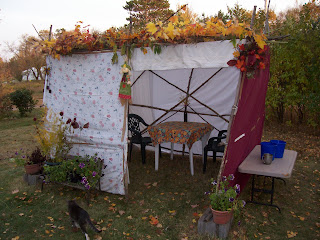
Our sukkah in 2012

Tuesday, September 11, 2012

Harvesting Wild Plums (Prunus americana)

One good thing about the unusually warm spring we had this year: we got a great crop of wild plums.  This far north, the plum crop is rather iffy, because a late frost often kills the blossoms.  But not in 2012.  I just finished making jam, fruit leather, and wine from the fruit of our plum thicket.

Wild plums gathered on our land.
The window of opportunity for harvesting these delicious little plums is very narrow.  No sooner do they ripen, than the wind knocks them to the ground, where they are relished by various forms of wildlife.  In fact, it was my chickens who alerted me to the fact that the plums were ripe.  When the roosters find something especially good to eat, they call the hens with a very specific cackle and they all come running.  (This, by the way, is why the Talmud, Eruvin 100b, says we should learn "courtesy from the rooster" -- he lets his hens eat first.)   When I heard my chickens calling and scratching back there in the plum thicket, I knew something was up!  Chipmunks and wild birds were also enjoying the feast.

Wild plums don't keep very well, which is why you will never see them for sale in the store.  If you want to preserve them, you have to process them right away.  We usually make jam, and this year I decided to make fruit leather as well.  The normal way to extract the pulp and juice is to boil the plums and strain out the pits and skins, but this kills the seeds.  I wanted viable seeds to sell in my eBay store, The Happy Rooster, so I pitted them by hand.  A messy job! 

For fruit leather, I loaded the pitted plums, skins and all, into the food processor, set it on puree, then dried the resulting mess in my food dehydrator (which has special inserts for making leathers.  I suppose you could also do it on waxed paper in a low oven.  I'm told the Indians used to dry the pitted plums in the sun, and I've heard of people making solar food dryers.)  These plums are pretty tart, so we tried both a sweetened and non-sweetened version.  Both are delicious!

Getting a clear jelly from these plums is next to impossible, but they make a pretty good jam if you strain out the skins and most of the yellowish pulp.  I use a colander for this, since it is too thick to go through cheesecloth.  This leaves me with a pink slurry.  Following an old traditional recipe, I add one cup of sugar per cup of juice, then boil until it "seals the tines of a fork," or jells when you cool a spoonful.  (I suppose there is a proper temperature if you use a candy thermometer, but I've always done it seat-of-the-pants.)   I find there is enough pectin in the plums to jell on their own, but if you have some apple juice to add, it makes a nice combination.  If for some reason your jelly doesn't jell, you can still use it as a delicious syrup on pancakes or ice cream.

The last product I made is (or soon will be) a gallon of plum wine.  I started making my own wines when we moved to rural Minnesota, because the only kosher wine we could find here was Manischewitz grape, which is cheap and sweet for the local winos but not a vintage that I enjoy.  Over the years I've experimented with making all kinds of wines, some better than others.  Just be sure to use wine yeast, which you can order online, not baking yeast.  My last batch of plum wine was pretty good.  I'll let you know in a few months how this vintage turns out.  L'chaim!

(To add wild plums to your wildlife landscaping, either buy trees from garden catalogues or, if you have the patience to grow trees from seed, you can get seeds from my eBay store, The Happy Rooster  while supplies last.  This is a native species that grows in zones 3-7.)

Wild plum blossoms in spring.  In addition to fruit,
these trees form a thorny thicket that birds like to nest in


Tuesday, March 20, 2012

2012 heat wave: Spring has never been so early here!

Lately the news has been full of photos of cherry blossoms and daffodils blooming a month early in places like Washington, DC.  Here in Pine County, Minnesota, things are not that far along yet, but signs of spring are still unseasonably early. 

On the right you see a bouquet of budding twigs that include (from left to right) forsythia, false spirea, pussy willows and black maple.  For many years it has been our custom to cut a bouquet like this for Passover, then watch as the buds slowly open during the eight days of the festival.  Well, this year we are going to have to do something different, because Passover is still almost three weeks away and buds are swelling now.

Nor are budding trees the only early signs of spring.  The Canada geese are back, along with robins, starlings,  red-wing blackbirds, song sparrows, juncos, mourning doves, and the phoebe who nests in the rafters of our shed each year.  Pheasants are calling, grouse are drumming, and last night -- believe it or not -- I heard spring peeper frogs and the ones we call "clacking frogs" calling in the marsh across the road.  This is the absolute earliest that any of this has happened here as far as I can remember.

Those swelling maple buds meant that I didn't get any maple syrup.  Normally you start tapping the trees when the days are around 40 degrees and the nights are still below freezing.  But when the temperature soars into the high 70s like it has done this March (smashing local records for days in a row), the nights stay warm, the trees bud out, and the sap flow stops.  Everybody I've talked to around here says the same thing:  Their maple trees dried up overnight.  I never even bothered to tap mine.  Which is probably just as well, because we are also in a drought.  All of our snow seems to have moved way down south.  Arizona is getting buried, while Minnesota stays high and dry.  We only got one decent snowstorm here all winter, and within days it had melted away.  Yesterday we got a nice steady rain, which was a good thing, because with all that dried grass around, not to mention some very early lightning storms, the fire danger was extremely high.

All of which adds up to one thing:  Climate change is real, and it is here.

Wednesday, September 14, 2011

Wild Turkeys -- hard freeze tonight -- picking green tomatoes

This has to be the most cruelty-free wild turkey feather ever -- it was dropped on our dirt road by a passing flock of turkeys about a week ago.   I frequently see turkeys around here, sometimes as many as 20 or more.   I wish I knew where they are roosting -- then I could find lots of feathers!

This morning our dogs were raising a ruckus from inside the house, and when I looked outside, there was a crow walking down the road.  I thought it was odd to see a crow taking a stroll there, but thought maybe he was looking for gravel or grains.  Then I saw the turkeys following behind.  At least, that's how it looked.  I grabbed my camera but of course, as soon as I went outside, the crow let out a warning call and the turkeys all ran into the bush.   I did get a good enough look to see that there were 5 adults and 2 older juveniles. 

Was the crow actually serving as a lookout for the turkeys?  It sure looked like it.  And he did fly off in the same direction that they went.

On another topic, we are due for a hard frost tonight -- going down to 26F, which is probably going to break some records around here. This is really early for a killing frost. Way too cold for tomatoes to survive, even if they are covered.  So I'm taking a break right now from picking and storing them all in the shed.   Some will ripen, and for the rest, I've got lots of recipes using green tomatoes -- fried, pickled, in sauces and relishes.   (BTW, naturally-ripening tomatoes do so from the inside out.  Any tomato showing some whitish or reddish on the skin is already ripening inside and will eventually turn red.) 

I've already pickled all my cukes, picked all my beans, onions, leeks and hot peppers, made sauerkraut and kimchi from the cabbages, jelly from the grapes.   All in all, it was a pretty good year for the garden.  Tonight we are making apple butter and applesauce, using fruit from our trees.  All of this certainly helps with the winter food budget.


Scarlet Sumac leaves against the sky
Pine County, Minnesota


Sunday, September 4, 2011

Birds flocking, crickets chirping -- Rosh Hashanah is coming soon!

 I woke up very early this morning and went outside for a dawn walk, to be met with the squawking of a huge flock of birds waking up in a distant tree. (Probably starlings, they were too far away to positively ID.)  I don't have a telephoto lens, just a digital point-and-shoot, but was able to snap this pic just as the flock took off with the sunrise.   Even though it's not the best photo I ever took, I'm pretty proud of it -- migrating birds have gathered in that same tree for years, and this is the first time I was able to capture them taking flight.


Flocks of chattering birds mean autumn is coming.  So does another sound:  the chirping of crickets.  I have always heard this as a sweet-sad sound: sweet, because I love the song of crickets, and sad, because it marks the beginning of the end of summer.  Crickets are around earlier, of course, but they do not get their song until they shed their skins for the final time and the males get wings with the "instrument" to make the sound.  It is the wings -- not the legs as is commonly thought -- that crickets rub together for this sound. 

A third sound that I associate with fall is not made by nature, although it does require a natural  object to produce it.  This is the sound of the shofar or ram's horn, that Jews blow on Rosh Hashanah, the Jewish New Year, as well as during the Hebrew month of Elul that preceeds the holy day.   The Jewish calendar is lunar, so the exact date of Rosh Hashanah varies form year to year, but it is usually in September.  (This year it is quite late, beginning after sundown on the 28th.)

Typical ram's horn Shofar
Some Christian Bibles mistakenly translate shofar as "trumpet" and refer to Rosh Hashanah as "the Feast of Trumpets."  The first time somebody asked me about the Feast of Trumpets, I had no idea what they were talking about, because no Jew would ever mistake a shofar for a trumpet.  Trumpets were also blown in the ancient Jerusalem Temple, but a shofar is definitely not a trumpet!  The shofar is an ancient, primitive horn that is literally made from an animal's  horn, usually from a male sheep but it can also be from a goat or gazelle.  (Never a cow, though, because of the sin of the Golden Calf.)   The shofar produces an archetypal, visceral sound that shakes the very soul and is meant to wake us up spiritually.  "Wake up, wake up!" the shofar says, "Return to the path of God, your Creator!"

I suppose that in the Southern Hemisphere, where it is now the beginning of spring, not fall, there are other nature sounds that Jews associate with Rosh Hashanah.  But for me, it is the sound of the crickets and the calls of migrating birds that remind me the High Holy Days are coming.

Sunday, August 7, 2011

Thousands of USA heat records broken -- new widget tracks them all

The weather has finally cooled down here in Minnesota -- at least for now.  Over 4000 heat records have been broken so far this summer in the USA, and the PBS Newshour site has developed this widget to track them all.   Use the scroll arrows to see records set by day, month, and year.  (You can get the widget code for your own site at:  http://www.pbs.org/newshour/rundown/2011/08/is-this-record-breaking-record-breaking-heat.html, where you will also find an informative article.   And yes, the widget will run year round, since records get broken in winter, too.)


As you can see, some of these records stood for more that 50 years.  Clearly this is a disturbing pattern -- and one that does not bode well for the future.  Global warming is here, whether the deniers like it or not.  Perhaps that's the REAL meaning of the endtime prophecy that says people will be "eating and drinking as in the days of Noah."  Maybe not gluttony as has been thought, but apathy in the face of warnings.   No doubt they laughed Noah, too: "A flood?  In the desert?  You've got to be kidding!" And we all know what happened to that generation.

And it's not just a matter of things warming up.   Climate change means weather patterns are changing, too.  Places that used to get rain are turning into deserts -- witness the drought and famine in Africa.   I remember hearing years ago that the monsoons in India were no longer coming reliably, but nobody heeded the warning.    Those same monsoons are what used to water the fields of Somalia.  And the southwestern USA (where a lot of these records are being broken even as I write) is experiencing the worst drought since the Dust Bowl of the 1930s.

On the other hand, Minnesota has been drowning in much more rain than usual.   Rivers reached record highs, there have been numerous flash floods and many more severe storms than usual.   Every time the Jet Stream takes an  abnormal plunge south, it sucks up moisture from the Gulf of Mexico and pulls it north.   Here in Pine County, MN, it rained just about every other day (sometimes several days in a row) in July.  I ended up growing a lot of my garden veggies in containers, because it was just plain too wet to till the ground.

Down the road from me is a cornfield that never got planted.  Lots of other fields lie fallow, too.   All of which is resulting in higher prices in the supermarket.   Parts of my lawn got so out of control I just let them go to seed and will mow it down for chicken bedding when -- if ever -- it dries up a bit.  Meanwhile, I struggle to keep up the mowing around the house and trails to the outbuildings.  Wild plants in general are huge -- I've got ragweed with inch-thick stems, eight-foot-high Jerusalem Artichokes (sunchokes), and enormous blackberry canes trying to take over my garden.

 On the other hand, pollination has been iffy.  There were very few wild berries in spite of all the rapid growth.  And not one wild plum on my trees.  Pollinating insects don't fly in the rain.  Some don't even fly on cloudy days.  And I have not seen one single honeybee -- not one!   Whatever is causing the demise of the honeybees has apparently reached here.  This spring, when I stood under my apple trees, I did not hear the happy buzz of honeybees, although some pollination did happen from other insects, because apples are forming.  The honeybee niche seems to have been taken over by a  species of small bumblebee, which I have seen on my cucumbers and squashes in large numbers.  Something is pollinating my tomatoes also, although there are fewer fruits than in other years.   And as I wrote in a previous blog post, the Monarch butterfly population crashed here this year -- I have not found one single caterpillar.

All of this is very disturbing, to say the least.  Nature will eventually adjust to climate change -- but will we?

Friday, April 15, 2011

Spring is here, cleaning for Passover, birds are back!

I haven't had much time to write on my blog lately -- between making maple syrup, cleaning out the chicken coop, and cleaning the house for Passover, I haven't been online much in the past couple weeks.   So this is just a quick note to let all my readers know I'm fine, and very much enjoying the return of the birds.  The bird migration north is in full swing.  The phoebes that nest on my land (one in the open garage and the other under the eaves of the chicken coop) are back.  Of course, I have no way to know if they are the exact same birds that nested here last year, but we have had phoebe nests in the same areas for about 5 years now, so it is either them or their descendants. 

This is a photo I took of the young birds in a phoebe nest in 2009 -- they fledged the next day.   I liked it so much, I made it up as a souvenir postcard (you can still buy a copy in my ebay store, The Happy Rooster):


The Canada geese are back in droves, and I've seen Sandhill Cranes flying over several times now.  Monday on the way to Hinckley, my wife and I saw two pair of Snow Geese standing in two different flooded fields -- an unusual sight, we usually see them flying over on their way to Canada but rarely on the ground.  But Sunday night it was very windy so I supsect we had a  bird drop (which is different from a bird dropping) because overnight there were suddenly lots of migrating birds in the trees and bushes.  On the same day, the pond across the street was full of ducks, and I also heard them back in our seasonal woodland wetlands area, where it floods every spring.  All waiting out the high winds, I guess.

Plus there are robins, flocks of Juncos, and song sparrows, pheasants calling, grouse drumming.  I also saw a red-tailed hawk and a pair of Bald Eagles.   And the pair of starlings that nests in a hole in the eaves every year is back.  I keep meaning to get up there and plug it up, but I'm a bit old for climbing second-story ladders now.  Starlings are not really a big problem here, this is the only pair we ever see and I enjoy  enjoy seeing them sitting on the power lines and flying back and forth to feed their young.  When I do get the eaves fixed, I plan to put a birdhouse for them up there.   Otherwise, they might go compete with the Bluebirds or Tree Swallows.

Starlings, you have probably heard, were purposely released in the USA by a guy who wanted to introduce all the birds mentioned in Shakespeare's plays.   There's a chapter about this in a new book, "How Shakespeare Changed Everything," due out on May 10.  (I got an advance review copy.  Since I'm not a Shakespeare expert, I found it very informative -- basically a good book with odd facts to get teenagers or newbies interested in the classics.)  The starling release has over-succeeded.  In many place they are serious pests.  But up here in the North Woods, they are just another species returning for spring.

Crocuses are blooming, the daffodils are coming up, and the frogs are out, too -- across the road is a marsh where the Spring Peepers are almost deafening, along with a species I call "clacking frogs" because that's the sound they make, likeone of those kids' clacker toys.  I've never actually seen them do it, so I'm not sure what the species is.  No singing toads yet, but I expect to hear them soon.  Last year a big toad took up residence in the flower garden outside the front window and we heard him all summer.

Yesterday I dug up my horseradish for the "bitter herbs" at our Seder (on Monday and Tuesday nights) and today I get to vacuum the rugs.   Sunday we kosher the kitchen to get rid of all leavening, bring down the Passover dishes from the attic, etc. (We order matzoh online -- it has already arrived.)   Monday we go buy fresh veggies and begin cooking for the first Seder Monday night.   So I might not get around to blogging again for a while -- until then, wishing you all a Happy Spring (or fall if you are reading this Down Under.)

Wednesday, March 23, 2011

March storm is roaring like a lion!

A few days ago, it was in the mid-50s with my chickens out foraging in patches of bare ground.  There were even bits of green grass poking up, I heard robins calling and saw my first pair of Canada geese returning for the season.  Today, I slogged through knee-deep snow drifts in howling 50 mph winds to get to the coop.  As the saying goes, "If you don't like the weather in Minnesota, just wait 10 minutes."  All the poultry are shut inside --  literally "cooped up" -- happily dry and safe.  I even got 8 eggs.   My two ganders were fighting -- not too seriously, but another sign that spring is coming.

Here's a picture of  Buffy, one of our barn cats, coming out from under the evergreen in our front yard (He's a stray who wandered in, and except for really, really cold weather, he prefers to be outside.  He comes to the porch to eat and sleeps in the old garage.)

One good thing about the storm is that it will prolong the maple syrup season, since there won't be any fire danger for a while (I was getting a bit worried at how fast it was melting off last week, revealing all that long dead grass on the hillside.)   I'm not up to going out to do any photography in this wind -- but here is one of my favorite photos from a previous storm in 2007.  I call it, appropriately, "Dawn after the Storm":


And here is essentially the same view in early spring  that same year -- a sight I'm definitely looking forward to SOON!   As for why we are getting so much snow lately, see my previous blog post, "If the earth is warming up, why are we getting so much snow?"


Wednesday, February 16, 2011

If a tree falls, you can definitely hear it!

Yesterday, as I was sitting at my computer, I heard a loud falling, sliding, crunching sound and assumed it was ice sliding off the roof (which has already happened before -- the other day a huge thick sheet of it came crashing down off the chicken coop as I was doing chores down there -- startling me and upsetting the chickens, who cackled for five minutes afterward.  Luckily this happened outside their pen and nobody got crushed.) 

When I went outside to look for the source of the latest crash, there was no sign of a snow pile on the ground, just the usual drips. Puzzled, I looked the other way -- and saw that the noise was made by the top of this tree snapping off in the wind and crashing to the ground.  This tree has been dying for a quite while and, since it's not close enough to the house to be a hazard, I had left it for the woodpeckers and nuthatches.   And they are still enjoying it -- I saw a Downy hopping up and down the fallen top this morning.  The debris scattered on the ground will eventually get picked up and probably used for firewood when I make maple syrup -- which will be soon if these warm days keep up.

I imagine this will also open up an area where the sun can shine in better.  Last time a tree fell in this windbreak, a patch of orange daylilies burst into bloom.   They had apparently been there since the previous owners of this land (I certainly didn't plant them) but had never bloomed until the tree fell.  Under this new topless tree, there is an old clump of peonies, probably planted back when these pines were little evergreens.  The peonies have bloomed for me, but it will be interesting to see if they do better now that the top of the tree is gone and better light gets in.

As you can see, I've been allowing other younger trees to grow in beyond the older ones, to maintain the windbreak, which is on the west side of the house.  It makes a big difference, both in winter when the winds blow and summer when the sun beats down, to have trees there.  In addition to stuff that has grown up on its own, I've moved quite a few young trees and bushes into the new row.  My grandson's Arbor Day tree got planted there, too.

Sunday, January 30, 2011

Living within the seasons

One of the things I quickly learned after moving to the country was how to plan ahead for Jewish holidays, because way out here, there just aren't any kosher specialty stores.  That's why I'm already thinking about Passover in January.

For example, you need nuts to make charoset, the apples-and-nuts mixture served at the Passover Seder.  And the nuts must either be certified free of any leavening products (that is, kosher for Passover), or still in their shells.  Finding Passover certified nuts in small-town America is next to impossible, and nuts in the shell can only be found in December or early January (except for peanuts, but they're legumes, not real nuts.)   So I learned very quickly to plan ahead and stock up on almonds and walnuts and such in December so I'll have them at Passover time in April.  (I also save black walnuts from my own tree in the fall, and wild hazelnuts when I can find them.)

The same is true for many other things people take for granted in the city.  One of the reasons my wife and I  are vegetarians (although by no means the only reason!) is because of the hassle and extra expense of trying to get kosher meat outside of the Metro area.  I suppose I could have learned to slaughter my own chickens (one of the best-kept secrets of the kosher meat industry is that any Jew who knows how can slaughter for own his household, provided he doesn't sell the meat as kosher to others) but I'm just not cut out for that.  My backyard chickens are friends, not food.  And to be honest, we eat much better as vegetarians than we would be for the same amount of money as carnivores. 

There have also been years when I couldn't find fresh parsley for the Seder, either, because the local grocery didn't have it and there certainly wasn't any growing out there under the snow.  In fact, this is why the traditional dipping vegetable at a Russian Jewish Seder isn’t parsley, because nobody in Russia had fresh greens when the ground was still frozen solid at Passover time.  So they used a piece of boiled potato, which falls into the same pri ha-adamah ("fruit of the earth") blessing category as parsley.  Even today, if you go to a traditional Lubavitch Seder, they still use the potato, because that's what their Rebbes used in Russia.  A piece of carrot would do, too.

I also grow my own horseradish for the maror (bitter herbs), because once again, fresh horseradish just isn't available here in April, and the kind in the jar isn't so easy to find, either.  The first year we were here, I had to special order horseradish roots and take 5 pounds -- but at least I had enough left over to start the patch that I've harvested from ever since.  (Of course, I need to remember to shovel away the snow a couple weeks before Passover time, so the sun can reach the soil and thaw it enough to dig the stuff out.)

Yes, I could order these things from the Internet (and I do that with some things, such as vegetarian soup mixes), but that's not the point.  Simplifying my lifestyle and getting in touch with nature is.  Up until recently, nobody had the same fruits and vegetables all year round.  Eggs weren't so easily available, either.  When I made the decision not to eat factory farm eggs and only use those from my own chickens or free-run hens from places I trusted, our winter diet changed radically.  Right now, in the dead of winter, I'm getting maybe 6 eggs a week from my little flock, if that.  So I'm not having eggs for breakfast today.  They will get saved for baking bread and other things for the Sabbath.  My winter breakfasts consist more of hot cereals.

Urban  Jews will read this and probably wonder why I put myself through all this trouble.  But I think I have a better understanding of Hasidic stories when I live closer to the way that early Hasidim lived.  Foods were seasonal back then, and this was reflected in the way our feasts were celebrated. Lots of spiritual reasons are given for serving eggs at Passover time (or Easter for my Christian neighbors), but the most down-to-earth one is, that, in the natural order of things, the hens start laying again in spring.  I think it's important not to lose sight of that.