Showing posts with label animal rescue. Show all posts

Wednesday, September 25, 2019

Kapporos Protests: Reflections on a New Approach

Note from the Editor: As readers of this blog know, I was a founding member of the Alliance to End Chickens as Kaporos in 2010, but broke with the organization in 2014 over what I saw as disrespect of Hasidism and Hasidic culture on the part of Karen Davis, who was their primary spokesperson at the time.  In the past year, however, some members of that organization have re-evaluated their aggressive approach (which, quite frankly, was not working) and decided to try using love and compassion instead.  In this guest column,  Rina Deych, also a founding member of the Alliance, describes what they did in the fall of 2018, and how it was received by the Orthodox and Hasidic Jewish communities in New York. (Rabbi Gershom)


* * * * *

Kaporos Protests: Reflections on a New Approach

Guest Column by Rina Deych

Since 2010, the Alliance to End Chickens as Kaporos has been protesting the use of chickens in the custom of Kaporos (background info here.)  Although at times we did get into some great discussions with practitioners, interactions were often angry and contentious.   Last year, for the first time, we partnered with The Save Movement and Jewish Veg, and our approach was very different.

Compassion instead of anger

Author Rina Deych (left)
and Anita Krajnc 
Anita Krajnc, co-founder of The Save Movement, met with a group of us to promote a love-based initiative inspired by the writings of Leo Tolstoy.  It was a truly eye-(and heart)-opening experience to hear her speak.  She encouraged us to have love and respect for practitioners and to approach them from a place of compassion.

It made me remember a conversation I’d had with a friend who insisted that if she were brought up in a community that used chickens in the ritual she would “know” they were suffering and she’d refuse to do it.  I told her at the time (and mentioned when I spoke at our meeting) that no one can say that for sure.  I explained (to her, at the time, and later to the group) that if one is indoctrinated from birth to believe (or ignore) certain things, it’s very hard to change – especially when one lives in a community that reinforces those things. Therefore, difficult as it is, we need to feel compassion for these people.

Teaching a how to properly
hold a chicken by supporting
her body
Last Kaporos, we visited groups in Boro Park, Williamsburg and Crown Heights, Brooklyn, where the ritual was being performed.  Activists opened crates and gave food and water to as many chickens as they could reach.  Sadly, that wasn’t many, because they are so tightly crammed into crates that are stacked several high and many across.

A more positive response

I noticed almost immediately that the practitioners’ reactions to us were completely different than in previous years.  Children gathered around, wide-eyed with curiosity and both kids and adults were asking us questions.

Chickens drinking water
offered by protesters
Sage Max of Jewish Veg gave out flyers with historic information supporting the use of money (instead of chickens) in the ritual. There were activists showing practitioners the correct way to hold a chicken (under and around his or her body, instead of by their fragile wings).  One butcher (some of the rituals occur outside of butcher shops) with a long white beard came over to me and showed me that he was giving the birds challah (bread) soaked in water.  I was touched by his compassion and thanked him.

There were some angry words from practitioners, but we tried our best to respond to them with kindness.  This is what I call putting water on the fire.  In previous years, some of us have thrown gasoline on it… not intentionally, but in response to seeing the chickens suffering.   That approach was counterproductive and did not help the chickens.

Continuing postive outreach

This year, we plan to continue our feeding, watering, and outreach efforts.  We planted many seeds of compassion and this Kaporos we plan to water them.  I thank Rabbi Gershom for his wonderful book Kapporos Then and Now, which I have given to rabbis and some key members of the community to inspire them to use money, instead of chickens.  It has been an invaluable tool in helping to spread compassion.

Rina Deych
Founding Member
Alliance to End Chickens as Kaporos


---------------------------------------------------------

"Hasidic Man Speaks Out Against Mass Animal Sacrifice Kaporos" -- a video of last year's actions, produced by Donny Moss of  Their Turn. Note especially the outspoken young Hasidic man at the beginning of the video, who is protesting the custom.  It is important to remember that not all Orthodox Jews do this ceremony.


Also check out this well-written article by Donny Moss, about how the footage of the Hasidic man in the video came about, behind the scenes discussions with Hasidim who disapprove of using chickens, etc.  Very well-balanced, informative, and accurate.

For practical suggestions on organizing effective protests and other actions you can take, see Rabbi Gershom's activist manual online here. 

For more on Rabbi Gershom's Book, Kapporos Then and Now: Toward a More Compassionate Tradition, click here, where you can read a synopsis by the author and order copies at a discount.

Monday, September 25, 2017

Guest Column: "To Save a Life" by Rocky Schwartz

Editor's Intro: Each year I write a column about why I oppose using chickens for Kapporos, the pre-Yom Kippur ceremony practiced by some Orthodox and Hasidic Jews. I have written about it from the standpoints of history, of Jewish mysticism, of public opinion, of culture wars and politics.  In all of those stories, the chickens themselves were anonymous, suffering en masse in the background. This year, I received this story about one individual chicken whose life was spared at a Kapporos site, and the compassionate way that came about.  I was deeply touched by this true tale, and so I offer it to here, my readers. Perhaps seeing one chicken as an individual life will help you to see all of them as God's creatures, each with his or her own story to live. (Rabbi Gershom) 


*  *  *  *  *


To Save a Life

by Rocky Schwartz

On a Monday night in October, we walked into hell. We had come to protest an Orthodox Jewish ceremony called Kapporos, in which chickens are slaughtered before Yom Kippur, the Day of Atonement.  Although I myself am Jewish, I am not Hasidic and did not grow up practicing Kapporos.

Kapporos chickens in a crate
On a busy street corner, men were grabbing six-week-old baby birds, flipping them upside down and slicing their throats. Behind them, a truck sat on the sidewalk, filled with crates stacked upon crates of more babies.

When I immediately began sobbing at the horror of the sight, a dozen little boys gathered around me, mocking and laughing. Someone shouted, "Kill it right in front of her!" He swung a young peeping chicken by her wings.

I was horrified that such young people could be so callous toward baby animals suffering before them. The adults present either did not see what was happening, or they did not care.

After I composed myself (read: put up all the mental walls so as to not truly see the reality in front of me), I joined about 50 activists who stood protesting the slaughter. Tensions ran high on both sides, but I tried to remain calm. I walked among those who were swinging the birds, telling them:

They feel.

They feel pain.

They want to live.

They are fighting for their lives.

*You* have a choice.

Some people responded, "Yes, I have made my choice," meaning that they had decided to have their bird slaughtered. I told them the birds didn't have a choice in having their lives taken from them. Most ignored or mocked me, but one young girl, maybe 12 years old, spoke with me. She told me her name was Rose, and said a lot of people were listening to us and and having their minds changed, even if they did not say so in public.  She herself was torn. Should she follow the lead of her parents or not?

I asked her if she would do it if the animals being used were cats or dogs.

"Definitely not," she answered.

I told her the birds are no different, that they, too, feel pain and fear. I showed her the background on my phone, in which I'm hugging my late love, a rooster named Tabitha. I told her he was my best friend, but he died in January.

"And tonight," I told her, you have the choice not to take someone else's life."

"But what do I do?" she asked. "I already have a ticket!"

A fellow protester named David instructed me to ask her to still use her ticket to get a bird, but give the bird to me after the ceremony, instead of having her killed.

"I'll give her a safe home," I assured her.

"Okay," she said, "I'll find you."

I returned to the group of protesters, hopeful but not optimistic that the child would actually return and give me the chicken.

To my surprise, only five minutes later a young figure ran toward me through the crowd and shouted, "Here!"

Rose the hen at about six weeks old,
soon after she was rescued
It was the same girl. She quickly pushed a live hen into my hands. Then we ran in opposite directions, she back into the crowd and I toward the safety of my fellow protesters Vanessa and Steven's car. As I ran, I called out a stunned "thank you," clasping the trembling, feathered body in my arms.

On the way back to the car, I hid the small survivor behind my protest sign, shielding her from the crowd filling the street, who were killing her kin. I was also afraid someone might grab her from me. Once in the car, the chicken continued to tremble in my lap, but slowly accepted gentle petting and some water. I decided to name her Rose, after the little girl who had spared her life.

While I was sitting in the car, my partner Jay spoke with the girl. He told her how brave she was and asked if she wanted to be an animal rights activist. She told him her parents are extremely protective, that she doesn't even have a cell phone or email address. She wasn't able to protest publicly, but she did care about animals. I wondered how many others in the crowd didn't want to kill their chicken, but were not as brave as this child.

Vanessa and Steve returned to the protest, managed to convince one more man to spare a baby rooster, and then drove us home.

*  *  *  *  *

Rose today, as full-grown adult
Safe at home, Rose the rescue hen sits contented in my lap, preening herself and my arm. Out in the expanse of our backyard, she chooses to stand beside me. When I go to put her to bed at night, she cries out in panic and runs after me toward my bed, until I sit with her as she falls asleep.

She still bears the marks of the life she escaped. Badly infected feet from days spent in filth and crammed into a crate. A too-big body for a six-week-old, still-peeping chick, the result of over-breeding for the meat industry.  Anxiety from her history of trauma.

But she is one of the lucky ones. Though she was specifically destined to be part of a religious ritual, her fate was to be no different from the 263 baby chickens killed for food in the United States each second, an incomprehensible 52 billion globally each year. The only difference for her? She was seen as an individual. And a child had the power to save her life.


The author, Rocky, and her new friend Rose

*  *  *  *  *
Editor's postscript:  Rocky refers to the birds being slaughtered as "babies."  These are not fluffy baby chicks, but six-week-old broiler chickens who have been artificially over-bred to grow and gain weight as fast as possible.  It is not that the Hasidim purposely choose to use babies as such; rather, it is that these are the type of chickens available from the meat industry.  The days of mother hens raising their chicks to maturity are long gone.  If you eat chicken, the likelihood is that the bird on your plate was also a juvenile bird hatched in an incubator and killed when only a couple months old.  They go to their deaths peeping in panic, never living long enough to cluck or crow. 

For more on this issue read my previous 2013 post, Kapporos Chicken's Don't Sing!  about the peeping chickens, and why Hasidim do not understand that they are crying. 

See also The Baal Shem Tov did it with a chicken, so why do you tell me not to? which explains this question from the standpoint of Hasidic mysticism.  

Wednesday, November 4, 2015

In memory of Sapphire, a wonderful companion cat

My cat, Sapphire, named for his beautiful blue eyes, passed away peacefully in my arms early Saturday morning.  He was, we estimate, about 16 years old.   We don't know exactly, because he was a stray who showed up in our yard in January 2000.  He was an adult and not kittenish when we found him, so we assumed  he was about 2 years old then.

It was actually my sheepdog, Grett (now deceased) who found him.  When I went out to do chores one morning, Grett kept trying to lead me to the old garage we use as a shed.  He would look back at me, take a few steps, then look back again.  I followed the dog and there was Sapphire, sitting up on a shelf.  He was lost and afraid, also cold, hungry, and thirsty.  I began putting food and water out for him, and soon he came down to greet me each day.  He began letting me pet him, but it was a long time before  I could hold him.

"Brotherly Love Cats"
A favorite photo I took of Sapphire (left)
and his friend Patches (right)
Eventually he did get to where he would come up to the house, then later inside.  From then on, he was a loving cuddle kitty who liked to sleep on the bed.  He was also a "nurse cat" in that he sensed when another cat or a human was sick.  He especially liked to lick and groom the other cats, and was often the first to welcome new cats when the arrived on our little hobby farm.  (We have taken in a lot of strays over the years.).

You may have heard of dogs that can smell tumors and such?  Well, Sapphire kept insisting on putting his head on my wife Caryl's abdomen where she has a hernia.  After surgery to correct this, Sapphire did not do that anymore.  We believe he knew something was wrong.

About two years ago he had what we think was a stroke.  We though we were going to lose him then, but he rallied and recovered.  From then on he was a bit uncoordinated and sometimes confused, so we kept him inside the house unless one of us was outside to watch him.

About a month ago he began to slowly go downhill, eating less, sleeping more, and I knew the end was near.  He slipped n and out of a coma until finally, around 3am on the Sabbath (Saturday), he crossed over.  (It is strange how many of my pets have died on the Sabbath.  Far more than would be mere coincidence.  Perhaps it is because the sabbath is a taste of Eden?)


On Sunday morning, as is our custom, we buried him on our land, marking the grave with stones.  Frost had already killed most of the flowers in the yard, but I found enough to decorate the grave.  He will be sorely missed, and remembered as a wonderful friend.

You can make a donation to the ASPCA in Sapphire's memory at:

https://www.aspca.org/team/Sapphire-memorial-campaign

Sapphire's grave, November 1, 2015


Thursday, June 4, 2015

New Book: "Kapporos Then and Now: Toward a More Compassionate Tradition" by Yonassan Gershom

Every year, right before Yom Kippur, the Day of Atonement, there is a cultural war in certain Jewish neighborhoods over a ceremony called Kapporos, in which a chicken is slaughtered just before the holy day. The animal rights people show up claiming, “Meat is murder!” while the Orthodox and Hasidic Jews who practice this ceremony accuse the activists of antisemitism and violating their freedom of religion. Epithets fly and confrontations occur across the barricades, but nobody is really listening to each other.

In this book, I seek to build a bridge of understanding between these two warring camps. On the one hand, I oppose using live chickens as Kapporos, as I have written on this blog before. (Read More...)  Like many other religious Jews before me, I advocate giving money to charity instead. But on the other hand, I am a Hasid who understands and believes in the kabbalistic principles behind the ceremony and Hasidic life in general. In fact, it is that very mysticism that has led me not to use chickens for the ritual.  And I believe it is essential for activists to understand and respect this mystical worldview if they want to be effective.

On the surface, my task in writing this book would seem easy: Explain to animal rights people the reasons why some Orthodox Jews use chickens in a religious ceremony, and explain to Orthodox Jews why animal rights people find this offensive and cruel in modern times. But there is much more to it than that. Beyond this specific ritual lies a vast chasm between two very, very different worldviews. On both sides of the issue I have found sincere, caring people who, in all good faith, believe in what they are doing. But at the same time, each side is appallingly ignorant of the other. Could I possibly write a book to bridge the gap?

To do this successfully, the book could be neither a vegetarian manifesto nor a "Torah-true" religious tract.   My methodology was to approach the subject as a combination of theologian, cultural anthropologist, and participatory journalist, examining the issue from the perspectives of both sides.   As Richard H. Schwartz, author of Judaism and Vegetarianism, wrote in his Foreword to my book:

“Rabbi Gershom has a very clear, conversational style of writing, scholarly yet very readable, and he explains complex issues very well. He is careful to put issues in context. He is not a polemicist, but seeks common ground and solutions. He uses examples from his own personal experience and also cites authorities.”

Chapter 1 opens with my involvement with the Alliance to End Chickens as Kapporos (Karen Davis' org), my reasons for leaving the Alliance over theological issues (read more on that...) but not the movement itself -- and how this ultimately led me to write this book.

In the rest of the book I trace the history of Kapporos and the impact of the modern meat industry on the ceremony, comparing it to my own experience raising and observing chickens in natural, free-range flocks on my hobby farm in Minnesota.   I explain how the very un-Jewish ideas of Descartes have affected Jews and gentiles alike.  And because I believe it is essential for activists to understand the mystical worldview of Hasidism, I devote an entire chapter to "raising Holy sparks," the question of whether animals have souls and/or consciousness, and how this relates to Kapporos.

In short, I explore the issue from many different perspectives and present what I believe to be a number of convincing arguments for why, in modern times, this ritual can best be accomplished by using money instead of chickens.  This will not be an easy book for either side to read, but I believe it fills an important educational gap on both sides.

You can order your copy now  on Lulu.com. Also available on Amazon but if you order thru Lulu you get a discount and I get a better deal as an author. Lulu also offers quantity discounts.

Wednesday, April 29, 2015

Be Kind to Animals Week: a Jewish perspective


I did not grow up Hasidic.  There are those who immediately discount me for that reason, arguing that I am “tainted” by the secular world and therefore not a “real” Hasid.   However, I would quote back to them the adage that “The baal tshuvah (repentant sinner) stands in a place where the perfect Zaddik (saint) cannot stand.”  And both places are good, both have something to teach us.  Besides, I've been observant for decades now, so that should count for something.

Growing up in the 1950s in America, I went to public school, spent part of my summer at Scout camp, and otherwise participated in the world at large.  I was what is now called a “free range kid,” roaming the neighborhood on my bike, playing in the nearby woods, and spending a lot of time alone in nature.  For part of my early childhood we lived on the edge of what my father called a “game preserve,” where deer and pheasants were a common sight in the backyard.  The exact location was long ago lost to urban sprawl, but the memories are still with me.

Vintage ASPCA poster
"The cat they left behind"
One of my fondest childhood memories is Be Kind to Animals Week.  This was a nationwide event sponsored by the American Humane Association and the ASPCA, with posters and contests, public service announcements on TV by celebrities, and local animal-oriented events.  I hadn’t heard much about it lately, being mostly involved in the Jewish community, and I got to wondering if it still existed.  Yes, it does, and this year (2015) is the 100th anniversary!   In fact, Be Kind to Animals Week is the oldest commemorative week in all of U.S. history. It is observed during the  first week in May.

Next I wondered if it is observed in Jewish schools.  Do yeshiva students ever enter posters in the contest?  Does your school do anything to celebrate it?  I found a lot of older references to Jews participating, but very little about it in today’s curriculum.  This is not to say that no Jewish schools observe it, but it does not seem to be much of a priority nowadays, at least not enough to write about it on their websites. That’s too bad.  It would be wonderful to see some Jewish kids design posters about kindness to animals, which is, after all, a Torah teaching as well as a secular one.   It would be a great opportunity to teach the greater society about tzaar baalei chayyim, the Jewish prohibition against cruelty to animals.

It was suggested to me that the reason this event is no longer celebrated as much among Jews is because environmental issues have gotten linked to the Jewish holiday of Tu B’Shevat, the New Year for Trees, which has become a sort of Jewish Earth Day.  That is possible.  But Tu’B’Shevat focuses more on planting trees and recycling trash than on animals.  Still, there is no reason why animals could not be more actively included in it.

There is also a recent movement to make the first day of the Hebrew month of Elul, which the Talmud calls the New Year for Animals,  into a humane education event.  This seems a bit topsy-turvy to me, since this was originally the day that Jewish farmers tithed their flocks, so it was hardly “Animal Rights Day.”  But it would not be the first time that a Jewish holiday got re-defined after the Temple was destroyed.  Shavuot, the “Feast of Weeks,” was originally celebrated with processions of people bringing their firstfruits to the Temple.  Today it focuses on receiving the Torah at Mt. Sinai, which also took place on the same date.  Tu B'Shevat, the “New Year for Trees” is now a form of Jewish Earth Day, when people not only plant trees, but also focus on current environmental issues.  So it would not be out of line to transform "Rosh Hashanah for the Animals."

However one may choose to approach it, there is definitely a need for more humane education.   While researching my new book, Kapporos Then and Now: Toward a more Compassionate Tradition (due out in June, God willing),  I found some appalling stories about Jewish children poking sticks at Kapporos chickens, throwing stones at stray cats, chasing pigeons in the park, and behaving badly at zoos.  Not all Jewish kids do this, of course, but there were far more such stories than there should be.  Kids will be kids, and wearing a yarmulke does not transform them into saints.  However, it does make them visible as Jews and it reflects badly on the community.

So I am suggesting that if your school or synagogue is not observing Be Kind to Animals Week, then this year would be a good time to start.  Why invent another holiday when we already have a national tradition that is a century old?  In fact, it is rapidly become an international event; in my searches I found posters and articles in many languages.  Really, it should be a global event, since we all share the same planet and the animals on it.  So if you are celebrating "Kindness 100" this year, I'd love to hear about it.  Tell me what you are doing to bring more kindness to God's creatures.


Tuesday, December 30, 2014

Koko and Appleblossom, my two latest rescue kittens

A couple weeks ago, some cruel, heartless person dumped a box of kittens outside the laundromat in Sandstone, Minnesota (nearest town to where I live).  My daughter-in-law Leona was there and saw the car pull up, throw out the box, and drive away.  She tried to get the license number but it was too dark outside.  (In Minnesota, dumping animals is a crime.  As it should be.  A curse on people who do this cruelty!)

Leona went and got the box, which was fastened shut and moving as the poor cats struggled to get out.  Inside were three kittens -- two grey tabbies about 6 weeks old and an older kitten who looks like a purebred Siamese.   She brought them to me that same night.  All three were cold, thin, sick, and frightened.  It's a mitzvah to help an animal in need, even if it is a stray and even if the suffering is not your fault.  So of course I took them in.

The smallest grey tabby (in the middle of this picture) was just skin and bones and had diarrhea.  In spite of my best efforts, he died two days later.  This is the only picture I have of him, taken the day after the rescue, and you can see how weak and tiny he was.  But at least he had warmth, food, cuddling and love for the last days of his little life.  I had been calling him and his sister "Majnun and Layli" after characters in a Middle Eastern legend, but when Majnun died, it was just too sad to keep calling his sister Layli.   So she became "Appleblossom" after the cat in the book by that name written by Shulamit Levi Oppenheim.  (One of my all-time favorite Jewish children's stories.)

The Siamese we named Koko after the famous cat detective in the "Cat Who" series.  And he certainly does love to snoop around!  Both cats are now doing fine and very bonded to me -- they cuddle when I lie down and sit on my lap whenever they can.  And they come running every time I go in the bathroom, which is where I feed them so the other cats don't take their special kitten food.  It did not take them long to learn where the goodies are!

My other cats have accepted them pretty well, with varying degrees of attention.  Annabelle, who has always been a little grump, growls if they get too close, so she's not too happy about it.  But Sapphire, my old blue-eyed neutered male, licks their faces and cleans them.  Angel Cat doesn't go that far, but she lets them sit next to her.  As for all the others, they seem to just sigh and say, "Here we go again!"

Koko and Appleblossom curled up together.
I'd call this pic "A Tail of Two Kitties!"

Wednesday, March 20, 2013

Baby Chicks are not Easter Toys!

Or Passover toys.  Both Easter and Passover are spring festivals (In the Northern Hemisphere at least).  Jews are not as strongly focused on chicks and bunnies this time of year, so I suppose this post is directed more at my non-Jewish readers, but my plea to both is the same:  Please don't buy baby animals that you can't keep for their entire lifetime.   It's not fair to your kids, and not fair to the animals.

Day-old incubator chicks
(Photo courtesy of USDA)
Those cute fuzzy chicks are going to grow up -- very quickly -- into full-sized chickens, most likely roosters, because the hatcheries keep the more valuable females for the egg trade.  In addition, you really can't keep just one chick, because these are flock birds who do not thrive in solitude.  That sharp, incessant peeping of a lone chick is a signal of extreme loneliness and distress.  He is calling for help from his flock mates -- who aren't there.

Chicks hatching under a mother hen bond with her and their nest mates even before hatching.  The hen clucks softly to her eggs, and the chicks begin peeping softly to each other from inside their eggs -- a very different sound than the distress call.  By the time the hatch is over, they are already a bonded family unit.  Incubator chicks can't bond with a machine, but they probably do bond with each other.

A mother hen sitting on her nest
in my backyard.  The pale yellow
spot by her breast is a new chick.
(click photo to enlarge)
Separation from the flock is very traumatic.  So is being kept under bright lights in a pet shop, because normally the chicks would periodically take shelter in the warmth and darkness under their mother's wings.  Being exposed to bright light and strange people all day long is like being out in the open and constantly threatened by a predator, with no place to hide.

A minimum of three chickens is needed for a happy flock.  Unless you live on a farm, just what are you going to do with three roosters?  Every year, animal shelters are inundated with unwanted chickens and ducks after the holiday, birds that have grown too big and too noisy for urban backyards.   These birds are very hard to re-home, because most people don't want a crowing rooster anymore than you and your neighbors do.

This little chick was hatched
by the hen above, and grew up
knowing his mother
Even worse, some people release them into the wild, mistakenly thinking they will get along just fine.  They might for a while -- but when winter comes, they will freeze to death, because domestic ducks cannot fly south like their wild cousins, and chickens are jungle birds, not well adapted to snow like pheasants or grouse.  A number of years ago I rescued two half-grown chicks that somebody had dumped at a freeway rest stop.  (Read that story)   And I found my white gander, Prince, waddling down our country dirt road.  He is still with us at the age of 13 and may live to be 30.  None of these birds would have survived in the wild.

There is also a very real danger that children can accidentally kill a baby chick or duckling simply by holding it wrong.  Birds do not breathe the same way we do.  They have no diaphragm.  Instead, they must rely on the expansion and contraction of their little chests to breathe.  If you hold a chick too tightly -- as children often do -- he can smother in minutes.   Unfortunately, this happens more often than we want to hear about.   There is nothing more traumatic than having a child's pet die in her hands.

The bottom line is:  Jewish law says that you should not acquire any animal unless you can feed and care for it properly.  As readers of my blog know, I myself have chickens, and I am not against keeping them, if you can properly care for them for their full lifespans -- which is an average of 8 to 10 years.  If not, then it is better to buy your kids a plush toy.

Tuesday, October 16, 2012

Coolio Cat and Nightshade: Did their love transcend death?

Do bonds of friendship between animals survive death?  This is an interesting question that may not be provable with hard evidence, but I believe that, in some cases at least, they do.

Coolio Cat
Consider the story of Coolio Cat and Nightshade, two of my cats who shared a lifetime together.  Three weeks ago, Coolio passed away peacefully at the age of 15 (Read his memorial story).  This past Friday, his lifelong friend, Nightshade, followed him into the light.  Now granted, Nightshade was 14 years old, and her health was not very good lately.  But what interests me is how quickly she went downhill after Coolio's death, and how her behavior changed.  I also had a sense that Coolio's spirit was still with us, and that he was hanging around with Nightshade, watching over her.

Nightshade in her Halloween cat stance
Nightshade was always an emotionally needy cat. She was a rescue who had a terrible, abusive kittenhood.  Once we had adopted her, she quickly bonded with us and with Coolio, a young stray cat we took in when we moved here.  Although Coolio was a year older than she was, he was still young enough to romp and play and teach her how to be a happy cat.  On the other hand, she didn't trust our dogs, and would puff up and hiss if they got too close. It was this habit of rearing up like a Halloween cat, along with her somewhat grumpy facial expression, that earned her the name Nightshade.

In terms of black cat superstitions, I used to joke that although a black cat crossed my path every day, I also had a lucky white cat that canceled the bad luck out. Sort of yin and yang. Of course, I don't really believe in any of this, it was just family fun. As Groucho Marx once said, "If a black cat crosses your path, it means the animal is going somewhere." (Oddly enough, Nightshade started turning white in her old age. When we adopted her, she was pure black, but in later years she had developed several white spots on her fur.)

Nightshade also loved to ride around on my shoulder -- so much so, that I used to joke she was a reincarnation of a parrot. This was cute, but also sometimes rather painful, because, as she got older, she would dig her claws in. Even as a kitten she was always afraid of falling, which led me to believe she must have been dropped, or even thrown, at some time before we got her, especially since she was distrustful of children. (Unfortunately, I don't have any photos of her doing the parrot act, to my deep regret.)

After Coolio died, Nightshade became even more clingy.  She wanted to be held constantly, and spent a lot more time riding around on my shoulder.  Meanwhile, her health took a sudden turn for the worse.  She developed breathing problems, ate less, and seemed to have trouble keeping warm.  I would often find her sitting on top of the fridge, or next to the crock pot when it was on.  She also sat on top of the stove when we were using the oven, and would snuggle against the other cats on the couch.  And she spent more time sitting in the sun, where, presumably, her black fur absorbed the warmth like a feline solar heater.

Nightshade in her younger days,
when she was pure black
On the day she died, I had let her outside with the other cats, where she liked to sit on the front porch.  An hour or so later, I found her dead on the grass in the front yard.  My first thought was one of guilt:  If only I had kept her inside, she would still be alive.  Which wasn't really true.  There were no signs of trauma on her body, no indication that she had been hit by a car or attacked by an animal.  She had simply passed away.  Had I kept her inside, she would have died inside.  As it was, she crossed over while doing something she really loved:  sunning herself in the grass on a warm autumn day.  (I am reminded of my brother-in-law Enzo, a licensed falconer, who died of a heart attack while releasing his hawk at a bird demonstration.   He, too, went while doing what he loved.)

Because it was the afternoon before the Sabbath, I was unable to bury her right away.  (She is the third cat I've had die just before the Sabbath, and Coolio died on the Sabbath itself.  Is this coincidence, or do they prefer to go then because it is more spiritual?  The Sabbath is sometimes called "a taste of Eden," and Eden is, after all, the Jewish metaphor for Heaven.  Plus, Eden has animals in it.)

On Sunday I buried her next to Coolio -- and here is where things got strange.  I dug the hole as usual, lined it with dry grass, and laid her in it, wrapped in a soft blanket.  After saying my final goodbyes, I filled in the hole and marked it with rocks.  Then suddenly the wind came up, and there was a feeling of light and happiness.  For a fleeting moment I had a mental image of Coolio and Nightshade walking together, healthy and happy again.  Then it was over.  Some might say it was just my imagination, but I am convinced that Coolio's spirit was waiting for her, and that they went together to the spiritual Garden of Eden.

http://gofundme.com/rooster613-cats


The graphic I used for years on eBay.  These kittens are,
of course, long ago adopted out to forever homes,
after which their mother, Chayah Cat, was spayed. 

Sunday, August 19, 2012

Bradford G. Wheler brings together art and cats in a PURRR-fect new book

Today is the first of Elul on the Jewish calendar.  It is both the start of the period of introspection leading up to the High Holy Days, and the "New Year for Animals" (see my previous post.)   So I thought this would be a good time to review a new animal art book, CAT SAYINGS: wit & wisdom from the whiskered ones by Bradford G. Wheler.   I savored this book on Shabbat afternoon the way I feel it should always be read, relaxing on the couch with three of my furry-purry feline friends curled up with me.

The book features full-color works by 60 different artists from 9 different countries.  Some are full time professional artists, others are hobbyists, but all share a love of animals and, in a myriad different styles and media, have captured the beauty, mystery, love and whimsy of the cat.  Add to this the wonderful collection of quotes about cats, and you have a book to treasure and savor for years to come.

 A few of my favorite quotes are:

"A black cat crossing your path signifies the animal is going somewhere" -- Groucho Marx

"A kitten is the rosebud in the garden of the animal kingdom" -- Robert Southey

"I care not for a man's religion whose dog and cat are not the better for it" -- Abraham Lincoln

That last quote was a new one to me, and especially precious, because I have been involved in animal welfare for many years, and am currently planning, with my friend and co-writer Richard H. Schwartz, to develop a curriculum resource book for the New Year for Animals. 

As I have written on this blog before, many Jews, especially among the Orthodox, are cut off from nature and animals.  As a community, we suffer from a severe case of "nature deficit disorder," often oblivious to the beauty of God's creation.  And this in spite of the many beautiful Jewish teachings about the humane treatment of animals in the Torah and writings of our Sages -- which, sadly, often go unstudied.  So I agree with Lincoln:  If religion does not teach us to treat our animals better, of what use is it?

And I was not surprised to read that Napoleon, Hitler, and Alexander of Macedonia all hated cats. You just can't order a cat around, they are independent thinkers who can't be dictated to.   As Mark Twain is quoted on page 8:  "Of all God's creatures there is only one that cannot be made the slave of the lash.  That one is the cat.  If man could be crossed with the cat, it would improve man, but it would deteriorate the cat."  I'm not sure if cats are the only independent animal species, but they certainly don't kowtow to humans.

Quite a few of the artists included in this book are also animal activists, many of whom donate part of their proceeds to animal shelters and various wildlife causes. The author has included biographies of all the artists in the back of the book, along with contact info and web addresses where you can view more of their work and, of course, buy it.

I also got a chuckle out of this quote from Ernest Hemmingway:  "One cat just leads to another,"  because we currently have 12 cats and no, I'm not hoarding them.  Several of them are rescues who wandered into our farm when so many homes were foreclosed around here a while back.  I suspect their owners abandoned them and, as my wife would say, I'm a cat magnet.  Some people are horse whisperers,  I'm a cat whisperer.  So we end up with a lot of stray cats who wheedle their way into my heart.  I'll close with this quote from Garrison Keillor, also cited in CAT SAYINGS:  "Cats are intended to teach us that not everything in nature has a function."  Some things just are.

CAT SAYINGS is available from amazon.com (this link benefits this blog) or directly from the publisher at BookCollaborative.com

Monday, January 3, 2011

Our latest kitty rescue

Meet Angel Cat! 

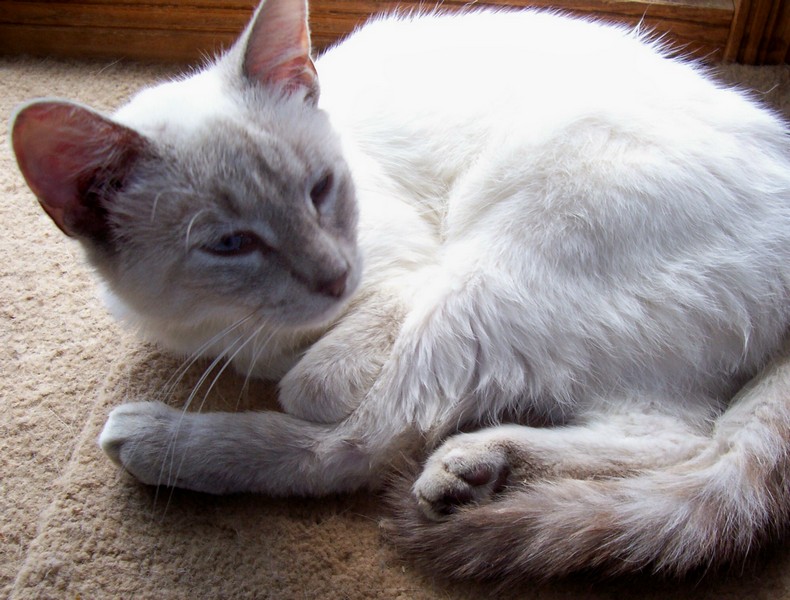
Our latest feline arrival is this pretty female Siamese/tabby who showed up after a heavy rainstorm this past summer (2010).  She was way up in high a tree and crying pitifully. The white cat looked like a little spirit up in that dark spruce tree, so I immediately named her Angel. When I called to her she came right down into my arms, which told me she wasn't feral.  But she was very thin and starving for both food and love.  Nobody ever claimed her, so she lives here now, too.  As soon as she was well enough, we got her spayed, thanks to the all the generous people who helped us out. She got so attached to me (sleeps on my bed now) that I did not want to traumatize her again by re-homing.  She really is a  very sweet kitty, I can't imagine why somebody would dump her.

People have asked me why we have so many cats.  No, I'm not hoarding them!!!  Frankly, I'd rather have fewer cats -- as of this writing, the kitty count is at 13, which is a LOT of cats.  The thing is, they keep showing up here on our farm, and I don't have the heart to send them to a shelter where they would probably be killed if not adopted.  There have been a lot of foreclosures around here and I think many of these cats were left behind when their owners moved.  People think (falsely) that cats are more attached to places than people -- not true, so never abandon your kitty! 

Anyway, they do help keep the rodent population down around the poultry house and garden, which is better than setting out traps and poisons.  So for now, I'm managing a cat colony, some indoors and some outdoors.  And yes, I do get them all spay/neutered, so we have the cat population under control.   This gets expensive on my limited income, so of you would like to help, go to:

http://gofundme.com/rooster613-cats


The graphic I used for years on eBay.  These kittens are,
of course, long ago adopted out to forever homes,
after which their mother, Chayah Cat, was spayed. 

Monday, September 21, 2009

Sunshine the rooster -- a rescue tale with a happy ending

Meet Sunshine --


a cross-breed rooster (probably Leghorn x Buff Orpington) that we rescued in 2005.  If he looks a little ragged  and henpecked -- well, you should have seen him the day we got him.  He was a whole lot worse back then.  This bird has been through a lot in his life.  Here is his story:

In the fall of 2005...  

My neighbor Bob from down the road stopped by and asked if I wanted a chicken. Seems this rooster had turned up at his brother's place and was being chased by the dogs and pecked by other chickens, until he finally squeezed himself behind some hay bales in the barn and hid.  His brother didn't need a rooster, but neither did he want to eat him or see him be killed. Could I please take him?   How could I say "No" to a story like that?

He gets his name

Bob had the chicken in a sack in the back of his pick-up truck and said the bird was pretty wild, so I didn't get a look at him until I put him into an empty cage.  Man, was that rooster in sorry shape. Most of his feathers were missing or broken, his comb, face, and back were all bloodied up, and he was absolutely terrified (can you blame him?)  From what was left of his feathers he appeared to be white with golden shoulders. I immediately thought of the John Denver song, "Sunshine on My Shoulders " (which, by the way, was written here in Minnesota) so I named him "Sunshine."

A bird with a serious social problem...

Sunshine spent that winter living in a cage by himself, both to heal and because he was so terrified of the other chickens. I speculate that he was somebody's "Easter chick" who imprinted on humans, then grew too big and noisy to keep, so they dumped him "out in the country" to fend for himself. Which he did not do very well.  Had we not captured him, he would never have survived a Minnesota winter. 

Sunshine was definitely a young bird from that year's hatch -- you could tell by the short spurs on his legs, which had not even grown in at the time I got him.  As he got to know me, he became tamer, and I was able to take him out of the cage for some attention and exercise. 

In the spring of 2006 a predator killed the old rooster in my flock, so I thought maybe Sunshine could live with those hens. Total disaster! They chased and harrassed him until he hid in the corner or in one of the nest boxes.  They saw him as an intruder to be driven away.  So it was back to the cage again. I hated that, because he was a big bird who needed to get out and stretch. In order to give him some freedom, I let him run loose inside the goose pen when the geese were outside free-ranging. 

The happy ending....

By the end of that summer, those roosterless hens were moulting and growing new feathers for winter. Sunshine had gotten to know them through the chicken wire door, and was no longer afraid of them. Plus, fall is the season when breeding is over and birds, both wild and domestic, are beginning to flock.   Could the hens accept Sunshine now? 

I gave it a try and.... YES !!!!! This time, there were no fights. Having been deprived of sex all summer, those hens were more than ready to accept a new rooster.  Sunshine began to flap his wings and strut like a rooster should.   And that's when I found out that Sunshine was what I call a "dancer" -- a rooster who struts and shows off and courts the hens gently, rather than chase and rape them like some roosters do.  He still looked pretty straggly in places, but he eventually lost his old battered feathers in the fall  moult and, as the new ones came in, was even more beautiful.

Then he became a father!

In the spring of 2009, he sired 3 chicks, two hens and a rooster, shown half-grown in this picture, with the barred bantam hen named Spunky who hatched them.   The white one in the upper right turned out to be a male that my grandson named Star.  (The others are both hens, named Snowball and Maggie.)   Star is almost full-grown now and so far, he gets along fine with his father and the rest of the flock.

Then he crossed the Rainbow Bridge in 2009 

Sunshine died peacefully in his sleep during the winter of 2009, "Crossed the Rainbow  Bridge," as some people say.  Star, his son, became leader of the flock, and his 2 sisters inherited thier mother's colored-egg-laying ability -- Snowball lays olive-green eggs and Maggie lays light blue ones. 

(This story was originally posted on my eBay blog in September 2006.  It was moved here and updated when eBay decided to close down their own blog platform.)

Monday, September 14, 2009

Bonnie and Clyde: Two chickens on the run!

In late summer of 1997, my wife and I were driving to Duluth (75 miles away) on Interstate 35 and went to use the facilities at a wooded rest stop located near a little pond. We noticed a pair of brown and grey half-grown chickens running around and asked the caretaker about them.  He told us they had showed up a couple weeks ago -- probably dumped there -- and he had been trying unsuccessfully to catch them in a live trap. He wasn't even sure they were really chickens -- he thought they might be pheasants -- but I assured them that yes, they were indeed chickens, only not the usual white-feathered commercial variety.

I asked if we could have the chickens and he said yes, if we can catch them, we can have them -- good riddance! Well, the best way to catch a chicken on the run is not with a trap. Rather, you figure out where they are roosting and come back at night. So I asked where they hung out at dusk, and he told me they went into some short evergreens. I looked under the trees and sure enough, there were chicken droppings on the ground. It was about 5:00 PM and we would not be back from Duluth until after dark, so I said I would bring a box and capture them then. This particular caretaker had just come on duty and said he would still be there when we got back.

Around midnight we returned, borrowed a flashlight, and headed for those trees. The two chickens were roosting on a branch about 6 feet off the ground. I simply picked them up and put them in the box, no problem. The caretaker was amazed at how easy it was. (But then, we are experienced Chicken Busters!) We took them home, put them into an empty breeding cage in the coop, and went to bed.

Next day, when I examined the chickens more closely, I could see we had a young rooster and a hen. We dubbed them Bonnie and Clyde because they were captured "on the run." They turned out to be some kind of gamecock variety. Clyde had a lovely silver-grey breast with golden hackle feathers, a reddish rump and shoulders, and a flowing silver-grey tail. Bonnie was brown and did indeed resemble a pheasant -- without the long pointed tail.

Clyde eventually sired a number of chicks with Bonnie and some of our other hens, and was an excellent watch-bird around the yard. He was friendly with people, but don't let a predator come around! He actually attacked my old sheepdog, Grett, who everafter stayed away from the chicken yard. (Grett didn't chase chickens, but Clyde was making sure!)

Bonnie lived to be 8 years old and died in the spring of 2005. Clyde lived to be 9 and died in the late winter of 2006. Both are buried in our pet cemetery now, but left many descendants behind, including. Rocky Rooster, the cocky bird on the covers of my Happy Rooster eBay selling series, who was a cross between Clyde and a Barred Rock hen.  (He, too, has now crossed the Rainbow Bridge.)  And so, their memory lives on!

Rock Rooster, son of Clyde,
inspired my eBay store,
"The Happy Rooster"