Showing posts with label nature. Show all posts

Tuesday, April 4, 2017

Book Review: "The 99 Names of God" by Daniel Thomas Dyer

Daniel Dyer, author and illustrator of this beautiful children's book, has created a wonderful set of lessons for connecting with God's presence in the world around us.  Although The 99 Names is intended for Muslim children, it's really a treasure for all ages and faiths. In fact, it could be used as a basic primer on spirituality, and would be a fine addition to any religious library. I defy anyone to read this book and not come away with a deeper appreciation of God's presence in the universe.

In a time when there is so much misinformation (and hostility) about Islam in the Western world, this book goes a long way toward opening a window on what true Islam is really like. If there's one thing Jews and Muslims have in common, it's the plethora of hostile websites claiming to "unmask" us by taking quotes out of context and compiling lists of every negative thing ever said by any of us anywhere.  For years it has been an uphill climb for me to convince non-Jewish readers that we Jews even have any spirituality. Recent dialogues with Muslim teachers have shown me that they, too, have this same struggle. Hence my delight in finding this very accessible book.
A sunset reminds us of God/Allah
as The Majestic One
The author begins by explaining that Allah is simply the Arabic word for God. In Arabic-speaking countries, non-Muslims -- including Christian priests -- also call God "Allah."  This is an important point, since many Christians in America assume that Allah is a separate deity from the Creator in Genesis. I have more than once been told that Muslims worship Allah, not God, which is as absurd as saying that Germans worship Gott and the French worship Dieu as separate deities. In fact, "Allah" comes from the same Semitic root as "Elohim," the name of God used in the first chapter of Genesis.

God/Allah is the Giver of Life 
Here again, Muslims and Jews have something in common, namely, the distortion of our God-language in the American public mind.  Non-Jews tends to think of the "Jewish God" as an "angry Jehovah" (which, by the way, is not how YHVH is pronounced) and some even go so far as to claim that Jews don't believe in God at all.  The "Muslim God," Allah, is seen as nothing but a cruel warmonger. Both of these are negative stereotypes that purposely disguise the fact that all three Abrahamic religions -- Judaism, Christianity, and Islam -- worship the same Creator of the universe.

This book serves as a primer for teaching us that true Islam is indeed a peaceful, reverent path that respects all life. Dyer, who is a British convert to Islam, was initially attracted to the faith through the poetry of Jalal'u'Din Rumi, a thirteenth century Persian mystic and scholar who taught: “Christian, Jew, Muslim, shaman, Zoroastrian, stone, ground, mountain, river, each has a secret way of being with the mystery, unique and not to be judged.” Rumi saw the evidence of God's presence everywhere.  This poetic universalism comes across in the book, teaching children to build bridges, not walls, among the faiths and peoples of the world.

Jalal'u'Din Rumi
Each lesson in The 99 Names has one or two Names (depending on context) in Arabic calligraphy, transliteration, English translation, and a quote from the Quran using the Name. This is followed by a simple but meaningful explanation of how that aspect of God is manifested in the world around us. Also included are teachings and stories from the Prophets and various Muslim sages, both male and female, and positive references to other religions.

Most non-Muslims (including me) would be hard put to name 99 different attributes of God -- which is what the Names really are. God is the Compassionate, The Merciful, the Sovereign, The Holy, the Source of Peace... and so many more. This, I believe, is a great gift that Islam has brought to the world at large, to remind us of how many different ways God manifests his/her Presence.  All too often, we limit God to a single attribute -- such as Love or Peace -- and forget how all-encompassing Omnipotence really is. Love is an attribute of God, yes. But God is so very much more.

A cat manifests God/Allah's
attribute of Watchfulness
I have gained a lot of new insights from contemplating the lessons that author Daniel Dyer sees in these Holy Names.  As author of a nature blog, I especially like the way the lessons connect the Names with nature, encouraging the reader to look for God's ways in all things. (The nature photos here are my own, not from the book. They are examples of how I see God/Allah's presence through the eye of my camera.)

 Once again,  Muslims and Jews are on a similar quest, to bring our urbanized children more in harmony with the wonders of God's world and our responsibility to care for it. This is where all people can come together in harmony, since we live on one earth. (I was also happy to read that Muhammad loved cats.  Readers of this blog know that I do, too!)

Each lesson has a "Signs of (Name)" section, with many examples taken from nature.  The cat, for example, is Watchful, pairs of geese are Faithful, a sunrise is Glorious.  The lessons also have a "Reflections and activities" section where children and parents can discuss/do things together. As author Dyer explains in his introduction,  "No answers are contained in this book. The important thing is that we learn to ask questions, reflect, research, and discuss with others to arrive at out own considered point of view."  Rather than being a book of dogmas, it is a map for exploration.  I highly recommend it.

(This essay was updated by the author on April 5, 2017)

Monday, May 23, 2016

In praise of dandelions!

Why would I be praising dandelions?  Aren't they the bane of every homeowner with a lawn?  Yes, if you want to maintain a total monoculture in your yard.  But nature abhors monocultures, and will do everything she can to diversify them. Perhaps it is time for us to rethink the way we use the land around our homes.

Early-blooming flowers like dandelions are a major source of spring food for bees, butterflies, and other pollenators.  With the current bee shortage in many parts of the world, these insects need all the help they can get.  So I let the dandelions alone until they are done blooming, then mow them down. Sure, that spreads the seeds around -- but since I want dandelions, that's no problem for me.  After all, a "weed" is by definition simply a plant growing where you don't want it.

Our street number in spring
Granted, I live out in the country, where the philosophy pretty much is "if it's green, its a lawn."  In more controlled suburban neighborhoods you might have a hard time convincing your neighbors to let you have a lawn full of dandelions -- but then again, that's why I don't live there.  Nature is more important to me than social status.  If you visit me in the spring, you will likely be greeted with hundreds of these bright yellow flowers dotting the landscape.

Dandelions are also nutritious. In fact, they were brought to the USA as a vegetable by the French. ("Dandelion" comes from the French dent de leon, "Lion's Tooth," named or the jagged edges of the leaves.)  Old herbals prescribe them as a cure for scurvy, and recommend eating as many leaves as you can find in the spring.  Good advice at a time when people didn't understand about Vitamin C deficiency.  But they did know that the plants leafed out very early and the cure worked.

You need to pick dandelion greens before the plants flower, however.  Once the blooms appear, the whole plant gets very bitter -- so bitter, in fact, that I've known nature-oriented Jews to use them for the "bitter herbs" at the Passover Seder instead of the usual horseradish. (Which is perfectly kosher -- the Torah says "bitter herbs" but does not name a species.)

My chickens and geese also know the value of dandelions as food, and will choose them over other greens. Here you see two geese gobbling down fresh dandelion leaves, while ignoring the grain feed they've been eating all winter.  They know good nutrition when they see it!

Dandelions can also be used to make dandelion wine.  There are a lot of good recipes online, but one thing they may not tell you is to use the yellow petals only!!! The first time I tried it, I used whole dandelion heads and ended up with a bitter brew that only a masochist would care to drink.  That's because the green base of the flower (called the calyx) has the same bitter taste as the stems.  Having learned my lesson, I now use only petals.  The easiest way to prepare these is to hold the flower head in one hand and cut off the yellow ends of the petals with a scissors. A bit tedious, but you'll have a far better wine.

If nothing else, I find dandelions to be a welcome, happy greeting in spring after a long Minnesota winter.  Like little yellow smiley faces, telling me to come out of hibernation -- spring is here!


Thursday, October 1, 2015

The Sukkot Super-moon eclipse of 2015

The first night of Sukkot (Feast of Booths) always falls on the full moon of the Hebrew month of Tishri.  This year it was not only a full moon, it was a super-moon, because the moon's orbit brought it closer to Earth than usual.  But even more special, it was also a total eclipse where I live.  All of which made this a Sukkot night to remember.

My wife Caryl and I began eating in the Sukkah around 7:30, when the eclipse was just beginning.  We could see the moon through the natural branches on the Sukkah roof, but after the meal we decided to move our chairs outside for a better view.  The sky was not perfectly clear.  There were clouds moving across the sky, which sometimes obscured the moon.  Each time it appeared through a hole in the clouds, it looked a bit different as the eclipse progressed.  This added to the mystique, I think.

The night itself was perfect.  Not too cold, yet cool enough to be comfortable.  One interesting thing we noticed was that during totality, there were no mosquitoes.  Do they become less active in total darkness?  Normally the bugs are most active at dawn and dusk in the twilight.  As the eclipse came out of totality, there were again a few mosquitoes buzzing around us.  An interesting phenomenon.

 Sitting there together under the eclipse light was a romantic experience for Caryl and me, and we began talking about how long it had been since we had simply sat together in quiet sharing.  Watching the eclipse became a calm, gentle meditation for both of us.

We stayed outside the whole 3.5+ hours it lasted here in Sandstone, MN.  We could not take any photos because that is forbidden on a Jewish holy day, but the beautiful images of the experience are forever saved in our hearts.

Friday, July 3, 2015

In Memory of "Big Bird," my pet rooster


I am sad to report that Big Bird, the ten-pound yellowish-white rooster who appeared with me on posters and the cover of my latest book, has crossed the Rainbow Bridge.  He was the victim of a predator attack, probably coyotes, that also took the lives of two other chickens and a guinea fowl.  They will all be very much missed.

Big Bird was going on 11 years old -- a very long life for a chicken -- and was spending a lot of time in a cage anyway, because he could no longer fly up to the roost at night.   But he still loved going outside with the other birds on nice days.  So I let him take the risk and enjoy a more natural life as a free-range chicken.  At dusk he would come back to the coop, where I would put him in his cage for the night.  Last night he did not return, and stayed outside somewhere, along with a few chickens and two guineas who had taken to roosting outside instead of inside the building.  I looked for him but could not find him in the dark.  This morning I found the carnage, including the destroyed nest of a barred hen named Rockette who had been secretly incubating in the bushes.  I knew she was broody by her behavior when she came it to eat, but had been unable to find her well-hidden nest.  Last night the coyotes obviously did.


It is always very sad when this happens.  Nature is not Disneyland, and in the real world animals do attack and eat each other.  That's the reality of that "circle of life" that everyone is romanticizing lately.  Life is not a cartoon, and finding piles of feathers and other remains in the yard is not pretty.  I feel terrible when I lose a bird to predators, but at the same time, I still feel they would rather run free than be caged all the time.

I suppose it's a lot like letting your children run free instead of "helicoptering" them everywhere.  Yes there are dangers and risks, but there are also the joys of freedom and exploration.  I feel sorry for many of today's kids who don't have the "free range" experience I had back in the 1950s, when I rode my bike all over town and played for hours alone in the woods.  That experience shaped my love of nature and helped make me the writer that I am today.  Nowadays, parents are being arrested in some cities for letting their kids walk a couple blocks alone to the park.
(See freerangekids.com for actual cases of these ridiculous ordinances.)


Big Bird was the poster child with me in the 2013 campaign against using chickens as Kapporos, by the Alliance to End Chickens as Kapporos.  (See poster above)

A different pose from the same photo shoot (My wife Caryl was the photographer that day) now immortalizes Big Bird on the cover of  my latest book, Kapporos Then and Now: Toward a More Compassionate Tradition,   In this book, I present the issue from both sides (practitioners and protesters), explaining why the vegan" meat is murder" argument does not work, and presenting other, more effective reasons for using money instead of chickens.

The best memorial  you could give to Big Bird is to buy a copy and educate yourself about the Kapporos controversy, then pass a copy on to your local Orthodox or Hasidic rabbi.  In this way, Big Bird will continue to help his fellow chickens live to lead longer, happier lives.

Thursday, October 23, 2014

Father Goose adopts flock of Guinea Fowl

Junior and Prince
This is the story of an inter-species friendship between Prince the Goose (white bird in photo on the right) and a flock of guineas.  Prince and his son, Junior (grey bird in photo), are the last of a small flock of geese we have had on our hobby farm.  Geese live a long time -- Prince is now 14, Junior 13 -- and I'm not getting any younger, so I have let the flock slowly dwindle from old age. (We are vegetarians.  We eat the eggs but do not slaughter.)

With geese, the ganders help care for the young.  Since Prince no longer has a mate and there are no goslings around, he has turned his affections toward my guineas.  From the moment I brought home four half-grown guineas last fall, he has taken a most paternal instinct toward them.

When they first arrived, I had to keep them in a cage inside the coop for a couple weeks before letting them free range -- otherwise they would try to "home" back to where they came from -- and Prince stood guard by the cage every night.  When I finally did let them loose, he followed them around the yard.  Junior went along, but it was primarily Prince who set the pace.  And he made sure they went back in the coop, too.  If they tried roosting in a tree, he stood at the bottom and raised a ruckus!  By the time the first snow came, they were well trained to go inside.

The guineas turned out to be three males and a female.  I really had no intention of breeding her, but she had other ideas.  Her first nest she built too close to the road for comfort.  Prince was having a fit because the road is his boundary and the males were going across it to my neighbor's yard.  That's how I found the nest.  I took the eggs before she started setting, hoping that would be the end of it.

Can't find Molly?  Click photo to
enlarge and try again!
So what did she do?  She hid her second nest closer to the coop in the tall grass.  I didn't find this one until she was incubating, so I let her be.  If you look really, really closely in the photo, you can see her in there.  That brave bird sat through two very strong rainstorms and held fast to her eggs -- I thought for sure I'd find her drowned the second time, when high winds brought four inches of rain within hours.  But she built well, on top of a little rise, earning her the name "Molly Brown"  (of Titanic fame, since both survived dangerous waters.)  Why didn't I move her inside?  Because moving a guinea nest is very risky.  They are wild, flighty birds who often abandon the eggs if disturbed.  Better to leave nature alone.

Molly's well-hidden nest
There were 15 eggs.  12 hatched but one baby died, leaving 11.  I wasn't sure exactly when she started sitting, so I checked every day.  Luckily I found them right after hatching, because the grass is cold and wet in the morning this late in the year.  That can mean death to new keets. So I caught them all with mother Molly and put them in a large cage inside.

Prince stood by them outside the cage, often not even wanting to come outside the coop.  When they were feathered out and big enough, I turned them loose -- and here you can see both ganders herding the flock around the yard!

Prince herds the flock home toward evening, fall 2014.

Prince and Junior guarding the flock
in the chicken yard, fall 2014. 

Wednesday, October 8, 2014

Blood Moon was beautiful on the morning before Sukkot starts, 5775

Tonight the Festival of Sukkot (booths) begins.  Because the Jewish calendar is lunar, Sukkot always begins on a full moon.   So nothing unusual about that.  What was special this year was the beautiful "blood moon" eclipse this morning (October 8, 2014).  It reached totality at 5:55 AM here in Minnesota, and is currently trending all over the Net.  In some places, people gathered for "blood moon parties" to watch and enjoy it.  That would have been fun, but out here in rural Minnesota, it was a solitary experience for me.

Here on our little hobby farm, I was up at 4 AM cooking food for the Festival so that I could use the daylight hours to finish setting up my sukkah booth.   The local news stations were covering the eclipse, so every half hour or so there was a live update during the weather report.

Just before totality, I went outside to take a look.  The sky was clear but the trees were in the way, so I had to walk out to the road to get a good view.  (We have a much better view of the sky in the east, where I often take wonderful dawn photos.  But this time around, the eclipse was happening as the moon was setting in the west, where we have a windbreak of trees and bushes.)

We live out of town on a dirt road with zero traffic this time of night, so I could stand there moon gazing, but it was also pretty cold  -- in the mid 30s -- so I didn't stay out long.  In fact, it was so chilly that there were no crickets chirping.  Nor were there any other nature sounds.  The wind, which had been blowing hard the last few days, was now still.  No traffic sounds, either -- even the freeway, which I can sometimes faintly hear at night if a noisy truck goes by, was silent.

Then, for some reason known only to himself, one of my roosters crowed.

According to an old superstition, a rooster crowing at night is a bad omen.  So is a blood moon in some cultures.  So a blood moon and a rooster crowing at the same time -- oy vey, is that a double whammy?

Hardly.  I'm not superstitious.  I see these things as natural phenomena, period.   One of my favorite stories is the one about the Jewish archer in the Roman army who asked why they had stopped marching.  His commanding officer pointed to a certain bird in a tree and said that it was an omen telling them to stop.  Whereupon the archer shot the bird and said, "That bird could not even protect itself from my arrow, so how can it protect an army?"  (Sad that the bird had to die, but the point was made:  Looking for omens in natural events is not a Jewish practice.)

Returning to the eclipse, I did take time to make the brochah (blessing) osseh ma-asseh bereshit -- praising "The One (God) Who creates the works of Creation" -- that Jews are supposed to say upon seeing a wonder of nature.  It may not be an omen, but it is a wonderful thing to look at.

My wife, who has difficulty walking and some balance problems when walking in the dark, opted to stay inside.  So I downloaded this beautiful photo on space.com taken in Nebraska by John W. Johnson of the Virtual Telescope Project.  I set it up as the desktop wallpaper on the computer, where we can both enjoy it today, as we continue to prepare for the holiday tonight.

Peace and blessings! 


Tuesday, September 23, 2014

Got allergies? Don't blame the goldenrod!

It's mid-September and the goldenrod is now in full bloom -- right about the same time that the pollen count hits the roof.  Over and over, I hear people blaming their hay fever on goldenrod.   But they are wrong!  Read on...

A field of goldenrod on my land in Minnesota --
haven for many butterflies & other insects
 Everyone can see the bright yellow of a field of goldenrod plants in full bloom.  As they look at all those yellow flowers along the road, they visualize clouds of pollen choking the air.  Just the sight of it all is enough to make some people sneeze.

But the fact is, goldenrod pollen is not spread by the wind at all.  This is why weather reports that include a pollen count never even mention goldenrod as a source.

A Goldenrod flower
Don't believe me?  See for yourself: Touch a goldenrod flower and you will not have any pollen on your hands.  Shake one and you won't see any clouds of pollen hitting the air.  It just doesn't blow around.   It spreads by sticking to the bodies of insects.  Unless you are a bug with lots of tiny hairs on your body to pick up the pollen, it doesn't leave the plant very easily.  Ecologically speaking, Goldenrod is an important nectaring flower for wasps, bees, butterflies, and other beneficial insects.  So please -- don't yank it out!

Ragweed plant in full bloom
The real culprit is ragweed, a coarse weedy green plant that blends into the background in fields and woodland edges.  Unlike the showy flowers of goldenrod, the rather nondescript flower stalks of ragweed are just loaded with pollen, and it does indeed spread on the wind.

Ragweed is not particular about habitat, and will grow just about anywhere.  The plant in this photo grew next to my compost pile, so it got to be over 6 feet tall from all that rich chicken manure.  Along the road you might see flowering ragweed only about a foot high, eking out an existence in the hard-packed gravel on the shoulder.  But once you learn to recognize it, you'll see it growing just about everywhere.

(Well, maybe not in the high desert -- but it crops up in irrigated areas like Las Vegas.  In fact, according to The 30 Worst Cities for Ragweed, Las Vegas ranks #2.  The top city on the list is Phoenix, Arizona.)

The stuff is very easy to pull up, so if you learn to to recognize it before it pollens out, you can at least eliminate it from your garden.  But with all the acres and acres of wild areas where it can flourish, you will probably have to wait until frost kills the plants before your "hay fever" finally goes away for the season.  Just don't blame your misery on the innocent goldenrod!

Typical distribution of ragweed pollen in
the USA in September

Tuesday, July 29, 2014

A beautiful pink and white spider!

"Even things you see as superfluous in this world -- like flies, fleas, and mosquitoes -- are part of the greater scheme of the creation of the world.  'And God saw all that God had created, and behold it was very good.'" (Midrash Exodus Rabbah 10:1)

For many people, including the words "beautiful" and "spider" together in the title of this blog post would be an oxymoron.  Spiders are often seen as ugly and even fearsome creatures.  But for those who can get beyond their arachnophobia, some spiders can indeed be attractive.  Consider this pretty spider I spotted on a milkweed plant in my garden. (Click photos to enlarge):

I had never seen a spider like this before, and was amazed at how the pink stripes on her (yes, it is a female) abdomen exactly match the color of the flowers.  I could not find this species in any of my nature books, so I googled "pink and white spider" and immediately found this page on a spider website that not only identified the species, it gave me a lot of other interesting info.  Turns out my pink and white spider is nothing rare.  The species is very widespread and often found on a variety of flowers. There were many, many more sites where people asked or wrote about this interesting spider.

The scientific name is Misumena vatia, and it a variety of crab spider, known as both a Milkweed Flower Crab Spider and a Yellow Goldenrod Crab Spider, among several other names.  This is one of the few North American spiders that can change its color to match its surroundings -- an arachnid chameleon!   After reading this, I remembered that I had seen similar spiders on goldenrod flowers, but they were yellow.  Now I know they are the same species.

This is a "wait and pounce" type of spider that does not spin a web.  Instead, it sits quietly on flowers, blending in and waiting for something to land.  When I checked back a few hours later, the spider was still there and feeding on a yellow jacket wasp that she had caught.

Which brings me to another nature observation.  This summer, I have not seen a single honeybee anywhere on my land.  Not one!  As you may already know, the honeybees are facing a serious health crisis and are dying out by the droves.  Years ago I used to stand under my apple trees when they were in bloom and hear a constant, busy humming as the bees did their work.  But no more.  This year, the fruit trees were silent. 


Hornet on milkweed
However, I am still getting pollenation on my flowers and vegetables.  The niche has been taken over by various other insects, including paper wasps, yellow jackets, hornets, flies,  moths, butterflies, and a variety of species of bumblebees.

This is why I do not remove wasp nests unless they are in a spot where they might be a problem for animals or humans -- such as right over a door way.  Otherwise, I leave them alone.  To those visitors who complain about wasps flying around, I reply that these are the insects responsible for pollenating the vegetables we harvest.  Plus they are insect predators, removing a lot of destructive caterpillars from the garden.  Really, the wasps and hornets are more beneficial that bothersome -- and if you don't bother them, they won't bother you.

Friday, August 30, 2013

Stirring up a hornet's nest -- literally!

Over the years, I have stirred up plenty of symbolic hornet's nests with my controversial stances on various issues -- but this time I did it for real.  OK, they were really Yellow Jackets, the smaller cousins of the Bald-faced Hornet -- but they get just as angry when you disturb their nests.

Yellow Jackets coming out of
an underground nest (Photo courtesy of
South Texas Nature Images on Flikr)
Of course I didn't do this on purpose -- nobody does that!  A couple days ago the wind took down a paper birch tree, and I needed some nice sticks for an upcoming Cub Scout craft project that my grandson's Pack is planning to do.  (Since I have a wood lot, it falls to me to provide a lot of the natural materials.)  I thought the white birch bark would look nice, so this morning I went out to cut off some of the branches -- and unwittingly stepped into the nest.

Yellow Jackets usually nest in the ground, often using an old rabbit hole or other tunnel, so they are very hard to see until it is too late  This one was covered by the crown of the fallen tree.   I was so intent on choosing and cutting my salvaged branches that I did not notice the wasps until a swarm was buzzing around me.

Luckily I was wearing heavy pants tucked into my boots, in preparation for tromping through underbrush in the ditch where the tree fell.  Good thing, because those little buggers grabbed onto the cloth of my pants and really hung on -- if I had been wearing shorts, I would have had stings all over my legs.  As it was, I only got 3 on my arms and one on my face as I high-tailed it out of there.  (This is why I'm always telling people NOT to wear shorts in the woods.   Sure it's hot wearing long pants -- but even worse getting scratched up or stung!)

While on the subject of Yellow Jackets, you may notice that there seem to be a lot more of them around your picnic table in the fall.  This is because during the summer they feed their young on insects, so they don't have much interest in your bottle of pop or your jelly roll.  But in the fall, after the new queens have flown and the colony starts to break up, the worker wasps switch to a sugary diet -- and start buzzing around your outdoor events.  Suddenly it seems as if the population has exploded overnight.  I myself have noticed a lot more of them around my hummingbird feeders lately -- and now I know where they are all coming from!  But really, they have been increasing steadily all summer, you just don't see many until fall.

Unlike honey bees, wasp and hornet colonies don't winter over.  The new queens fly and mate, then find a place to hibernate for the winter.  The rest of the wasps die off  with the cold weather.  So, after we get a few hard frosts, I'll be able to return to that tree and safely salvage some birch sticks.

Tuesday, August 13, 2013

Meteors and Memories

Last night I finally got to watch the Perseid meteor showers.  I say "finally" because the previous nights this year were cloudy, and last year it rained the whole time.  But last night was perfect.  A clear sky with no moon.

About half an hour after midnight I turned off all the house lights to avoid light pollution in the yard, then took a sleeping bag and a pillow outside and lay down on the front lawn.  (My wife originally wanted to go, too, but was too tired when the time came, so she wished me well and went back to sleep.)  I was soon joined by two of my cats, who came up from hunting rodents by the chicken coop to sit on me and purr.

I did not have to wait long to see a meteor.  I counted 23 in an hour, several of them big bright streaks, but none to compare with the fireball my wife and I saw several years ago.  But even with the excitement of seeing a meteor, it was still a slow, quiet activity, with a lot of waiting between sightings.  You can't push nature, you just have to go with her pace of things.  As I lay there waiting for the next one to streak across the sky, I was reminded of when we did this at summer camp many years ago. It was a pleasant time to reminisce.

I also saw what was probably a satellite moving across the sky -- or was it maybe the space station?  I remember back in the late 50s and early 60s, when satellites were a new thing, there used to be schedules in the paper about when they would pass over.  My father and I would go out in the yard to try and spot them.  It was a big deal back then to spot a passing satellite -- way before GPS and satellite TV, long before anybody felt a need to "unplug" because nobody was as plugged in and speeded-up like today.  What we watched were just little orbiting balls reflecting the sun, the very beginnings of space flight.

The night was chilly and getting downright cold -- unusual for mid-August here, but welcome, because there were no mosquitoes.  The ground was getting damp though, and my old bones were feeling the lumps in the ground.  so after another half hour, around 2am, I went inside and called it a night.

Tuesday, July 30, 2013

OY VEY! All this milkweed and NO MONARCHS!

For the past 16 years I have been allowing Common Milkweed to naturalize on my land for the Monarchs butterflies. This is just one of several big patches that I maintain.  (I am now in the process of certifying my land as a Monarch Way Station through Monarch Watch.)

Normally I could walk out there and within minutes find the whole life cycle of the Monarch butterflies.  This year: zero-zilch-nada.  I found only THREE EGGS, which I brought in to raise for my grandson to watch.  Only one hatched.  It is now a pupa.  The question is, when it emerges as a butterfly, will it be able to find a mate?

As for adult butterflies, I've only seen one Monarch all summer.  Other species are scarce, too.   Normally this field would be teeming with all kinds of butterflies, as well as bees and other insects.  This year there are very few.   According to a March 18, 2013 article on the National Geographic News site, this year has hit an all-time low for Monarch populations.

The most common butterflies on my land this summer seems to be the skippers and  fritillaries, but even those are few and far between.   I saw on the news that we have lost a whole generation of Monarchs down around Texas, due to bad weather.  Parts of the country were so cold this spring that there was no milkweed for the Monarchs to breed on when they arrived.  Here we had rain every day for a month, followed by an unseasonal heat wave.  Now it is chilly again, breaking record lows all over the state.   Yes indeed, global weirding is a reality!

We have also lost a lot of Monarchs over the years due to loss of habitat.  Monarchs migrate north in stages --as many as four generations per summer -- and if one of those generations can't find milkweed to breed on, well, you end up with no butterflies going further north.  Like this year (sigh).  As I always do in all my Monarch reports, I strongly encourage everyone to save a space in their landscaping for some milkweeds to feed the Monarchs.  If you don't want Common Milkweed (which spreads by underground runners that can be invasive in small spaces), then try one of the many other kinds.  The so-called Butterfly Flower (formerly "Butterfly Weed") comes in a variety of colors that will fit any garden.  And it stays put in a pretty clump.

The Torah (Leviticus 19.27) says:

"When you reap the harvest of your land, do not reap to the very edges of your field or gather the gleanings of your harvest.   Leave them for the poor and for the foreigner residing among you. I am the LORD your God."

Of course, this originally referred to the human poor gleaning the fields for leftover crops.  However, I would like to suggest that we extend this to include to other species on our planet.  We need those "wild corners" for species like Monarch butterflies to survive.  Maybe this is also something that God had in mind when he told us to leave the corners of our fields.  Nowadays, very few people actually go out and glean fields, but a lot of wildlife species benefit from leaving space for them to live.  We do not need to squeeze out every bit of profit from every inch of land.  Leaving the corners for God's creatures benefits us all.  Keep this in mind when you plan your garden.


Tuesday, May 14, 2013

Year of the Cicada -- again!

This year the 17-year cicadas are emerging in the eastern United States.  We don't get to see any here in  in Minnesota, unless a few stray westward -- Michigan seems to be the edge of the range.  We have the green-veined Annual Cicada, but those do not emerge in the huge numbers of the 17-year species.

17-year cicada adult
(Photo courtesy of USDA)
This particular insect holds a special place in my heart, because I credit them with furthering my lifelong interest in entomology.

There are several broods of cicadas that emerge in different years, because I distinctly remember seeing them in the Chicago area as a child -- but when I trace back this brood (Brood II) in increments of 17, I get 1996-1979-1962-1945.  I was born in 1947 and was in high school in 1962, so the brood I remember from childhood must be a different one.  I remember being in grade school at the time.

 According to this chart from the University of Michigan, in Illinois there were emergences of brood X in 1956  and brood XII in 1957, which is about the time I remember seeing them.   There were thousands of empty nymph cases clinging to the bark of trees after the adults had emerged, each one shaped exactly like a bug.  We kids used to stick them on the backs of people as a joke -- they really do cling well to clothes!  (Boys will be boys...)

 Not long after that, we moved to Philadelphia, where I encountered the 1962 emergence that was of this same brood II coming out this year.  At the time, we called them "17-year locusts," but they aren't really a locust, which is a type of grasshopper.   I suppose people called them that because they emerged in such huge numbers, reminiscent of the biblical plagues.  But these aren't as harmful.  They make a lot of noise and can be a nuisance (only the males buzz, but there are a LOT of them!), but they don't strip the trees or eat all the crops like real locusts.

They do naturally prune trees, because they lay their eggs in little slits they make in the branches.  When the eggs hatch, the little nymphs drop to the ground and burrow in, where they spend the next 17 years underground, feeding on roots, until the time comes to dig out and become an adult.  Nobody really knows how they can tel how many years have passed -- but they do.  One of nature's amazing mysteries.

Friday, April 26, 2013

My yard is full of birds -- and the Phoebes are safely back!

When I went outside this morning, the sun was out and the yard was full of birdsong.  I heard blue jays, robins, juncos, starlings, finches, pheasants, a drumming grouse and some geese overhead.  I also spotted a thrush in the bushes.  And best of all, the phoebe who nests in the open garage each year is back!  So glad they all survived the storm.

Of course, I'm not 100% sure the phoebe is the same bird -- maybe a descendant? -- but we have had phoebes nesting in the rafters of that building for years.  We've also had them nesting under the eaves of the chicken coop -- a good choice of location, since there are always lots of flies around there.  In 2009 I was lucky enough to get this picture of the coop family, which I made into a postcard:


I called it "Phoebe Fledglings Ready to Fly" -- and they certainly were.  The next day they were gone.  (You can buy a copy of this postcard online in my eBay store, The Happy Rooster.)

Now it's warming up into the 70s this weekend (it's 61 as I wrote this) and the snow is melting off fast.  A walk around the yard showed me bulbs starting to pop up and buds swelling.  I better get out the hummingbird feeders, because those little jewels will be arriving soon, too.  Since the flowers are very late this year, they  will be hungry!

Friday, April 19, 2013

Happy Spring in Minnesota -- Ha Ha Ha!

It's like a really late April Fool's Day joke -- one that doesn't seem very funny anymore.  Just when buds were beginning to swell and I thought "Spring at last!" we get this --  knee-deep snow in my yard, with more on the way - and that was on top of the other storm we got last week!   Minneapolis got 9 inches at the airport this time around, breaking the 1984 record for snowfall on that date and making this the 4th snowiest April on record in the metro area.  St. Cloud, MN, officially got 12 inches, Duluth got 18.  Hard to say what I got, because it is still drifting  all over the place, but it is at least a foot deep in flatter areas.

Enough is enough -- I'm sick of shoveling snow!

Here is a view of my chicken coop, taken from the back porch around 7:30 this morning (To see more detail in any of these shots, click the pic to enlarge):


Needless to say, the chickens and geese will not be going outside today.  I'm not looking forward to slogging down there to feed them, either.   This is a good day for everybody to stay cooped up inside.   Since the plow has not come down my back road yet, and probably won't be here for a long while, I can't go anywhere anyway.  This certainly is not the "1-4 inches" originally predicted!


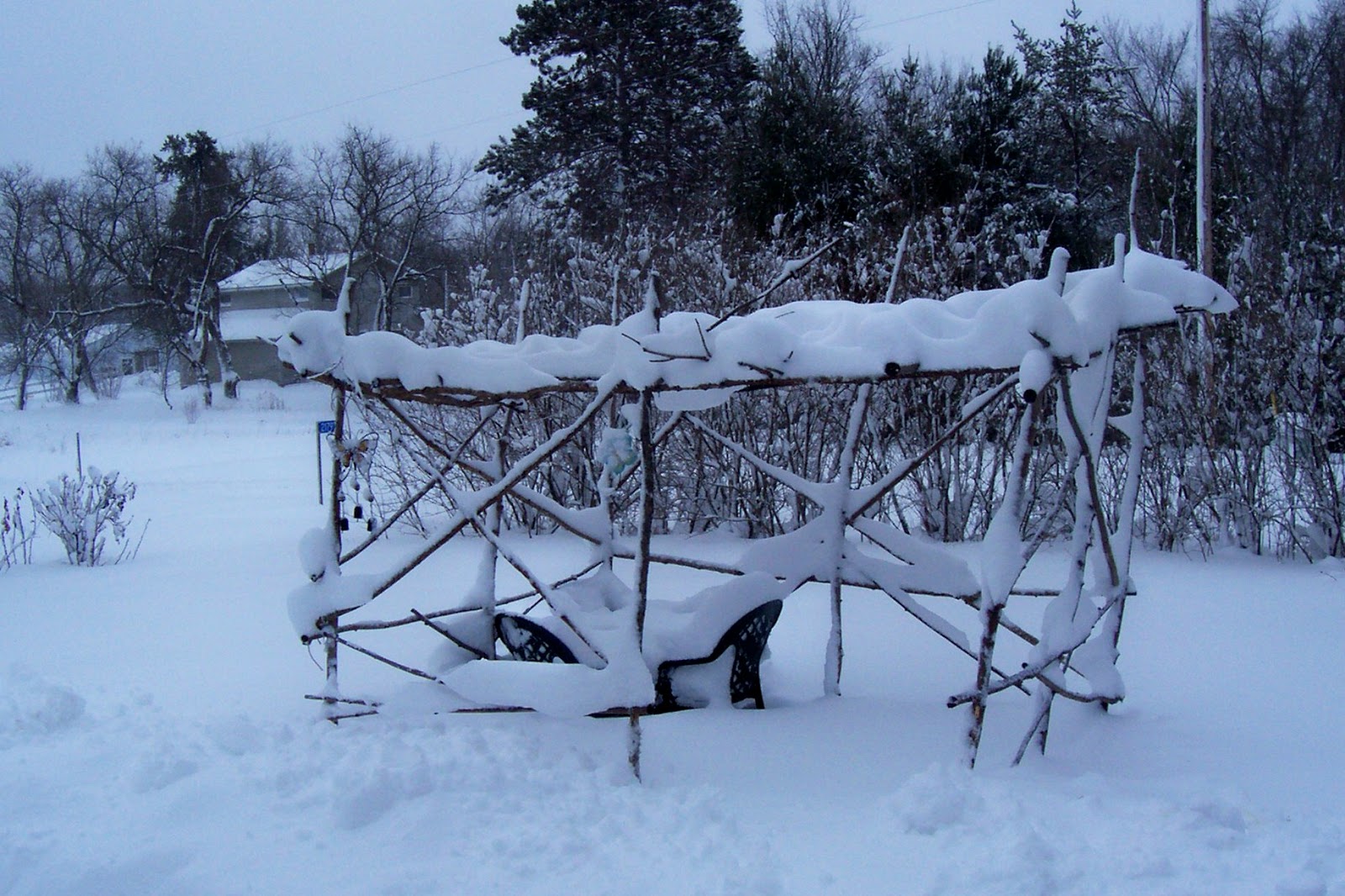
Here's a picture of my sukkah frame in the front yard.  (A sukkah is a special booth for a Jewish harvest festival.)   A couple seasons ago, I left the covering and top of the sukkah up too long, and the snow collapsed the whole thing.  (Read that story  and see a pic).  This time around, I was smart enough to remove everything down to the bare frame in the fall.  All the snow you see on top is clinging to nothing but the 2-inch diameter support poles.  Which just goes to show how very wet and sticky this stuff really is.  If it melts off too fast, there could be flooding, although since we are on a hill, we are reasonably safe from that.  But rivers are already rising in places like Iowa and Illinois, where this came down as rain.

My dog Jasmine was not too happy about the deep snow, either -- her disgust is very clear in this photo.  No way we could go for a walk today -- I just put her out on the chain to do her stuff.  She slogged out to her usual spot by the edge of the trees, then came  right back in, to flop on her bed in the mud room.

My other big dog, Gypsy, stayed out longer, but she wasn't too thrilled with deep snow, either.   She just pooped by the steps, barked in answer to the dogs down the road, then called it done.  Sherlock, our mini-schnauzer, usually goes out the front sliding door off-leash, but today he refused until I cleared the snow off the porch and shoveled an area for him at the bottom of the steps.  I can't blame him -- the snowdrifts are way over his head.

Willow tree at the edge
of my dirt road.
In spite of this late storm, there are still some visible signs of spring.  One of the first we see around here is the greening of the bark on the willow trees -- which you can see here, in spite of the blowing snow swirling past it.  While I was taking this picture I also saw pussy willows in bloom.  Normally I'd be cutting some of those to bring inside as a spring bouquet, but today I was not about to slog down there into the ditch to get them -- especially since things were starting to melt before this storm, so it could be swampy under all that snow.

The buds on this black maple are in my yard are beginning to swell.  The wind was shaking the branches so hard, the picture came out a bit blurry, but you can clearly see the reddish buds through the coating of snow.

This kind of storm does produce some really nice shots, because it sticks to everything, creating a sort of fantasyland.  Shoveling it, on the other hand, is another story.  It is heavy and sticky, clogging up the snowblowers and creating a lot of business for local chiropractors.  But since the snow is still blowing around and the plow has not been down our road yet, there's no point in clearing the driveway yet.  We're  going to just hunker down and get ready for the Sabbath this evening -- wishing everyone a Shabbat Shalom, Peace and blessings!

Thursday, April 11, 2013

Robins are back - I hope they survive this late winter storm

Three days ago I was listening to robins singing in my yard, watching a flock of juncos passing through on their way to Canada, and hearing flocks of geese overhead, honking their way back north.  Today we are getting buried in snow again -- at the same time Washington D.C. is having record breaking 90s -- in April!  Talk about global weirding.

Jet Stream, April 11, 2013
(Map courtesy of acuweather.com) 
The instability of the Jet Stream is a big contributor to all this strange weather.  I can remember when it pretty much stayed put up in there Canada, circling the arctic and dipping occasionally into Minnesota but no further south.  Now, as you can see from this map, it has gone crazy.  And with it comes all this weird  weather.  That huge dip is pulling cold air south, where it meets warm air from the Gulf and produces severe storms, including early tornadoes along the front.   It also traps warm air on the East Coast, resulting in those record-breaking 90s yesterday. (For more on how the Jet Stream is causing more severe weather lately, read this article on Climate Central.)

Last year's crab apples provide
food for spring birds
Meanwhile, birds on migration are getting caught in the storms.  The winds have been very strong today, so I suspect we will have a major bird drop around here (which is different from a bird dropping!)  A bird drop is when migrating birds come down to wait out the bad weather.  Sometimes you get to see some unusual species when the weather clears -- if the birds survive.

I find myself wondering what those robins on my land are eating today.  The Juncos can find seeds on tall grass stalks and the harrier hawk who returned a few days ago will no doubt find a rodent or two around the chicken coop.  But the ground is still too frozen for those robins to find any worms.  In the past I have seen them picking on frozen crab apples still on the trees.  So maybe that will help.

Minnesota drought map 4/11/2013
(Click pic to enlarge)
In spite of this snowstorm, we are still in the midst of a serious drought here.  Today's drought map shows my county, Pine, in the "severe" category.   (For more on the drought, click here.)

Last year it was so dry in late summer-fall that we headed into winter about 7 inches below normal in precipitation.  With the ground still frozen, all that this snow will do is run off -- which helps the wetlands downhill from my place, but won't do much for the garden.  In fact, it is so dry that, for the second year in a row, I decided not to tap my trees for maple syrup.  They grow along the edge of seasonal woodland wetlands that normally provides them with plenty of spring moisture during the melt-off, but this year it is bone dry.  I saw on the news that some syrup producers are getting a decent run -- guess it depends on where you are.  But for everybody it is very late, because of the abnormally cold spring.  In the past, syrup production would begin in mid-March and be over by now.

All of which goes to show that the climate is indeed changing.  Better get used to the new normal -- whatever that turns out to be...

Tuesday, February 26, 2013

Are eagles nesting too early this year?


This is a still shot from the Minnesota DNR EagleCam, which is focused on a nest in Minneapolis.  As you can see, there is already an eagle incubating eggs -- according to the website, there are 3 of them, laid around January 1st.  You can also see that the nest was full of snow, which the eagles have covered with straw.

Given that the incubation period for a Bald Eagle is about 35 days, these eggs are long overdue to hatch -- if they ever do.  January is awfully early for nesting here in Minnesota -- even now the lakes are still frozen, so it would be hard for eagles to catch fish (one of their favorite foods).  They do eat carrion -- I have seen them on deer carcasses -- but would the chicks do OK on that?  And what about getting chilled?  Since those eggs were laid, it has gone below zero several times.  I'll be watching this nest to see what happens.

Eagles are not the only birds who might be mixed up by the crazy weather this year.  There was a pair of mourning doves that apparently never migrated from here because of the long, snowless, unusually warm fall.  Then it went to 20 below zero (F) one night and stayed below zero for several days.   I have not seen the doves since.  Did they freeze to death?  And today I could swear I heard a robin -- no worms for it to eat yet.  Maybe it will survive on frozen crab apples still on the trees.

If climate change deniers would pay more attention to nature, it would become obvious that something is happening.   A friend of mine in Pennsylvania said she has had pigeons breeding all winter, when normally they stop until spring.   I read recently that birds in Europe are arriving 2-3 weeks early, long before the insects that they normally feed on have emerged.  This certainly messes up the breeding season, since those birds evolved to feed their young on insects.

Back here in Minnesota, we are getting a wildly fluctuating freeze-thaw-freeze-thaw, while most of our snow is going south.  In spite of the fact that there's about a foot of the stuff in my yard, we are still technically in a drought, because there was so little rain last fall that the ground under that snow is very dry.  And frozen, so when the snow does melt, it is just going to run off.  According to the weatherman, this leaves us with the strange possibility of having drought and flooding at the same time.

Friday, February 1, 2013

Nature knows no political parties

There is a saying in the Talmud that "Once the sword is let loose in the land, it does not distinguish between the innocent and the guilty."  Perhaps a corollary to this should be:  Once a storm is let loose in the land, it does not distinguish between Republicans and Democrats.

Radar map of areas
 affected by Hurricane Sandy,
October 29, 2012
I am referring to the hypocrisy of  the 36 Republican Senators who voted against federal aid for the victims of Hurricane Sandy,  yet previously voted for -- even demanded! -- similar aid for disasters in their own states. (See a list of who they are and what they previously voted for).  In Jewish numerology, the number 36 is "double life," but theirs was hardly a humanitarian decision.

To me this vote was the height of hypocrisy.  It makes me wonder why anybody would vote against helping their fellow Americans recover from the worst storm system to hit the East Coast since we have been recording the weather.  Was this in retaliation for New York City Mayor Bloomberg's support of Obama and acknowledgement that global warming is real?

If that sounds like some sort of paranoid conspiracy theory, consider the fact that in 2011 the Republicans on the House Energy Committee voted unanimously to deny the existence of climate change. This was part of a concerted campaign on the part of  the Tea Party to de-legitimize global warming in the minds of the public, starting right after Al Gore won the Nobel Prize for "An Inconvenient Truth." (Watch the PBS documentary "Climate of Doubt")  And they came close to succeeding -- until Hurricane Sandy hit and demonstrated what the scientists have been predicting all along:  Manhattan was going to end up under water.  Suddenly climate change seems very real after all.

This time the water receded, but if the polar ice caps continue to melt, the flooding of the Coast could  become permanent.  2012 marked a new low in the amount of polar ice since the advent of the satellite era (when we could observe the Earth from space.)  And no amount of denial is going to stop the big meltdown if we don't stop pouring CO2 into the atmosphere.

You can't vote science out of existence.  The universe is not a democracy, it simply is what it is.  Nature is no respecter of party politics.  Had we listened to the warnings that scientists have been sounding for decades, we might not be having these devastating (and very expensive!) super-storms now.  I have argued before that climate change -- not Obamacare or Medicare or whatever -- is the biggest threat to our economy.  Those who resist aid to storm victims are often the same people who have been trying to convince us that global warming is a hoax.  But nature does not listen to votes on congressional committees.  Nature just marches on.

It's not too late to begin changing our polluting ways, although turning the situation around is going to take a long time -- if it is even possible at this stage.  Meanwhile, the very least we can do is to help those who are in the path of the storms.

Shame on those 36 Republican Senators!


Tuesday, November 27, 2012

Stormy skies make the best sunrises

All of the photos on this page were take from the same hill on my land in Pine County, Minnesota, looking east.  And all of them were taken on cloudy mornings.

"Minnesota Snowscape"
On a clear dawn, there isn't much of a show.  The sky gradually gets lighter, there's a strip of orange on the horizon, the sun comes up, and that's it.  One clear day looks pretty much like another.  I don't photograph many of those.

But on a cloudy morning, there is potential for some really great shots.  No two cloud formations are ever the same, and the scene lasts much longer as the sun rises behind the clouds.  When I see a cloudy dawn, I grab my camera and head for my favorite spot.

"Dragon in the Sky"
And there's always that one special moment when it all peaks.  Capturing that moment can be a challenge, because you don't really know when it is coming.  So I shoot a series of shots and then choose the best.  It doesn't always pan out, but when it does, the results are spectacular. (As for the duds, well, as my father told me many years ago, even professional photographers take bad pictures -- they just don't show them to anybody.  For every great pic on my blog, there were a whole lot of deletes.)

"Flaming Sunrise"
When I was a child living in the city, we used to sing a song about "rain, rain go away -- come again another day, little Johnny wants to play." From an urban perspective, rain was a nuisance that kept me from going outside and having fun.  But now that I'm older and we are in the middle of a major drought, I realize that my childish wish for "rain, rain go away" would be a curse.  Without rain in summer and snow storms in winter, a lot of plants and animals suffer.  Including us humans.

"Red in the Morning"
And now comes the homily.  Life, like a sunrise, varies from day to day.  We say we'd like to have perpetually clear skies, but in reality that would be rather boring.  It's the clouds in our lives that add some interest, even if they do sometimes rain on our parades.  The storms provide the challenges.  As I look back over my life, the "sunny days" are pretty much one big blur.  The ones that stand out are those that -- for good or bad -- brought some excitement into my life.  And even those dark days had important lessons for me to learn.

This is not to say I'm always excited to have disruptions in my life.  After all, some storms can be really destructive.  But, as the old saying goes, there's a silver lining in every cloud.  Or, in the case of sunrises, there's always the potential for a really great peak experience.  Maybe this is why just about every religion has the symbolism of moving from the darkness into the light.  And every storm contains a potential rainbow.


"After the Storm"


Monday, November 5, 2012

Living with Predators on the Circle of Life

Last Saturday there was a big ruckus down at the chicken coop.  When I went to investigate, I soon saw why:  A Red-Tailed Hawk had killed one of my banty roosters and was feeding on the carcass in the middle of the chicken yard.  No wonder everybody was so upset!

Red Tailed Hawk
(Photo courtesy of
"Wayward" on Wikipedia)
Now, I had very mixed feelings about this sight.  On the one hand, I was sad to lose a good rooster.  But on the other hand, it was a rather exciting nature moment.  How often do you see a hawk feeding on a kill like that?  And of course I didn't have a camera  -- it was Shabbos (the Sabbath) so I wasn't taking pictures that day.  When the hawk saw me, it flew up into a tree, and just sat there, waiting for me to leave.

Over the years, I've lost a number of roosters to various predators.  Although I'm rarely there to see a wild animal go after the chickens (I did glimpse a fox once), I have seen the roosters stand up to cats and people.  In a free-range flock of chickens, the roosters are always on the alert for danger.  They are the sentries of the flock.  There is a distinctive "predator alert" call they give, which the other chickens recognize immediately and run for cover.  The rooster himself will often attack whatever is threatening them, and this is probably why so many lose their lives.  The banty that the hawk was eating must have put up a terrific fight; there were feathers all over the place.  But every other chicken made it safely into the shelter of the coop, where I found them all cackling and raising a huge racket.

Of course, if I kept the chickens penned up in cages all the time, this would not happen.  But part of the reason I have my own chickens is because I do not want my eggs to come from factory farms.  Giving the chickens freedom to scratch, peck, flock together and do all the things chickens do means a certain amount of risk.  But I believe the chickens, like most people, prefer some risk rather than be locked up.   Every living thing craves freedom.

There was a time when a farmer would shoot a chicken-stealing hawk as a matter of course.  Nowadays, these birds are protected, which I consider a good thing.  Although a hawk might take a chicken now and then, he is more likely to grab a mouse or a rat.  The number of rodents eaten by raptors is huge.  (I remember seeing a story about a family of Red-Tails that nested on a building near Central Park, New York.  I'll bet they found plenty of rats around there!)  So really, these beautiful birds are more beneficial than destructive.  Death is a part of the circle of life.  Although it is indeed sad to lose one of my roosters, I still prefer to try and live in peace with the hawks and other wildlife around here.