Showing posts with label rain. Show all posts

Sunday, September 30, 2012

A Small Miracle: The Extra Lulav and Esrog

On the Festival of Sukkot (Feast of Booths), Jews not only put up the Sukkah (booth) to eat our meals in (about which I have written before) we also wave the Four Species -- palm, myrtle, willow and estrog (also spelled etrog) fruit -- in the six directions on each day of the holiday (more on the meaning of that later).  Special sets of these are imported from Israel, and must be ordered in advance.  And therein lies a tale that proves how God works in mysterious ways.

Because I live in a remote area of Minnesota, 75 miles from the nearest synagogue, the easiest way for me to get my lulav set is to order online.  A guy named shmuly770 was selling them on eBay and since I also sell on eBay, I ordered from him.  According to plan, the lulav should have arrived by UPS on or before Thursday, September 27, well in time for the holiday, which begins this year on Sunday night.

However, there was a problem with UPS being late, and on Thursday morning UPS tracking still showed the package as "in transit," with the last known station still out in California.   Shmuly was worried that I would not get my set on time and not be able to do the mitzvah.  Out of the goodness of his heart, he sent a second set by Priority Mail at his own expense -- without me even asking.  (Such a mensch!) As it turned out, both sets arrived on time   But here is WHY Shmuly had to send that extra set:

I volunteer at the federal prison just outside of Sandstone to visit Jewish inmates.  Today I am scheduled to go there to put the shchach (natural plant materials) on the sukkah that is erected each year inside the compound, and be sure everything is kosher.  (The sukkah walls can be put up by anybody, and at the prison this is done by a work crew, but the shchach must be put on by Jews.  So I always go to personally supervise this.)

When I called the chaplain's office on Friday to be sure the sukkah was up and the greens were cut, he said yes, all that was ready, but their lulav set had not arrived yet. (It was also coming by UPS).  If it came Saturday he would not be able to get it from the warehouse because it is not open on weekends.  The chaplain himself was going to be gone Monday through Wednesday, which meant the soonest he could get it would be Thursday -- three days after the holiday started -- oy vey!  (Apparently only the chaplain can retrieve packages for the chapel, for security reasons.) But YES, I could bring in and donate the extra set I "just happen" to have on hand now -- which I will do today!  So this is why my first package was late, and why Shmuly had to send me an extra set!  Such a great mitzvah!

Now for the meaning of the Four Species.  Actually, there are several interpretations (as is often the case in Judaism), but I like this one best:

The Palm is tall and beautiful but has no scent.  It represents the Jew who has scholarly learning, but is lacking in actually doing the mitzvot.

The Myrtle is a scrubby bush with a lovely scent.  It represents the Jew who has very little Torah learning, but does many mitzvahs, acts of charity, and has compassion.

The Willow has no scent, but it is flexible.  This is the Jew who has neither Torah learning nor is he (or she) observant, but has humility and bends before God like a willow.

The esrog fruit is both beautiful and has a lovely scent.  It represents the Jew who has both Torah learning and mitzvot, but may be tempted to become proud and distance him/herself from the rest of the community.


In the ceremony, the first three species -- palm, myrtle, and willow -- are bound together and held in one hand, while the esrog is held separately in the other.  Only when all four species are brought together, with the esrog touching the other three, do we have the ceremonial Four Species.  In the same way, only when all the Jews, learned or not, observant or not, come together as one, do we have the complete Jewish community.

Raindrops photo by Linda F. Palmer
Courtesy of Wikimedia Commons 
In addition, all four of these species grow near water, and on the first day of Sukkot we add the prayer for rain to the liturgy. The word "Hosannah" come from the Hebrew ho-sha-nah, meaning "save us now," and is taken from the Sukkot prayer for rain.  In Israel, this is normally the beginning of the rainy season, and here in Minnesota we usually get fall rains also.  However, we are in the middle of a severe drought right now and there has been no rain on my land for two months.  Israel, too, is suffering from drought.  So as I wave my lulav this year, I will indeed focus on rain for the land and water for all God's creatures who live upon it. (Strangely enough, rain often does come during Sukkot, no matter when it falls during the month.)

Wishing you all a joyous and, hopefully, rainy Sukkot.

  Chag Sameach!

Our sukkah in 2012

Sunday, July 15, 2012

On rainfall and creating vessels for the "divine outpouring"

There are many places in the Hebrew Scriptures which compare God's blessings to rain, such as:

For I (God) will pour water on the thirsty land, and streams in the dry ground.  I will pour out my Spirit on your offspring, and My blessing on your descendants.  (Isaiah 44:3)

Raindrops photo by Linda F. Palmer,
courtesy of Wikimedia Commons
There are also many references in kabbalah and Hasidic philosophy about creating vessels (kaylim) to hold the divine blessings.  These are, of course, symbolic -- the "vessels" being things like daily prayer times, giving charity,  doing mitzvot, etc.  But symbols usually have some basis in the natural world.  Last week, that point was brought home to me in very physical way.

On Thursday afternoon, our water pump went out.  I had just finished watering the animals and the container gardens, turned off the faucet, then came inside to wash the eggs. When I turned on the inside faucet, nothing came out.  Did we blow a fuse?  I went downstairs, checked the circuit breakers -- even flipped the one for the pump on and off again -- still nothing.

So I shut off the circuit to the pump in case there was a short or bad connection (did not want to risk a fire), then came back upstairs and began figuring out how we were going to cope with having no water in a heatwave.  If the pump needed replacing, that was going to be an expensive repair -- and we are flat broke.   Luckily I have been collecting rainwater off the roof of the house and the coop for the garden and animals, so I had some backup on hand, but that wouldn't last forever.  I could haul water from the lake if necessary, but did not look forward to doing that in the extreme  heat.  As for drinking water, I drove into town and bought eight gallons in reusable containers from the self-service reverse-osmosis station at our local grocery.

Friday there was a forecast of rain, so I began gathering every bucket, jug, barrel, and other container I could find to collect rain water.  Suddenly the symbolism of the "divine outpouring" became very, very clear.  God's blessings are infinite, but our receiving them is limited by the "vessels" we have created to receive them.   This point is brought home in the biblical story of The Widow's Oil (2 Kings chapter 4), where the prophet Elisha tells a poor woman to collect all the jars and jugs she can from her neighbors, then begin pouring what little cooking oil she had into these jugs.  As long as she had empty jugs to fill, the oil kept coming.  When she ran out of containers, the blessing stopped, but she had enough to sell and pay off her debts.

In my case, no miracle was required, only a downpour of rain -- which came on Friday afternoon.  I put on my swim trunks (to let nature wash the sweat off me) and went out to tend my containers.  Rain was gushing off the roof , and as a bucket filled, I replaced it with an empty one and poured the water into a jug.  I was also very happy to see my main garden getting watered, because I really did not want to lose my vegetables.  The zucchinis, cukes, squash and tomatoes are just beginning to form, and it would be a real hardship to lose them.

When the storm ended, I had enough water to tide me over  the weekend.  My wife (who joined me for a shower in the rain) and I were also washed clean for the Sabbath.  Never in my life had a cold shower felt so good!    As of today (Sunday) the pump still is not fixed (we hope to figure out some financing tomorrow), I'm all sweaty and smelly again, but this experience did give me a very good story about spirituality.

Religious practice, and ritual in general, can be considered a form of container to receive and hold God's blessing. You might not feel deeply inspired every time you go to services or sit down to pray privately, but if you make room for a regular prayer time, you are more likely to receive inspiration than if you never bother to pray at all.  This is why we speak of "making" the Sabbath.   The blessing of the Sabbath is there every week, poured out freely for every Jew to receive.  But unless you make proper preparations -- to create a vessel to receive and contain it -- the blessing of the Sabbath escapes you.  And so it is with any spiritual practice.

(UPDATE:  I did get the pump fixed a few days later.  Turned out it was only a broken switch on the pressure tank, so not as expensive after all.  But this experience did provide me with some interesting insights.)

Friday, May 25, 2012

On singing frogs and the Revelation at Sinai


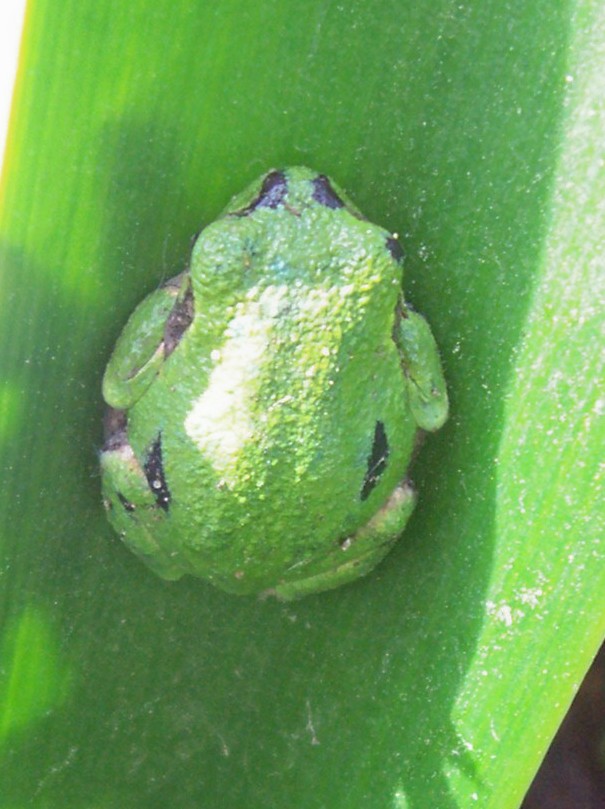
Can you find the frog in this picture? 


Click photo to enlarge
Actually, finding it in the wild was whole lot harder!  With all the rain we have had this week, the frogs are singing loud and clear, but rarely do you actually see one of these little fellows, commonly known around here as "spring peepers."  Only about an inch long and leaf green, they blend in perfectly.  I spotted this one by accident while checking on some potted Amaryllis plants I had set out for the summer.  Only by the slimmest chance did I happen to see this little fellow hiding among the leaves. 

In addition to hopping into in my garden, frogs also appear in Jewish folklore.  There is a story in Perek Shirah, the classical Jewish text about how everything is praising God, which goes like this:

The Sages said concerning King David that when he completed the Psalms, he became proud.  He said before the Holy One, Blessed be He, "Is there any creature You have created in Your World that says more songs and praises than I?" 

At that moment, a frog happened across David's path, and it said to him,  "David! Do not become proud, for I recite more songs and praises than you do.  Furthermore, every song I say contains three thousand parables, as it says, 'And he spoke three thousand parables, and his songs were one thousand and five' (I Kings 5:12)."

It must have been very humbling for David, the Sweet Singer of Psalms, to be outclassed by a frog.  But anyone who has ever heard a spring chorus of singing frogs can see that this is true.  David certainly did not sing constantly all night, every night, like the frogs do!

On the other hand, when the Torah was given at Mt. Sinai, the Midrash (Exodus Rabba 24:9) tells us, there was absolute silence:

Rabbi Abbahu said in the name of Rabbi Yochanan:  When the Holy One, Blessed be He, gave the Torah, not a bird cried out, not a fowl flew, not an ox bellowed, the angels did not fly, the seraphim did not say Holy, Holy, Holy, the sea did not stir, the human creatures did not speak, but the world was still and silent.  Then the Voice went forth: "I am the Lord Thy God" (Exodus 20:2)

The purpose of this silence was so that the people gathered at the foot of Sinai would not mistake some animal sound for the Voice of God and be misled into worshipping nature.  We need only look at the plethora of animal gods that have been worshipped throughout history to see how easy this is to do.  Animals are wonderful creations, as are plants, rocks, oceans and deserts -- but they are not deities to be worshipped.  The One God of Sinai is beyond all physical forms, all earthly sounds -- and only in silence can you really hear God's Voice. 

This is why, when Elijah went to the cave to meditate (I Kings 19:11-13),  he learned that God is not in the wind, or the earthquake, or the fire.  These are powerful natural phenomena, they can inspire awe or terror -- in fact, most of our natural disasters come, in one way or another, from earth, wind, or fire.  But they are not the voices of gods.   The true God speaks to our hearts and minds from the Primal Silence.

Sunday, August 7, 2011

Thousands of USA heat records broken -- new widget tracks them all

The weather has finally cooled down here in Minnesota -- at least for now.  Over 4000 heat records have been broken so far this summer in the USA, and the PBS Newshour site has developed this widget to track them all.   Use the scroll arrows to see records set by day, month, and year.  (You can get the widget code for your own site at:  http://www.pbs.org/newshour/rundown/2011/08/is-this-record-breaking-record-breaking-heat.html, where you will also find an informative article.   And yes, the widget will run year round, since records get broken in winter, too.)


As you can see, some of these records stood for more that 50 years.  Clearly this is a disturbing pattern -- and one that does not bode well for the future.  Global warming is here, whether the deniers like it or not.  Perhaps that's the REAL meaning of the endtime prophecy that says people will be "eating and drinking as in the days of Noah."  Maybe not gluttony as has been thought, but apathy in the face of warnings.   No doubt they laughed Noah, too: "A flood?  In the desert?  You've got to be kidding!" And we all know what happened to that generation.

And it's not just a matter of things warming up.   Climate change means weather patterns are changing, too.  Places that used to get rain are turning into deserts -- witness the drought and famine in Africa.   I remember hearing years ago that the monsoons in India were no longer coming reliably, but nobody heeded the warning.    Those same monsoons are what used to water the fields of Somalia.  And the southwestern USA (where a lot of these records are being broken even as I write) is experiencing the worst drought since the Dust Bowl of the 1930s.

On the other hand, Minnesota has been drowning in much more rain than usual.   Rivers reached record highs, there have been numerous flash floods and many more severe storms than usual.   Every time the Jet Stream takes an  abnormal plunge south, it sucks up moisture from the Gulf of Mexico and pulls it north.   Here in Pine County, MN, it rained just about every other day (sometimes several days in a row) in July.  I ended up growing a lot of my garden veggies in containers, because it was just plain too wet to till the ground.

Down the road from me is a cornfield that never got planted.  Lots of other fields lie fallow, too.   All of which is resulting in higher prices in the supermarket.   Parts of my lawn got so out of control I just let them go to seed and will mow it down for chicken bedding when -- if ever -- it dries up a bit.  Meanwhile, I struggle to keep up the mowing around the house and trails to the outbuildings.  Wild plants in general are huge -- I've got ragweed with inch-thick stems, eight-foot-high Jerusalem Artichokes (sunchokes), and enormous blackberry canes trying to take over my garden.

 On the other hand, pollination has been iffy.  There were very few wild berries in spite of all the rapid growth.  And not one wild plum on my trees.  Pollinating insects don't fly in the rain.  Some don't even fly on cloudy days.  And I have not seen one single honeybee -- not one!   Whatever is causing the demise of the honeybees has apparently reached here.  This spring, when I stood under my apple trees, I did not hear the happy buzz of honeybees, although some pollination did happen from other insects, because apples are forming.  The honeybee niche seems to have been taken over by a  species of small bumblebee, which I have seen on my cucumbers and squashes in large numbers.  Something is pollinating my tomatoes also, although there are fewer fruits than in other years.   And as I wrote in a previous blog post, the Monarch butterfly population crashed here this year -- I have not found one single caterpillar.

All of this is very disturbing, to say the least.  Nature will eventually adjust to climate change -- but will we?